Part 7: Science Fiction
Change one thing about the world, a technology, a discovery, a rule of physics or society, and follow the consequences with rigor. That one change is the novum, and it’s what separates science fiction from fantasy. The dividing line isn’t the presence of the strange. It’s the demand that the strange be plausible, and that the story run an honest experiment in what it would mean.
The genre’s engine is cognitive estrangement, displacing the familiar far enough that the reader can finally see it. The whole architecture exists to run that experiment cleanly.
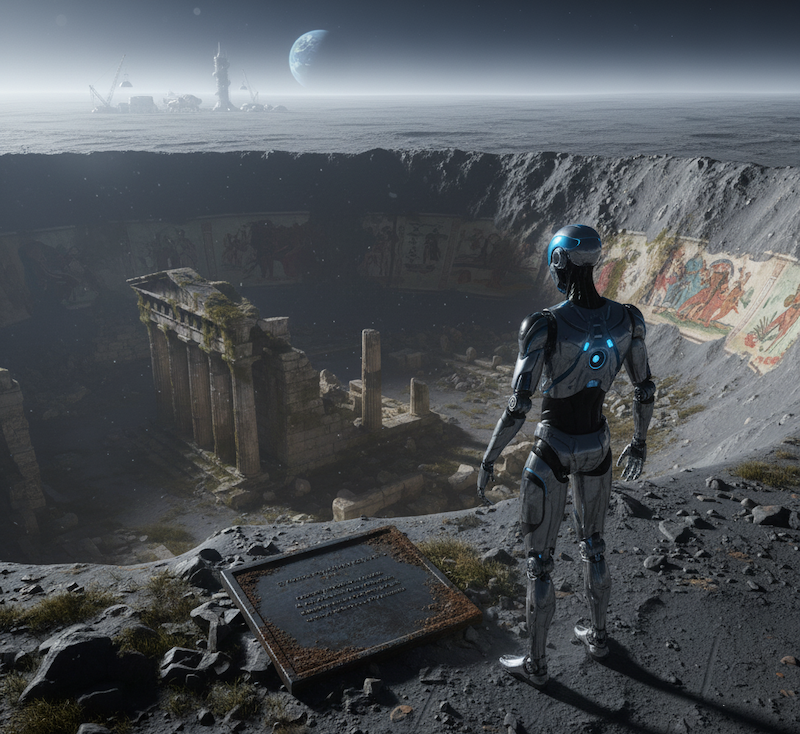
Science fiction uses the eight-sequence spine from Chapter 2: The Structural Skeleton and gives it a distinctive twist: the antagonist is frequently not a person but the idea itself and its implications. The result is an epistemological arc, a story whose real action is the protagonist’s struggle to understand.
Where a thriller hero fights an enemy, the SF protagonist builds a model, watches it fail, and builds a better one. The genre lives or dies on consistency, the same setup-and-payoff discipline the book established earlier, now made cosmological: the novum’s rules, planted in the opening, must govern the ending. That’s why the genre’s terms describe states of knowledge rather than states of feeling or safety: the baseline that defines normality, the novum that disrupts it, the cognitive signature through which it’s met.
Read straight through, the eight chapters of this part trace a single sustained inquiry, from first contact to the world the inquiry leaves behind. Chapter 48: The Baseline Reality builds the constructed world made to feel unremarkable, because the novum can only estrange a reader who first felt at home. It establishes the protagonist’s cognitive signature and plants the deniable seeds of what’s coming.
Chapter 49: The Novum delivers the idea itself in material form, posing a question by existing, working in a double register as plot event and philosophical question, and ends not on a spatial crossing but on a cognitive one. Chapter 50: The First Hypothesis shows the protagonist’s best model failing not by degree but in kind, the wrong strategy in epistemological form, the failure itself the first real data.
Chapter 51: Testing the Model works on three fronts at once: the gaps expanding rather than narrowing, the human ground making the abstract personal, and the forces of opposition exposed as the old model institutionalized. Chapter 52: The True Scope is the midpoint scale correction: the model shown right at the wrong scale, and the irreversible commitment to engage the novum as it actually is.
Chapter 53: The Revised Hypothesis is a categorical shift that proves correct and still insufficient, because the All Is Lost here is a model limit, not a model failure. Chapter 54: The Existential Reckoning collapses the question from how the novum works to what it means, answered not through courage but through the acceptance of transformation: comprehension without mastery. Chapter 55: The Thought Experiment Answered has the protagonist engage the novum through the premise’s own logic, the resolution one that couldn’t exist without the novum, and the closing image mirroring the opening with the baseline permanently gone.
The genre’s deepest argument runs underneath all eight: comprehension and mastery are not synonyms. Understanding a phenomenon places the protagonist in a truer relationship to reality without making them its master, and the universe is under no obligation to be manageable by those who correctly model it.
So science fiction’s climactic mode is the thought experiment answered. The story is complete when it can state what it now knows that it didn’t at the start, the equivalent of the romance’s grand gesture or the thriller’s final gambit, but at the level of idea.
And what finally makes science fiction science fiction is that the transformation Archplot requires is not only the protagonist’s but the reader’s. By displacing us into a rigorously imagined elsewhere, the genre returns us to our own world able to see what habit had made invisible.
See Also
-
Science Fiction chart in Rosetta