Sequence 3 - Entering the New World
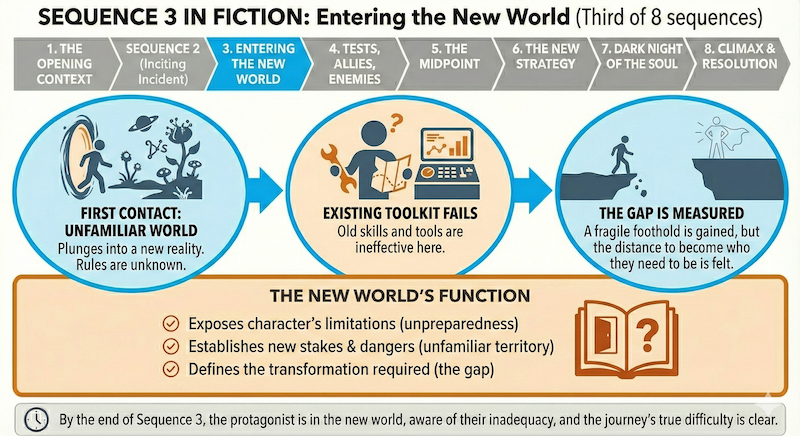
As a “fish out of water,” the protagonist enters unfamiliar territory and attempts to solve problems using old methods. These methods fail, revealing a significant growth gap between who the protagonist is and who they must become to succeed in this new environment.
Dramatic Purpose of Sequence 3
Sequence 3 opens Act Two, and its defining challenge is one of orientation: the protagonist has crossed the threshold into a new world — a new social reality, a new set of demands, a new set of rules — and neither they nor the audience know yet how to navigate it. The sequence’s primary job is to make the new world legible while simultaneously demonstrating that the protagonist’s existing toolkit is insufficient for it.
This is the sequence of first contact. The protagonist encounters the new world’s inhabitants, its logic, its dangers, and its possibilities — often all at once, without the luxury of preparation. Everything they try in Sequence 3 is based on who they were in Act One. The new world will not accommodate that person. Act Two’s entire arc is the slow, painful, transformative process of becoming someone the new world can accommodate — but that arc cannot begin until Sequence 3 has established exactly how large the gap is between who the protagonist currently is and who they need to become.
Sequence 3 occupies roughly pages 30—45 of a feature screenplay — the opening movement of Act Two. Its emotional register is characteristically unstable: moments of unexpected competence punctuated by moments of bewildering failure, flashes of possibility alongside the growing weight of what has been lost. The protagonist is improvising. Some of the improvisation works. Most of it does not. By the end of Sequence 3, the protagonist has a partial foothold in the new world — just enough to continue — but no real map for what lies ahead.
In the Disney sequence book structure, Sequence 3 is often the first sequence developed separately from the opening movement, because it requires its own production logic: new locations, new supporting characters, new visual vocabulary. It is the first sequence that is fully interior to Act Two.
| THE ORIENTATION PARADOX |
|---|
Sequence 3 must accomplish two contradictory things simultaneously: make the new world feel genuinely dangerous and disorienting (so the protagonist’s struggle is credible) while also making it feel specific and engaging (so the audience wants to inhabit it). A new world that is merely hostile is punishing to watch. A new world that is merely interesting lacks dramatic stakes. The balance point is a world that is both — where the danger is specific and personal, and the texture is rich enough to make survival worth caring about. |
What Must Be True at the End of Sequence 3
| Was NOT true at the start of Sequence 3 | IS true at the end of Sequence 3 |
|---|---|
The new world was unknown territory |
The new world’s basic rules, inhabitants, and dangers have been established — the audience can navigate it |
The protagonist had no position in the new world |
The protagonist has a provisional foothold — a role, an alliance, a purpose that allows them to continue |
The wrong strategy was untested |
The protagonist’s initial (flawed) strategy has been deployed and shown to be insufficient — the first cost has been paid |
The Act Two antagonist was an abstraction |
The antagonistic force has been encountered directly and has demonstrated its specific power over the protagonist |
The gap between who the protagonist is and who they need to become was implied |
That gap has been made concrete — we have seen it in action, measured its size, felt its weight |
Section 3a — Arrival and First Encounter
Section 3a delivers the protagonist’s first full immersion in the new world. Where section 1a established the ordinary world through observation, section 3a establishes the new world through collision — the protagonist does not observe the new world from a distance but is immediately plunged into it, forced to respond in real time without preparation.
The arrival is always a form of shock, even in stories where the protagonist has theoretically prepared for it. The new world is never quite what was expected. Its logic is different from the ordinary world’s logic in ways the protagonist did not anticipate. Its inhabitants read situations differently, value different things, and respond to the protagonist’s ordinary-world competence with indifference, hostility, or bewilderment. The protagonist’s identity — the thing they have been in Act One — is not recognized here.
This non-recognition is the new world’s central gift to the story: it strips the protagonist of the social and psychological scaffolding that supported their Act One identity. Without the roles, relationships, and routines of the ordinary world, the protagonist must discover who they are underneath their self-presentation. Section 3a initiates that discovery by making the self-presentation fail.
| THE NON-RECOGNITION PRINCIPLE |
|---|
The protagonist’s Act One identity — their competence, their social role, their self-image — is not recognized or valued in the new world. This is not rejection; it is irrelevance. The protagonist arrives carrying currency that doesn’t spend here. The specific form of non-recognition tells us what the new world values and what the protagonist will need to become. The gap between what they offer and what is needed is the measure of the transformation required. |
Required Dramatic Ingredients in Section 3a
1. The New World’s Visual Grammar
The new world must be established visually and tonally distinct from the ordinary world of Act One. Color palette, physical geography, social architecture, behavioral norms — all of it must signal to the audience that the old rules no longer apply. This visual grammar is the foundation on which everything else in Act Two will be built; if it is established clearly in 3a, the audience will be able to read the new world’s logic throughout.
In animation, the new world’s visual grammar is the work of production design: Pixar’s underwater world in Finding Nemo, the Land of the Dead in Coco, Zootopia’s biome districts each represent a complete visual reimagining that signals new rules. In live action, it is more often social architecture — the visual language of a new environment (a prison, a foreign country, a corporate headquarters, a criminal underworld) that codes the new rules into physical space.
2. The First Contact with the New World’s Inhabitants
The protagonist meets the new world’s population for the first time. These encounters are structured as tests: each new character the protagonist meets in 3a is a representative of the new world’s logic, and their response to the protagonist tells us something specific about what the new world values and what it refuses. The protagonist typically tries to apply ordinary-world social strategies — competence display, status assertion, relationship building — and finds them producing unexpected results.
The new world’s inhabitants fall into an initial taxonomy that 3a begins to sketch: potential allies (who are not yet allies), potential antagonists (who are not yet fully revealed as such), and neutral figures (whose significance will emerge later). This taxonomy is rarely clear to the protagonist — they misread relationships constantly in 3a — but it should be legible to the attentive audience.
| FIRST CONTACT: MICRO-PATTERNS |
|---|
The Unexpected Helper: A character in the new world extends unexpected assistance — not from established relationship but from the new world’s own logic (a code of conduct, a debt, a recognition). This ally is rarely who the protagonist would have chosen. |
The Unexpected Threat: A character or situation the protagonist dismissed or underestimated proves to be the new world’s first real danger. The threat takes a form the protagonist’s ordinary-world radar was not calibrated to detect. |
The Mirror Character: Someone in the new world who has already solved the problem the protagonist is trying to solve — or who has failed to solve it in a way that reveals the cost of failure. |
The Gatekeeper: A figure who controls access to something the protagonist needs — information, resources, permission — and whose terms of exchange reveal the new world’s value system. |
The Translator: A character who bridges the gap between the protagonist and the new world, offering interpretation that the protagonist cannot yet provide for themselves. |
3. The First Failure of the Old Toolkit
Within section 3a, the protagonist attempts to apply their most reliable Act One strategy to a problem in the new world — and it produces the wrong result. Not a catastrophic failure (that comes later) but a moment of visible inadequacy: the protagonist’s best move is met with indifference, misunderstanding, or a complication they did not anticipate.
This first failure is crucial because it establishes the new world’s resistance to who the protagonist currently is. It is not personal — the new world is not malicious toward the protagonist specifically — but it is structural. The protagonist’s existing skills and strategies were developed in response to the ordinary world’s logic. The new world operates on different logic. Importing the old solution to the new problem is category error, and 3a must demonstrate this clearly.
4. The New World’s Central Stakes
By the end of 3a, the audience must understand what is at stake in the new world specifically — what can be won or lost here, what the new world offers and what it threatens. These stakes overlap with but are not identical to the stakes established in Sequence 2. The inciting incident defined what the protagonist has already lost; the new world defines what they might still lose or gain going forward.
The new world’s central stakes are often related to the protagonist’s unconscious need rather than their conscious desire. The new world is, structurally, the environment specifically designed to force the protagonist to confront what they most need to change. Its stakes are therefore personal in the deepest sense: it is asking the protagonist, at some level they cannot yet articulate, to become someone different.
5. The Provisional Goal
The protagonist must establish a provisional goal within the new world — a specific, achievable objective that gives them direction in the short term. This provisional goal is almost always wrong: it is typically a restatement of the protagonist’s conscious desire in the new world’s terms, and it misidentifies what will actually resolve the story’s central conflict. But it is necessary because without it the protagonist has no reason to continue engaging with the new world, and the story has no forward momentum.
The provisional goal is the map the protagonist draws based on incomplete information. Act Two will systematically dismantle this map and force the protagonist to draw a more accurate one. But in 3a, the map is all they have, and its existence — however wrong — gives the sequence its forward propulsion.
How to Render These Ingredients as Scenes
Scene Type 1: The Arrival Scene
The protagonist physically or socially enters the new world for the first time. This scene should have the quality of displacement: the protagonist is clearly out of their context, visibly carrying the habits and assumptions of a world that no longer applies. The arrival scene works best when the new world is shown in full operation around the protagonist — busy, indifferent to their arrival, running on its own logic — while the protagonist tries to find a foothold.
The craft challenge is to make the arrival feel genuinely disorienting without making it feel hostile. The new world is not attacking the protagonist — it is simply not accommodating them. This distinction matters: a hostile new world creates an external conflict story; an indifferent new world creates a character transformation story.
Scene Type 2: The First Contact Scene
The protagonist’s first substantive interaction with the new world’s inhabitants. This scene establishes the new world’s social logic through behavioral demonstration: how do people here treat each other, what do they compete for, what is the currency of exchange? The protagonist participates in this social logic — often awkwardly, often by violating rules they didn’t know existed — and the response reveals the new world’s values.
This scene almost always contains the protagonist’s first application of their old-world competence, and its results should be ambiguous: not a clean success, not a clean failure, but something in between that creates uncertainty about whether the old toolkit will work here. The audience should leave this scene unsure — which is exactly the right emotional state for the beginning of Act Two.
Scene Type 3: The Orientation Scene
A scene in which the protagonist receives some form of orientation to the new world — information, guidance, or demonstration from a character who knows the territory. This scene is the new world’s equivalent of the section 1b mentor relationship: someone who partially bridges the gap between the protagonist’s current knowledge and what they need to know. The information is always incomplete, always partial, always filtered through the guide’s own perspective and agenda.
The orientation scene must avoid becoming an exposition dump. The information must be delivered through character — through the guide’s specific voice, their specific relationship to the new world, their specific investment in the protagonist’s navigation of it. We learn the new world’s rules through the guide’s personality, not through a lecture.
| 3a SEQUENCE DIAGNOSTIC |
|---|
Ask these questions of any section 3a draft: |
Is the new world visually and tonally distinct from the ordinary world — do the new rules feel different from the old ones? |
Has the protagonist’s Act One identity been made irrelevant — are they no longer the same person they were in that world? |
Has the first failure of the old toolkit occurred — and is it clearly a structural mismatch rather than simple incompetence? |
Has a provisional goal been established — does the protagonist have direction, even if it is misdirection? |
Has at least one new world inhabitant been introduced who will matter to the story going forward? |
Section 3b — The Wrong Strategy
Section 3b is the sequence in which the protagonist commits to a strategy for navigating the new world — and that strategy is wrong. Not obviously wrong (the protagonist is not foolish), not randomly wrong (it follows logically from who they are and what they have experienced), but structurally wrong: it is the strategy of someone who has not yet understood what the new world actually requires.
The wrong strategy is the story’s central irony generator for the first half of Act Two. The protagonist pursues it with genuine conviction, applies genuine skill, and achieves genuine partial progress — which makes the eventual revelation of its wrongness more devastating. If the strategy were obviously flawed, the protagonist’s commitment to it would make them seem stupid. If it were entirely ineffective, the story would stall. The wrong strategy must be plausible, partially effective, and fundamentally insufficient.
Section 3b is structurally essential because it establishes the protagonist’s current ceiling: the maximum result that their current self can achieve. They will push against this ceiling for the remainder of the first half of Act Two. Only when they have exhausted the wrong strategy entirely — when they have pushed it as far as it can go and found it still insufficient — will the transformation required by the story become available to them.
| THE WRONG STRATEGY PRINCIPLE |
|---|
The wrong strategy must be the most logical strategy available to the protagonist given who they currently are. It should be the strategy that any reasonable person in their position, with their specific history and competence, would choose. Its wrongness must be invisible to the protagonist — and nearly invisible to the audience — until the story has had time to demonstrate the cost. A wrong strategy that is obviously wrong is not a dramatic irony; it is a flaw in characterization. |
Required Dramatic Ingredients in Section 3b
1. The Strategy’s Logical Foundation
The wrong strategy must have a clear logical foundation in the protagonist’s history, wound, desire, or competence. It is not arbitrary — it grows directly from who the protagonist is. A protagonist whose wound is abandonment will pursue a strategy built around self-sufficiency. A protagonist whose flaw is control will pursue a strategy that maximizes their control over the situation. A protagonist whose desire is recognition will pursue a strategy that prioritizes visibility over effectiveness.
The logic of the wrong strategy is the story’s most important diagnostic tool for the protagonist’s character: if you want to understand what is broken in a protagonist, look at their wrong strategy. It will always be a direct expression of the thing they need to change. The strategy is wrong precisely because it is the thing the protagonist is best at — and best at in a way that prevents them from becoming what they need to become.
2. The Strategy’s Partial Success
The wrong strategy must produce genuine results — partial, provisional, real progress toward the provisional goal. This is what makes the strategy’s wrongness so difficult to see: it works, up to a point. The protagonist achieves things in 3b. They make connections, acquire resources, advance their position. The new world partially accommodates their approach. The partial success is what locks them into the strategy: why abandon something that is working?
The partial success also provides the story’s forward momentum in the early phases of Act Two. The audience needs to believe the protagonist might succeed; the wrong strategy’s partial effectiveness maintains that belief while the story quietly accumulates evidence of its ultimate inadequacy.
3. The First Sign of the Strategy’s Cost
Alongside the partial success, 3b must plant the first evidence that the wrong strategy is extracting a price — that pursuing it requires the protagonist to sacrifice something they should not be sacrificing, compromise something they should not be compromising, or ignore something they should not be ignoring. This cost is initially small enough to seem acceptable. It will grow.
The cost is almost always related to the protagonist’s unconscious need: the wrong strategy succeeds at the conscious desire while systematically undermining the unconscious need. A protagonist pursuing recognition succeeds at being seen while becoming someone less worth seeing. A protagonist pursuing control succeeds at managing their situation while destroying the relationships that make the situation worth managing. The cost is the story’s quiet argument that the protagonist is going in the wrong direction.
4. The Complication from the Antagonistic Force
The antagonistic force makes a significant move in 3b — not yet its decisive move (that comes at the midpoint or later) but a move that demonstrates its power and intelligence, and that specifically targets the weakness in the protagonist’s strategy. The antagonistic force has, in effect, read the protagonist correctly: it knows the strategy is wrong, and it is prepared to exploit that wrongness.
The antagonistic force’s move in 3b should feel like a response to the protagonist’s strategy — as if the opposition has been watching, analyzing, and is now answering. This creates the sense that the protagonist is in a genuine contest with something worthy of them, rather than simply navigating a world of obstacles. The antagonist is thinking too. The antagonist may be thinking better.
5. The Alliance That Complicates
The protagonist forms or deepens at least one significant relationship in the new world during 3b. This relationship is almost never simple: it brings genuine benefit (information, support, resource, emotional sustenance) alongside genuine complication (obligation, risk, misalignment of interests, the potential for betrayal). The alliance that complicates is the story’s way of giving the protagonist something to lose beyond their original goal — which is essential for raising the personal stakes of Act Two.
The alliance often embodies the protagonist’s wrong strategy as well: the relationship works within the wrong strategy’s logic, offers what the wrong strategy prizes, and will eventually be tested by the strategy’s failure. When the wrong strategy fails, the alliance will often be the specific thing placed at risk.
How to Render These Ingredients as Scenes
Scene Type 1: The Strategy Formation Scene
The protagonist, having gathered enough information about the new world from 3a, commits to a specific course of action. This scene is often a moment of decision or declaration — the protagonist announces (to themselves, to an ally, or to the audience through action) what they intend to do. The scene must make the strategy feel logical and achievable; the audience must be able to follow the protagonist’s reasoning, even if we sense something is off.
The craft challenge is to make this scene simultaneously forward-propelling (exciting, purposeful, full of momentum) and quietly ominous (the strategy’s flaw is visible if you know where to look). The tonal balance — optimism laced with unease — is one of the more difficult achievements in screenwriting.
Scene Type 2: The Strategy in Action Scene
The protagonist executes the wrong strategy and achieves partial success. This is often the most kinetically engaging scene of Sequence 3 — the protagonist at their most competent, making things happen in the new world. The scene must give the protagonist genuine wins that the audience can enjoy and believe in, because those wins are what will make the strategy’s eventual failure meaningful.
The strategy in action scene also reveals the cost’s first appearance: embedded within the success is a small sacrifice, a small compromise, a small decision that prioritizes the wrong thing over the right one. The protagonist is too focused on the success to register the cost. The audience may or may not notice it. Either way, it is planted.
Scene Type 3: The Alliance Scene
The protagonist and a new world figure enter a relationship of mutual dependence, trust, or collaborative purpose. This scene establishes the relationship’s warmth and utility — it must feel like a genuine gain for the protagonist — while also establishing its fragility: the thing that could break it, the misalignment that neither party is addressing, the unspoken tension beneath the explicit partnership.
The alliance scene in 3b is often the most emotionally warm scene in the early Act Two — a moment of genuine connection in an unfamiliar world. Writers should allow this warmth fully rather than ironizing it. The relationship must be real enough that its eventual complication will hurt.
Scene Type 4: The Antagonistic Pressure Scene
The antagonistic force makes a move that directly complicates the protagonist’s strategy — not yet defeating it but creating a new obstacle that the strategy is not equipped to handle. The protagonist responds with improvisation, patching the strategy rather than reconsidering it. This scene ends section 3b on a note of increasing pressure: the protagonist has momentum, but the situation is becoming more complex, and the strategy is showing its first cracks.
| 3b SEQUENCE DIAGNOSTIC |
|---|
Ask these questions of any section 3b draft: |
Is the wrong strategy logically rooted in the protagonist’s specific wound, flaw, or competence? |
Does the strategy produce genuine partial success — real results that justify the protagonist’s commitment to it? |
Is the cost of the strategy present — the thing being sacrificed that should not be sacrificed? |
Has the antagonistic force demonstrated its specific intelligence and power in direct response to the strategy? |
Has an alliance been formed that gives the protagonist something new to lose? |
Section 3c — The First Cost
Section 3c delivers the wrong strategy’s first significant consequence: the protagonist pays a real price, not a symbolic one, for pursuing the wrong approach in the wrong way. This is not the climax of the wrong strategy’s failure — that comes later, at the midpoint or in the approach to it — but it is the first genuine wound the story inflicts. Something of real value is damaged or lost, and the protagonist is forced to absorb this loss while continuing to advance.
The first cost serves a dual structural function. First, it validates the story’s argument that the wrong strategy is genuinely wrong — the protagonist can no longer pretend the strategy is entirely working. The cost has made the inadequacy personal. Second, it creates the emotional weight that will make the midpoint resonant: the first cost is the beginning of the accumulation of consequences that will eventually force the protagonist to abandon the wrong strategy entirely.
Section 3c also closes the opening movement of Act Two — Sequences 3a, 3b, and 3c constitute the protagonist’s initial engagement with the new world, and 3c’s first cost marks the end of the period in which the protagonist could still plausibly believe their initial strategy will be sufficient. They press on, but with a new awareness. They know now that this will cost them. They do not yet know how much.
| THE FIRST COST PRINCIPLE |
|---|
The first cost must be real — not a near miss, not a temporary setback, but an actual loss. Something the protagonist valued is diminished or destroyed. The loss must be proportionate: large enough to register as genuinely harmful, small enough not to be the story’s climax. And it must be directly traceable to the wrong strategy — the protagonist should be able to see, if they choose to look, the connection between their approach and the cost it produced. Most protagonists, at this stage, choose not to look. |
Required Dramatic Ingredients in Section 3c
1. The Precipitating Miscalculation
The first cost flows from a specific miscalculation — a moment in which the protagonist’s wrong strategy produces an outcome they did not intend and could not have predicted using their current map of the new world. The miscalculation is not incompetence; it is the logical extension of the wrong strategy reaching the limit of its applicability. The protagonist did exactly what their strategy told them to do, and the new world responded in a way their strategy did not account for.
The miscalculation is often a moment of overconfidence: the protagonist, emboldened by the partial success of 3b, pushes further or faster than the situation supports. The wrong strategy, having worked well enough in 3b, now encounters the specific circumstance it was never equipped to handle.
2. The Real Loss
The first cost must manifest as something the protagonist actually valued — not a generic setback but the specific loss of something that mattered. This loss is calibrated to the protagonist’s wound and desire: it targets exactly the thing they were trying to protect, exactly the relationship they were trying to preserve, exactly the identity they were trying to maintain.
Common forms of the first cost: a relationship is damaged or broken. A resource or advantage is lost. A truth is revealed that the protagonist was not ready to face. A line is crossed that the protagonist cannot uncross. The protagonist is seen doing something they should not have done, by someone whose opinion of them matters. In each case, the loss is personal — it attacks who the protagonist is, not merely what they have.
3. The Moment of Self-Recognition
The first cost forces a moment of self-recognition on the protagonist — a brief, unwelcome glimpse of the connection between who they are and what has just happened. This moment is not full self-awareness (that comes later, at the dark night of the soul), but it is the first crack in the protagonist’s self-concept. For a moment — before the defenses close over it — the protagonist sees themselves clearly.
The moment of self-recognition is often expressed through a reaction rather than a statement: a pause, a look, a small physical gesture that reveals the impact of what they have understood. It is rarely more than a beat or two. The protagonist moves on quickly. But the audience has seen it, and it matters: it is the first evidence that the transformation required by the story is possible.
4. The Recommitment Despite the Cost
After the first cost, the protagonist does not abandon the wrong strategy. They recommit to it — sometimes by doubling down explicitly, sometimes by simply continuing to pursue the provisional goal without revising the approach. This recommitment is psychologically realistic: people rarely abandon strategies at the first sign of failure, especially when the partial success of the strategy has given them genuine results.
The recommitment serves the story’s structure by extending the wrong strategy’s operation into the early midpoint sequences. But it must be rendered honestly: the protagonist who recommits after the first cost must do so with some awareness of what they are choosing. They are not entirely blind. They see the cost and choose the strategy anyway. This choice — to continue despite the evidence — is itself a character revelation, and often a moment of genuine moral complexity.
5. The Raised Horizon
Despite the first cost, 3c ends with the story’s horizon expanding — a new possibility, a new piece of information, or a new development that gives both the protagonist and the audience a reason to keep moving forward. The raised horizon is not a restoration of the ordinary world’s comfort; it is the new world offering something — a promise, a lead, a glimpse of what resolution might look like — that makes the cost seem survivable.
The raised horizon is carefully positioned: it must not negate the first cost (that would be false comfort) but must coexist with it. The story is saying: yes, this cost was real and it will have consequences — and also, there is still something worth moving toward. Both things are true simultaneously. This is the emotional texture of the best Act Two sequences: genuine loss alongside genuine hope, without either canceling the other.
How to Render These Ingredients as Scenes
Scene Type 1: The Overreach Scene
The protagonist pushes their wrong strategy past the point of safety — attempting something larger, riskier, or more aggressive than the situation warrants, driven by the confidence the partial success of 3b has generated. This scene is often the most dramatic scene in Sequence 3: the protagonist is doing something bold and it goes wrong in a specific, consequential way.
The craft challenge: the overreach must be clearly the product of the wrong strategy, not random bad luck. The audience must understand — even if the protagonist does not — that this outcome was the strategy’s logical consequence. The world is not being arbitrarily cruel; the strategy produced this result.
Scene Type 2: The Cost Scene
The loss crystallizes. Something that mattered is gone, damaged, or broken. This scene must be given its full emotional weight — not minimized, not rushed past, not immediately followed by reassurance. The protagonist (and the audience) must be allowed to feel the loss. The cost scene is often the most emotionally demanding scene in the first half of Act Two, and its emotional truth is what will make the story’s second half possible.
The cost scene frequently involves a secondary character — the ally from 3b, or a figure from the protagonist’s ordinary world — whose reaction to the protagonist’s failure reflects back what the protagonist cannot yet fully see. The secondary character becomes a mirror: their pain, disappointment, or departure is the measure of the protagonist’s miscalculation.
Scene Type 3: The Reflection and Recommitment Scene
The protagonist processes the cost — briefly, imperfectly, with whatever emotional tools they currently possess — and chooses to continue. This scene is the psychological hinge of Sequence 3: it demonstrates the protagonist’s resilience (which is genuine and admirable) while also revealing their blindness (the recommitment is to the wrong strategy). The audience should be able to hold both responses simultaneously: admiration for their refusal to quit, concern for their failure to learn.
This scene sometimes contains the sequence’s most important dialogue — a conversation with an ally, a confrontation with an antagonist, or a moment of internal declaration in which the protagonist articulates their revised commitment. The words chosen reveal the extent of the self-recognition: how much did they actually see, and how much did they choose not to see?
Scene Type 4: The Raised Horizon Scene
The sequence ends with a development that pulls the story forward: a new discovery, a new possibility, a new connection, or a new challenge that gives the protagonist’s continuing engagement a specific target. This scene is propulsive by design — its job is to send the audience into the intermission of Sequences 4 and 5 with momentum, with questions, with desire to know what happens next.
The raised horizon scene should feel earned — not a random injection of new plot but a development that grows naturally from what has come before. The story is not resetting; it is deepening. The new development adds complexity to the situation already established, making the path forward more interesting rather than simply longer.
| 3c SEQUENCE DIAGNOSTIC |
|---|
Ask these questions of any section 3c draft: |
Does the first cost flow directly from the wrong strategy — is the connection between approach and consequence legible? |
Is the loss real — something the protagonist actually valued, not a generic setback? |
Is the moment of self-recognition present — the brief, unwelcome glimpse of the protagonist’s own contribution to the cost? |
Does the protagonist recommit to the wrong strategy in a way that reveals character — choosing it consciously, not blindly? |
Does the raised horizon give the story genuine forward momentum without negating the cost? |
Common Failures in Seq. 3
The Welcoming New World (Section 3a Failure)
A new world that immediately accommodates the protagonist — where their Act One skills translate directly, where the inhabitants are friendly and receptive, where the protagonist finds their footing without difficulty. This removes the structural tension that Sequence 3 is designed to create. If the new world does not resist the protagonist’s existing identity, there is no gap to close, no transformation required, no story to tell. The new world must be genuinely difficult to navigate — not hostile, but indifferent to who the protagonist currently is.
The Obvious Wrong Strategy (Section 3b Failure)
A wrong strategy whose wrongness is visible to any reasonable observer, making the protagonist seem oblivious rather than understandably mistaken. The wrong strategy must be the most reasonable choice available to someone with the protagonist’s specific history, wound, and competence. If the audience can clearly see the better strategy that the protagonist is ignoring, the protagonist’s commitment to the wrong one reads as stupidity rather than human limitation. The craft requirement is to make the right strategy genuinely unavailable to the protagonist at this stage of their development.
The Costless First Cost (Section 3c Failure)
A first cost that is immediately compensated for — a loss that is immediately followed by a gain that restores the protagonist to their pre-cost position. This is false cost: the story gestures toward consequence without actually imposing it. Real consequences accumulate; they are not erased by the next scene. The first cost must leave a mark that remains visible for the remainder of Act Two. If the protagonist is back to full strength five minutes after the cost scene, the cost was not real.
The Absent Alliance (Section 3b/3c Failure)
A protagonist who navigates the new world entirely alone — who forms no significant relationships in the new world and therefore has nothing new at stake beyond their original goal. The new world’s alliances are essential because they give the story emotional range: the protagonist can succeed at their goal and still lose something that matters, or fail at their goal and still gain something that matters. Without the alliances of Act Two, the story collapses into pure plot.
The Passive New World
A new world that serves only as backdrop — a setting in which events occur rather than an active force that shapes and tests the protagonist. The new world must have its own logic, its own inhabitants with their own agendas, its own resistance to the protagonist’s presence. It should feel like a living system that existed before the protagonist arrived and will continue after they leave. A new world that merely reacts to the protagonist is not a world; it is a stage.
Skipping the Self-Recognition Moment (Section 3c Failure)
The first cost passes without the protagonist registering any connection between their approach and its consequence. If the protagonist experiences the cost as simply bad luck — as something done to them rather than as the logical outcome of who they are and how they have been operating — the story’s argument about the need for transformation is severed. The first cost must implicate the protagonist. They are not merely a victim of circumstances; they are, at least in part, the author of their own difficulty.
Cross-Media Examples
Film — Finding Nemo (Pixar, 2003)
- Section 3a
-
Marlin enters the open ocean — a world visually and logically opposite to his anemone home. Non-recognition is immediate: his instinct to protect (the ordinary world’s logic) is useless and counterproductive in open water. Dory’s arrival provides an unlikely translation function, establishing the new world’s first alliance.
- Section 3b
-
Marlin’s wrong strategy — treating the ocean as a threat to be managed rather than a world to be navigated — produces partial success (he keeps moving toward Nemo) while extracting a specific cost (it alienates Dory and makes every encounter more dangerous than it needs to be). The ocean itself becomes the antagonistic force, testing the strategy at every turn.
- Section 3c
-
The jellyfish forest — Marlin follows Dory’s instinct rather than his own and both are nearly killed. The first real cost: his inability to trust costs him both their safety and temporarily his only ally. The moment of self-recognition comes in Marlin’s quiet beat with the sea turtles — the beginning of his understanding that his strategy is wrong.
Film — The Social Network (Fincher, 2010)
- Section 3a
-
Mark Zuckerberg enters the new world of Silicon Valley startup culture after The Facebook’s early success. His Act One coding competence translates directly — and this translation is itself the seed of the wrong strategy: Mark believes the new world is still a meritocracy of intelligence, as the old world was.
- Section 3b
-
The wrong strategy — treating the company as a technical problem to be optimized rather than a social and legal organism — produces extraordinary partial success (rapid growth, powerful allies) while simultaneously destroying the relationships that make success meaningful. The first alliance complication: Eduardo’s CFO role is being undermined by the strategy.
- Section 3c
-
Eduardo’s shares are diluted — the first real cost of the strategy. The moment of self-recognition is visible in Zuckerberg’s face when he sees Eduardo’s reaction: a flicker of something that is not quite guilt but is its precursor. He recommits immediately, translating the cost into a strategic problem to be managed.
Novel — The Great Gatsby (Fitzgerald, 1925)
- Section 3a
-
Gatsby’s new world is the world of old money and social legitimacy — East Egg — into which he has bought proximity but not access. His Act One identity (self-made wealth, manufactured persona) is precisely what the new world does not recognize. First contact with Daisy establishes both the goal and the new world’s central resistance.
- Section 3b
-
The wrong strategy — using wealth and spectacle to recreate the past — achieves genuine partial success. Daisy is drawn back. The parties work. The strategy’s cost is already embedded: Jay Gatsby is not who he says he is, and the new world is beginning to look more carefully.
- Section 3c
-
Tom’s suspicion — the first cost. The wrong strategy has attracted exactly the scrutiny it cannot survive. Gatsby’s moment of self-recognition is the conversation with Nick where the past and the present become briefly incompatible. He recommits immediately: the dream is still possible, the past can still be repeated.
TV — Ted Lasso (Season 1)
- Section 3a
-
Ted arrives at AFC Richmond — a new world (English football culture) that is entirely indifferent to his Act One competence (American football coaching). Non-recognition is total and comic: his credentials mean nothing here. The new world’s inhabitants range from openly contemptuous (Nate’s eventual reversal begins from this baseline) to professionally skeptical.
- Section 3b
-
Ted’s wrong strategy — treating football management as a human development problem rather than a tactical problem — achieves genuine results in team morale while producing zero results on the pitch. The cost is embedded in the strategy’s success: the players like him but don’t respect his tactical authority.
- Section 3c
-
The first real loss — a significant match defeat that could have been avoided with tactical competence Ted does not have. The cost is real: a relationship with a player who needed tactical support Ted couldn’t provide is damaged. Ted’s recommitment is to the thing he actually knows how to do, with the honest acknowledgment that it may not be enough.