Sequence 6 - The New Strategy
Sequence 6 is the rebuilding sequence — the first full movement of Act Two’s second half, in which the protagonist replaces the wrong strategy with one grounded in the midpoint’s new truth. Working from a position of genuine honesty for the first time, the protagonist begins to close the gap between who they are and who the story requires them to become. The sequence moves through three phases: the reckoning and reconstruction of section 6a, the new strategy’s first full deployment in section 6b, and the escalation to maximum pre-climax stakes in section 6c that assembles the conditions for the dark night of the soul.
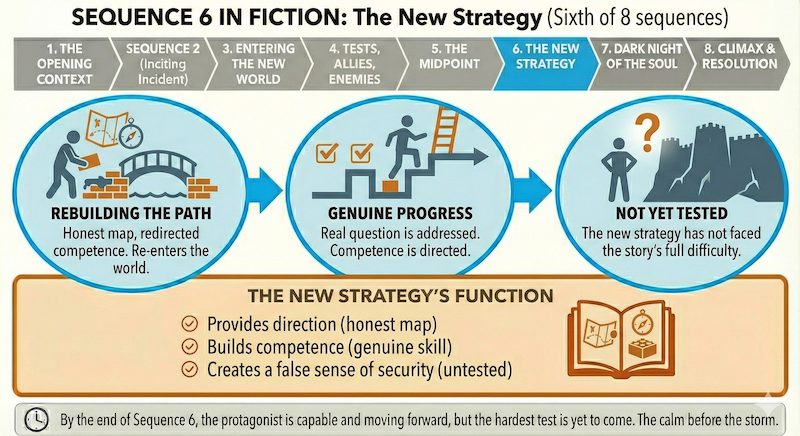
Dramatic Purpose of Sequence 6
Sequence 6 is the rebuilding sequence — the first full movement of Act Two’s second half, in which the protagonist begins to operate from the new understanding the midpoint delivered. The wrong strategy is gone. The provisional goal has been replaced or radically reframed. The protagonist is now working from a more honest position — but honest position is not the same as equipped position. They know more than they knew before; they are not yet who the story needs them to be. Sequence 6 is the space in which that gap begins, for the first time, to close.
The new strategy that emerges in Sequence 6 is not the mirror opposite of the wrong strategy — it is not simply the thing the protagonist was refusing to do in Act Two’s first half. It is something more nuanced: an approach that integrates the protagonist’s genuine competence with the new truth delivered by the midpoint. The wrong strategy used the protagonist’s strengths in service of a false goal; the new strategy redirects those same strengths toward the story’s real question. The protagonist does not become a different person in Sequence 6. They become a more honest version of the person they have always been.
Sequence 6 mirrors Sequence 3 in structure but inverts its emotional logic. Where Sequence 3 was about the protagonist entering the new world and deploying the wrong toolkit, Sequence 6 is about the same protagonist re-entering the same world with a more accurate map. The new world has not changed; the protagonist’s understanding of it has. This structural mirror is one of the ways great stories create the feeling of earned transformation: we are watching the same person in the same world making different choices, and the difference is felt precisely because we remember how the wrong choices looked.
In the Rossio framework, Sequence 6 occupies roughly pages 70—85 of a feature screenplay. It is the Act Two second half’s first major movement, positioned between the midpoint’s devastation and the dark night of the soul’s deepest testing. Its emotional register is characteristically mixed: genuine hope alongside genuine danger, real progress alongside the awareness that the new strategy has not yet been tested against the story’s full difficulty.
| THE RECONSTRUCTION PRINCIPLE |
|---|
Sequence 6 is not a recovery sequence — the protagonist does not return to the position they held before the midpoint’s destruction. Recovery would mean reinstating the wrong strategy under a different name, which is one of Act Two’s most seductive traps. Reconstruction means building something new on the ground the midpoint cleared. The protagonist’s competence is the same; the goal, the values, and the relationships through which that competence operates are different. The new strategy must be visibly distinct from the wrong strategy — not just tactically but morally and relationally. |
What Must Be True at the End of Sequence 6
| Was NOT true at the start of Sequence 6 | IS true at the end of Sequence 6 |
|---|---|
The protagonist was operating without a viable strategy |
The new strategy has been formed, articulated, and deployed for the first time — it is in motion |
The protagonist’s wound was partially visible but unaddressed |
The protagonist has begun — imperfectly, incompletely — to address the wound directly, not just manage its symptoms |
The rebuilt alliances were nascent |
The alliances of the second half have been deepened and tested — the protagonist knows who will stand with them now |
The antagonistic force had not yet responded to the midpoint’s changed conditions |
The antagonistic force has registered the protagonist’s new direction and is adjusting — the contest has escalated |
The dark night of the soul was distant |
The conditions for the dark night have been assembled — the new strategy’s first serious test is imminent, and the protagonist is not yet ready for it |
Section 6a — Rebuilding
Section 6a picks up in the direct aftermath of the midpoint’s devastation and begins the slow, difficult work of reconstruction. The protagonist is operating from a deficit — alliances damaged, resources diminished, the wrong strategy’s accumulated cost now fully visible — and the first task is not to advance toward the new goal but simply to establish a viable position from which advancement is possible.
The rebuilding of 6a is distinct from the orientation of section 3a in one crucial respect: the protagonist is now rebuilding with knowledge rather than discovering without it. In Sequence 3, they entered the new world with the ordinary world’s assumptions intact. In section 6a, they return to the same terrain with the midpoint’s new truth operative. This means that the same situations that produced wrong responses in Sequence 3 can now produce right ones — not because the world has changed, but because the protagonist’s reading of it has.
The emotional texture of 6a is fragile determination: the protagonist is genuinely diminished by the midpoint but genuinely committed to the new direction. The fragility is important — 6a must not skip over the cost the midpoint extracted. The determination is equally important — the rebuilding must feel like forward motion, not stasis. Both qualities must be present simultaneously, which is one of the more demanding tonal challenges in Act Two’s second half.
| THE FRAGILE DETERMINATION TONE |
|---|
section 6a lives in the tonal space between grief and purpose — the protagonist has lost something real and is moving forward anyway. The worst failure of 6a is to skip the grief: a protagonist who bounces back from the midpoint with full energy and confidence has not truly experienced the midpoint’s destruction. The second worst failure is to dwell in the grief until the sequence loses forward momentum. The craft target is a protagonist who is visibly carrying the midpoint’s cost while making genuine, intentional progress in the new direction. |
Required Dramatic Ingredients in Section 6a
1. The Reckoning with What Was Lost
Before rebuilding can begin, the protagonist must acknowledge — specifically and concretely — what the midpoint’s destruction cost them. Not in a scene of prolonged grief (that is 6a’s emotional starting point, not its primary content) but in a clear-eyed confrontation with the specific losses: the alliance that broke, the resource that was depleted, the version of themselves that the wrong strategy required and that is now gone.
The reckoning is the protagonist taking inventory from the new position the midpoint has placed them in. What they have is what they will rebuild with. What they have lost defines the shape of the new structure: the rebuilt alliances will be different from the old ones, the new approach will work differently from the wrong strategy, the protagonist themselves will operate differently from the person who entered the new world in Sequence 3. The reckoning establishes what is being rebuilt from and why the result will be something new rather than a restoration of the old.
2. The First Honest Self-Assessment
For the first time in the story, the protagonist conducts a genuinely honest assessment of their own capabilities and limitations — without the wrong strategy’s distortions, without the false confidence of the provisional goal, without the ordinary world’s self-concept organizing what they allow themselves to see. The honest self-assessment is often a humbling experience: the protagonist sees capabilities they underestimated and limitations they overestimated, and the combination produces a more accurate, if less comfortable, picture of who they are.
The first honest self-assessment is structurally essential because the new strategy must be built on what the protagonist actually is rather than on who they believed themselves to be. A strategy built on false self-knowledge will reproduce the wrong strategy’s errors under different labels. The honest self-assessment ensures that the new strategy is genuinely new — grounded in the protagonist’s real resources rather than their performed ones.
3. The Re-evaluation of Key Relationships
With the midpoint’s revelation reorganizing the protagonist’s understanding of their situation, the relationships that survived the midpoint must be re-evaluated: who was actually an ally, who was actually a threat, and who was something more complicated than either category accommodates? The re-evaluation often produces surprises — figures who seemed antagonistic in Act Two’s first half reveal themselves to be genuinely supportive when approached differently; figures who seemed supportive reveal themselves to be working from fundamentally incompatible values.
The re-evaluation of key relationships is the social dimension of the protagonist’s new strategy: they are building a different kind of team, based on different values, for a different purpose than the provisional goal required. The new team is smaller and more honest than the old one. It is built on genuine alignment rather than tactical convenience, which means it is more reliable under the stress of Act Two’s second half — but also more vulnerable to the personal costs that genuine alliance carries.
4. The First Application of the New Understanding
The protagonist encounters a situation in section 6a that they would have handled wrongly under the old strategy — and handles it differently, more honestly, with the new understanding operative. This first application is not a triumph: it is tentative, imperfect, and probably not entirely successful. But it is visibly different from what the protagonist would have done in Sequences 3 or 4, and the difference is felt as meaningful even in its imperfection.
The first application of the new understanding is the story’s first evidence that the midpoint’s transformation is actually happening — not just declared but demonstrated. Writers sometimes declare transformation (the protagonist says they have changed) without demonstrating it (the protagonist makes the same choices they would have made before). Section 6a must demonstrate the change in action: the same situation, a different response, a different outcome.
5. The Antagonist’s Registration of the Change
The antagonistic force perceives that the protagonist has shifted strategy and adjusts its own approach in response. This adjustment signals that the contest has entered a new phase: the wrong strategy could be countered by the enemy’s existing methods; the new strategy requires the enemy to escalate, adapt, or reveal new capabilities. The antagonist’s registration of the change is the story’s way of confirming that the new strategy is genuinely different — not just a cosmetic revision but a structural shift that the opposition must take seriously.
The antagonist’s response in 6a also raises the stakes of the second half: if the wrong strategy provoked a certain level of opposition, the new strategy — which moves more directly toward the story’s real question — provokes a higher level. The more accurately the protagonist is pursuing what the story actually requires, the more fiercely the antagonistic force will resist it.
How to Render These Ingredients as Scenes
Scene Type 1: The Morning After Scene
The protagonist in the first moments following the midpoint’s destruction — taking stock of where they are, what they have, and what they have lost. This scene is often quiet and intimate: the protagonist alone, or with one remaining ally, confronting the changed landscape of their situation. Its function is not to dramatize the grief (which section 5b has already done) but to establish the new starting position: diminished, honest, still present.
The morning after scene establishes the emotional baseline from which Sequence 6 will build. Its tone — fragile but purposeful, grieving but not collapsed — sets the register for the entire second half of Act Two. Writers who skip this scene, moving immediately to action, rob the second half of the emotional grounding that makes its progress meaningful.
Scene Type 2: The Honest Conversation Scene
The protagonist has a conversation — with a surviving ally, with a figure they have been avoiding, or in some stories with themselves through action — in which genuine honesty replaces the wrong strategy’s managed performance. This scene is characterized by the absence of the protagonist’s usual defenses: they say true things they would not have said before, acknowledge limitations they would have hidden, ask for help they would have refused.
The honest conversation scene is often the most emotionally intimate scene since the alliance deepening of section 4b — but it is more truly intimate because it is stripped of the wrong strategy’s utility calculus. The protagonist is not managing this relationship for strategic benefit; they are simply in it, honestly, for the first time.
Scene Type 3: The Different Response Scene
The protagonist encounters a situation that is structurally identical or similar to one they encountered in Act Two’s first half — and responds differently. The similarity to the earlier situation must be legible to the audience: we must recognize that this is the same test, and feel the difference in how it is handled. The different response is the story’s clearest demonstration that transformation is occurring.
The craft challenge: the different response must be genuinely better — not just different but more aligned with the story’s values, more honest, more effective in the directions that actually matter. If the new response produces a worse outcome than the old one, the sequence loses its forward momentum. The new strategy must work, at least partially, the first time it is applied.
Scene Type 4: The Enemy Escalation Scene
The antagonistic force makes a move in direct response to the protagonist’s changed approach — a move that is more targeted, more dangerous, or more personally threatening than anything deployed in Sequences 3 or 4. This scene ends section 6a by making clear that the second half will be more difficult than the first: the protagonist’s new direction has removed the wrong strategy’s cover, and they are now exposed to opposition that the old approach could avoid by misdirecting the enemy’s attention.
| 6a SEQUENCE DIAGNOSTIC |
|---|
Ask these questions of any section 6a draft: |
Is the reckoning with loss present — specific and concrete, not abstract? |
Has the protagonist conducted a genuinely honest self-assessment — seeing both capabilities and limitations without distortion? |
Have key relationships been re-evaluated — are the protagonist’s allies now chosen on different terms than before? |
Is there a demonstrated application of the new understanding — the same situation, a different response? |
Has the antagonistic force registered the change and escalated accordingly? |
Section 6b — The New Strategy in Action
Section 6b deploys the new strategy at full commitment for the first time — not tentatively, as in 6a’s first application, but with the protagonist’s full capabilities directed toward the story’s real question. This is the sequence’s kinetic heart: the protagonist doing what the story has been building them toward, operating from an honest position, pursuing the right goal with the full force of their genuine — not performed — self.
The new strategy in action must be visibly, substantively different from the wrong strategy’s operation in section 3b and 4a. Not just different in tone (more honest, more vulnerable) but different in method: the protagonist is making choices they would not have made before, using resources they did not previously recognize or value, pursuing goals through relationships rather than around them, or accepting costs the wrong strategy specifically refused to pay.
Section 6b also delivers the new strategy’s first significant result — a genuine advance toward the story’s redefined goal. This advance is not the climax; there is still a dark night of the soul and a climax to come. But it is real progress, and it needs to feel real: the audience must believe that the new strategy is working, that the midpoint’s transformation is producing actual consequences in the story’s world. Without this genuine progress, the second half of Act Two loses credibility as a transformation arc.
| THE NEW STRATEGY’S DEFINING CHARACTERISTIC |
|---|
The new strategy is always distinguished from the wrong strategy by one specific quality: it operates through genuine relationship rather than around it. The wrong strategy treated other people as resources to be managed, obstacles to be navigated, or threats to be neutralized. The new strategy recognizes that other people are the story’s actual terrain — that the protagonist’s real task has always been to change how they relate to others, not to achieve an outcome independent of relationship. The new strategy’s first full deployment will always involve the protagonist doing something that requires genuine trust, genuine vulnerability, or genuine surrender of control in a relationship context. |
Required Dramatic Ingredients in Section 6b
1. The New Strategy’s Core Action
The new strategy has a specific, concrete core action — a thing the protagonist does that could not have been done under the wrong strategy’s logic. This action is the sequence’s central dramatic event: everything else in 6b supports, enables, or results from it. The core action must be specific enough to be memorable and universal enough to carry the story’s thematic weight.
The core action is often an act of genuine connection: the protagonist reaching toward someone or something they have been keeping at a distance, offering something of real value rather than performing the offer, asking for help they genuinely need rather than managing the appearance of self-sufficiency. It is the action that the wrong strategy specifically prevented — the thing the protagonist could not do while operating under the wrong strategy’s logic — and its performance is the most direct evidence of transformation available to the story.
2. The Genuine Progress
The new strategy produces a concrete advance — something changes in the story’s situation as a direct result of the protagonist’s new approach. This advance is qualitatively different from the partial successes of the wrong strategy in section 3b: those successes were real but built on a false foundation. The new strategy’s advance is built on the honest foundation of the midpoint’s truth, which means it is more durable, more meaningful, and more directly connected to what the story is actually about.
The genuine progress often takes a form that the wrong strategy could not have produced: a relationship that deepens through honesty rather than utility, a problem solved through collaboration rather than control, a truth acknowledged that makes the overall situation clearer rather than more managed. The progress is not just tactical; it is moral and relational.
3. The New Strategy’s Specific Cost
The new strategy is not costless. It requires the protagonist to give up something that the wrong strategy protected — a form of control, a degree of invulnerability, a defense against a specific fear. The new strategy’s specific cost appears in 6b as a concrete demand: to achieve the genuine progress, the protagonist must pay a price that the wrong strategy was specifically organized to avoid.
This cost distinguishes the new strategy from both the wrong strategy and from simple wish-fulfillment. A transformed protagonist who operates without cost is not a character; they are a fantasy. The new strategy’s cost confirms that transformation has a price — that becoming who the story requires means surrendering something that was genuinely valuable, however distorting its influence. The protagonist pays this price willingly in 6b, which is one of the sequence’s most important demonstrations of change.
| NEW STRATEGY COST: MICRO-PATTERNS |
|---|
The Vulnerability Cost: The protagonist must reveal something they have been protecting — a weakness, a need, a fear — in order to make the genuine connection the new strategy requires. |
The Control Cost: The protagonist must surrender a degree of control over outcomes, trusting someone else’s judgment or capability where they would previously have insisted on their own. |
The Speed Cost: The new strategy requires patience — the willingness to let something develop at its own pace rather than forcing the outcome the wrong strategy would have pursued. |
The Comfort Cost: The protagonist must inhabit discomfort — social, emotional, physical — that the wrong strategy specifically organized to avoid. |
The Identity Cost: The protagonist must act in a way that contradicts their previous self-presentation — being seen doing something they would have considered beneath them or incompatible with their identity. |
4. The Thematic Argument Embodied
When the new strategy is in full operation, the story’s central theme becomes embodied in action rather than merely stated or implied. The thematic statement planted in section 1c — the casual claim about how the world works that the story has been testing ever since — is now answered, at least provisionally, by the protagonist’s actions in 6b. The answer may not yet be final (the dark night of the soul will challenge it again), but it is the first time the story’s thematic argument has been concretely demonstrated rather than just asserted.
The thematic argument embodied in 6b is the story’s moral center made visible: what the story actually believes about how people should live, relate, choose, and change. This is the sequence in which the writer’s deepest convictions about human possibility are most directly expressed — not through dialogue or narration but through the protagonist’s specific choices and their specific consequences.
5. The Raised Antagonistic Stakes
The genuine progress of the new strategy provokes the antagonistic force’s most significant response yet — a move that makes the second half of Act Two’s escalation concrete and personal. The antagonistic force is no longer responding to the wrong strategy’s misdirection; it is engaging with the protagonist’s real intention, which means its opposition is now more precisely targeted and more genuinely threatening.
The raised antagonistic stakes set up the dark night of the soul: the protagonist’s new strategy is working well enough to represent a genuine threat to the antagonistic force, which now has real reason to bring its full capability to bear. The dark night of the soul will be the result of this escalation — the moment when the antagonistic force’s response to the new strategy lands with full force.
How to Render These Ingredients as Scenes
Scene Type 1: The New Strategy Declaration Scene
The protagonist commits to the new approach in a specific, concrete act — this is not a speech or a statement but an action that makes the new strategy operative. In genre stories this might be a plan revealed or a collaboration initiated; in character-driven stories it is more likely a relational choice or an honest admission. What matters is that the declaration is in deed rather than in word: the protagonist does something that makes the new strategy real.
The declaration scene has a different quality from the wrong strategy’s formation scene in section 3b: it is quieter, more certain, less performed. The wrong strategy was launched with urgency and energy; the new strategy is initiated with something more like clarity. The protagonist is not excited about what they are about to do. They are simply going to do it.
Scene Type 2: The Core Action Scene
The protagonist performs the new strategy’s central act — the thing the wrong strategy prevented, the action that embodies the transformation, the moment in which the story’s thematic argument is made concrete. This scene is often the most emotionally significant scene in Sequence 6, and possibly in Act Two’s second half. It must be given its full weight: the time to land, the space to resonate, the specificity to mean something beyond the immediate plot.
The core action scene is the sequence’s equivalent of the wrong strategy’s competence display in section 3b — but where the wrong strategy displayed competence at the wrong thing, the new strategy’s core action displays competence at the right thing. It is the protagonist being most fully themselves, operating from their genuine values, in service of what actually matters.
Scene Type 3: The Progress and Cost Scene
The new strategy produces its genuine advance and simultaneously extracts its specific cost. This scene holds both outcomes simultaneously: the protagonist achieves something real and pays something real, and neither outcome cancels the other. The craft challenge is to render both with equal weight — to not let the triumph overwhelm the cost, or the cost overwhelm the triumph.
The progress and cost scene is often the most emotionally complex scene in section 6b: it is simultaneously hopeful (the new strategy is working) and sobering (at a price we can see and feel). This complexity is precisely what distinguishes Act Two’s second half from its first half — the second half operates in full moral awareness of what things cost, rather than in the first half’s strategic avoidance of that awareness.
Scene Type 4: The Antagonistic Escalation Scene
The antagonistic force responds to the new strategy’s genuine progress with its most targeted and dangerous move yet. This scene ends section 6b at maximum tension: the protagonist has made real progress, paid a real cost, and now faces opposition calibrated precisely to the new direction they are pursuing. The dark night of the soul is not yet here — but its conditions have been assembled.
| 6b SEQUENCE DIAGNOSTIC |
|---|
Ask these questions of any section 6b draft: |
Is the new strategy’s core action specific and concrete — the thing the wrong strategy specifically prevented? |
Does the genuine progress feel qualitatively different from the wrong strategy’s partial successes? |
Is the new strategy’s specific cost present and paid willingly — not avoided or minimized? |
Is the thematic argument embodied in action rather than stated in dialogue? |
Has the antagonistic force escalated in direct response to the new strategy’s genuine threat? |
Section 6c — Rising Stakes
Section 6c closes the new strategy’s first full deployment by escalating the stakes to their highest pre-climax level — the point at which everything the protagonist has been working toward, everything they have rebuilt since the midpoint, and everything they still stand to lose is simultaneously at maximum risk. The sequence’s job is to make the dark night of the soul — the next sequence’s catastrophic testing — feel inevitable and genuinely threatening, not as a plot event but as the logical consequence of the protagonist operating at full commitment in a world that will not yield easily.
The rising stakes of 6c operate on three levels simultaneously: external (the plot situation has become more dangerous and more urgent), relational (the protagonist’s most valued relationships are under maximum pressure), and internal (the protagonist is being asked to sustain the new strategy under conditions that the wrong strategy was specifically designed to avoid). All three levels must be escalating together. A sequence that raises only the external stakes produces action without drama; one that raises only the internal stakes produces drama without urgency.
Section 6c also functions as the story’s final preparation before the dark night: it assembles all of the specific elements that the dark night of the soul will test — the new alliances, the new strategy’s specific vulnerabilities, the protagonist’s remaining blind spots, and the antagonistic force’s most powerful available move. By the end of 6c, the audience should feel the dark night approaching not as a dramatic device but as an inevitable consequence of the situation that has been built.
| THE THREE-LEVEL ESCALATION |
|---|
Every scene in section 6c should be raising stakes across all three levels: External: The plot situation grows more dangerous — timelines compress, resources diminish, the antagonistic force’s move becomes more imminent. Relational: The protagonist’s key relationships come under maximum pressure — genuine alliances are tested to their limit, the false ally’s position becomes untenable, the most valued relationship faces a crisis that cannot be deferred. Internal: The protagonist encounters the specific demand that the new strategy makes at its highest level of difficulty — the thing they have never yet had to do, the cost they have been paying willingly but are now approaching their limit for. If any of these three levels is absent from 6c, the dark night of the soul will arrive without the preparation it needs to be genuinely devastating. |
Required Dramatic Ingredients in Section 6c
1. The Compressed Timeline
In most stories, 6c introduces or intensifies a ticking clock — a deadline or accelerating pressure that removes the protagonist’s ability to proceed at the new strategy’s measured pace. The compressed timeline forces the protagonist to make choices they are not yet fully ready to make, at a speed that does not allow for the deliberation the new strategy’s honest approach requires. Speed and honesty are often in direct conflict: the compressed timeline is the story’s way of testing whether the new strategy can survive under conditions of maximum urgency.
The compressed timeline is not always a literal countdown. It may be a relationship reaching its breaking point, a resource being exhausted, an opportunity that will not recur, or a position that is deteriorating faster than the new strategy can repair it. What matters is the quality of compression: the protagonist can feel the available space shrinking, and each choice carries more weight than the last.
2. The Relational Maximum
The protagonist’s most important relationship is brought to its maximum pressure point in 6c — not yet breaking (that is the dark night’s work) but tested at the exact limit of what it can sustain. This relational maximum reveals the specific vulnerability that the dark night of the soul will exploit: the thing the relationship cannot survive, the cost it cannot absorb, the truth it cannot accommodate.
The relational maximum scene is often the sequence’s most emotionally resonant moment: two characters who genuinely care about each other, under maximum pressure, being asked to give more than they currently have. The scene must convey both the depth of the relationship (these people matter to each other) and the reality of the limit (there is a point beyond which caring is not enough).
3. The Protagonist’s Final Blind Spot
Despite the honest self-assessment of 6a and the genuine progress of 6b, the protagonist retains one specific blind spot — one area of self-knowledge that the new strategy has not yet required them to confront. Section 6c surfaces this blind spot without resolving it: it becomes visible, briefly, before the protagonist’s defenses close over it. The dark night of the soul will force it open entirely.
The final blind spot is almost always the story’s most personal truth — the thing the protagonist has been closest to seeing throughout Act Two but has managed, each time, to look away from. It is connected directly to the wound, the wrong strategy, and the ultimate transformation the story requires. Surfacing it in 6c without resolving it ensures that the dark night’s revelation will feel earned rather than sudden.
4. The Antagonistic Force’s Decisive Setup
In 6c, the antagonistic force makes the specific preparatory move that will produce the dark night of the soul in Sequence 7. This move is not the dark night itself — it is the positioning that makes the dark night inevitable. The antagonistic force has been watching the new strategy’s operation, has identified its specific vulnerability, and is now moving into position to exploit it at the moment of maximum damage.
The antagonistic force’s decisive setup may be visible to the audience before it is visible to the protagonist — creating the dramatic irony of watching the trap close while the protagonist continues advancing. Or it may be invisible even to the audience, only retrospectively legible after the dark night has arrived. Either approach is valid; what matters is that the setup is there, structurally, so that the dark night does not feel like a random disaster but like the logical consequence of the specific contest the story has been building.
5. The Highest Stakes Articulation
Section 6c ends with the clearest possible articulation — through action, dialogue, or image — of what the protagonist stands to lose if the dark night destroys the new strategy. This is not exposition; it is the story showing us, in vivid specificity, the thing that must not be lost. The audience must feel, entering the dark night of the soul, exactly what is at stake — not abstractly but in terms of a specific person, a specific relationship, a specific version of the world that the protagonist’s transformation has made possible.
The highest stakes articulation is often the most beautiful moment in Sequence 6: a brief glimpse of what the story is fighting for — the thing worth the cost of the transformation, the reason the protagonist is still moving forward despite everything the midpoint destroyed. It is the story reminding the audience, and the protagonist, what all of this difficulty is in service of.
How to Render These Ingredients as Scenes
Scene Type 1: The Pressure Compressor Scene
A scene in which the timeline or available space suddenly contracts — a revelation of how little time remains, a resource that turns out to be smaller than expected, a relationship that announces its own limit. The protagonist absorbs this compression and makes an immediate adaptive decision: they can no longer proceed at the new strategy’s measured pace; something must be accelerated or sacrificed.
The pressure compressor scene has a specific kinetic quality — the pace of the story itself seems to change, scenes getting shorter, decisions arriving faster, the narrative breathing less easily. This tonal shift signals the approach of the dark night and generates the audience’s anticipatory tension.
Scene Type 2: The Relational Limit Scene
The protagonist and their most important new-world ally reach the limit of what the relationship can currently sustain — a moment of genuine rupture or near-rupture that is held together only by the depth of what has been built in 6a and 6b. This scene must be emotionally truthful: the limit is real, the pressure is real, and the relationship’s survival of this moment is not guaranteed.
The relational limit scene is the story’s most explicit foreshadowing of the dark night: we can see exactly what could break the relationship, and we understand that the dark night will push directly on this point. The scene creates dread in the best dramatic sense — not fear of something unexpected but fear of something we can see approaching.
Scene Type 3: The Glimpsed Blind Spot Scene
A brief scene in which the protagonist’s final blind spot becomes momentarily visible — a small moment of something they almost see and then don’t, a reflection they pass without fully confronting, a truth someone almost says and then doesn’t quite complete. This scene is subtle by design: its purpose is to plant the seed of the dark night’s revelation without prematurely delivering it.
The glimpsed blind spot scene is often the most technically demanding scene in section 6c: it must register with the audience without registering with the protagonist, and it must feel significant without announcing its significance. In film, it is often a visual beat rather than a dialogue beat; in prose fiction, it is often an interior moment that the protagonist narrates away from rather than into.
Scene Type 4: The Stakes Crystallization Scene
The final scene of section 6c — and therefore the final scene before the dark night of the soul — crystallizes everything the story has been building toward in a single, specific image, moment, or exchange. The protagonist and the audience both know, after this scene, exactly what is at stake: not abstractly but in terms of the specific person, relationship, or possibility that cannot be lost.
The stakes crystallization scene ends Act Two’s second half’s opening movement. Everything that has been rebuilt since the midpoint is now visible in its fullness — and in full view of what is about to test it. The sequence, and Sequence 6 as a whole, ends not on triumph but on the specific, weighted awareness of what is about to be required.
| 6c SEQUENCE DIAGNOSTIC |
|---|
Ask these questions of any section 6c draft: |
Is the timeline compressed — has the available space for the new strategy’s measured operation been significantly reduced? |
Has the most important relationship reached its pressure maximum — tested to the limit but not yet broken? |
Is the protagonist’s final blind spot surfaced — briefly visible before the defenses close over it? |
Has the antagonistic force made the specific preparatory move that will produce the dark night? |
Does the sequence end with a clear, specific crystallization of what cannot be lost? |
Common Failures in Seq. 6
The Wrong Strategy Renamed (Section 6a/6b Failure)
The most fundamental failure of Sequence 6: a new strategy that is structurally identical to the wrong strategy with different surface features. The protagonist pursues the same goal by similar means under a different label, having learned only tactical rather than transformational lessons from the midpoint. The test: does the new strategy require the protagonist to do something the wrong strategy specifically prevented? If not, it is not a new strategy.
The Skipped Reckoning (Section 6a Failure)
A protagonist who moves immediately from the midpoint’s destruction into purposeful action without reckoning with what was lost. This produces the paradox of a protagonist who appears to have changed while exhibiting no genuine signs of change: they are simply pursuing a revised version of the provisional goal with the same energy and confidence as before. The reckoning is not optional sentimentality — it is the structural foundation of the new strategy’s authenticity.
The Costless New Strategy (Section 6b Failure)
A new strategy that produces genuine progress without extracting a genuine cost. The wrong strategy had costs, but they were costs the protagonist refused to acknowledge; the new strategy must have costs that the protagonist actively, consciously pays. A transformed protagonist who achieves the right thing without paying the right price is not transformed; they are rewarded. The story’s moral logic requires that the new strategy’s approach — honesty, vulnerability, genuine relationship — costs the protagonist something real.
The Absent Antagonist (Section 6b/6c Failure)
A Sequence 6 in which the antagonistic force does not respond to the new strategy’s genuine progress — in which the enemy continues operating at the same level of opposition regardless of the protagonist’s changed approach. The antagonist must escalate in response to the new strategy’s genuine threat. An antagonist who does not respond to the protagonist’s most significant development is not sufficiently characterized as a genuine opposing force; they are a collection of obstacles rather than a worthy enemy.
The Unprepared Dark Night (Section 6c Failure)
A section 6c that does not assemble the specific conditions the dark night of the soul requires. The dark night is not a random catastrophe — it is the precise consequence of the story’s accumulated pressures. If 6c has not identified the protagonist’s final blind spot, brought the most important relationship to its pressure maximum, and positioned the antagonistic force for its decisive move, the dark night of the soul will arrive as a dramatic device rather than a narrative inevitability.
The Triumphant Transition to the Dark Night
A Sequence 6 that ends on too high a note — with the protagonist confident, the new strategy seemingly unassailable, the stakes apparently manageable. The transition into the dark night of the soul must arrive from a position of partial success combined with maximum exposure: the protagonist has achieved something real and is now, because of that achievement, more vulnerable than ever to what the antagonistic force has prepared. Triumphant endings to Sequence 6 produce dark nights that feel like bad luck rather than narrative consequence.
Cross-Media Examples
Film — Inside Out (Pixar, 2015)
- Section 6a
-
Joy and Sadness begin rebuilding after being lost in Long-Term Memory — the reckoning with loss is the loss of the core memories themselves, and the honest self-assessment is Joy’s first genuine consideration that Sadness might have a function rather than being a problem to be managed. The re-evaluation of relationships: Joy’s understanding of Bing Bong shifts from tactical resource to genuine connection.
- Section 6b
-
The new strategy — allowing Sadness to participate rather than suppressing her — produces its first concrete result when Sadness successfully connects with Bing Bong through genuine empathy where Joy’s attempts at cheerfulness failed. The core action is Joy allowing Sadness to do what Sadness is actually for. The cost: Joy must accept that she cannot solve every problem, that some feelings must be felt rather than overcome. The thematic argument embodied: sadness is not the enemy of happiness but its necessary companion.
- Section 6c
-
The approach to Riley’s memory headquarters with the core memories provides the compressed timeline; the risk to Riley’s sense of self provides the relational maximum; the antagonistic force (the decision to run away from home) positions itself decisively. The stakes crystallization: the image of a Riley who has lost the capacity to feel — neither sad nor happy — is the story’s clearest articulation of what cannot be lost.
Film — No Country for Old Men (Coen Brothers, 2007)
- Section 6a
-
Llewelyn Moss’s rebuilding after the motel confrontations constitutes a reckoning with the wrong strategy’s cost — he cannot simply run faster or hide more cleverly; the threat is not responsive to those strategies. The honest self-assessment: Llewelyn begins to understand that Chigurh is not a solvable problem within his existing framework. The re-evaluation of relationships: his wife Carla Jean becomes visible as more than a person to be protected — she is the specific thing at stake.
- Section 6b
-
The new strategy is implicit and incomplete — Llewelyn trying to operate with more genuine caution and less bravado — and its genuine progress is the brief period of safety it purchases. The core action is Llewelyn sending Carla Jean away: an act of genuine care that the wrong strategy (keep moving, stay ahead) would not have allowed. The cost: separation from the one relationship that made the chase meaningful.
- Section 6c
-
The compressed timeline arrives as Chigurh systematically closes off every remaining option. The relational maximum is the phone conversation with Carla Jean — the limit of what connection can do across the distance the wrong strategy’s consequences have created. The stakes crystallization is the coin — not as a symbol of fate but as the specific form of what cannot be negotiated with.
Novel — Jane Eyre (Bronte, 1847)
- Section 6a
-
Jane’s return to Thornfield after her aunt’s death constitutes the rebuilding — the reckoning with what was lost (her childhood’s bitterness, her isolation), the honest self-assessment of her own feelings for Rochester, and the re-evaluation of the relationship she has been managing at careful distance. The first application of the new understanding: Jane allows herself to acknowledge love rather than managing its expression.
- Section 6b
-
The new strategy — honest emotional engagement rather than guarded self-protection — produces its genuine advance in the betrothal. The core action is Jane’s direct declaration of her own equality: 'I am no bird; and no net ensnares me.' The cost: complete exposure — the wrong strategy’s protection of distance is gone entirely. The thematic argument embodied: genuine love requires the willingness to be fully seen.
- Section 6c
-
The compressed timeline arrives as the wedding approaches. The relational maximum is Jane’s growing awareness that something is being withheld — the presence of the hidden wife, sensed but not yet known, pressing against the new strategy’s honest foundation. The stakes crystallization is the wedding night vision, which Jane cannot explain and Rochester will not: the story’s blind spot, about to be forced open.
TV — Fleabag (Season 2)
- Section 6a
-
After the midpoint confession to the Priest, Fleabag’s rebuilding is the first genuine attempt to be honest in a relationship rather than performing honesty as a defense mechanism. The reckoning: the cost of the wrong strategy (compulsive deflection through humor and fourth-wall address) has been the inability to be in any relationship fully. The re-evaluation: her sister appears as someone to be genuinely connected with rather than managed.
- Section 6b
-
The new strategy — genuine presence without performance — produces its advance in the Priest relationship. The core action is Fleabag listening rather than directing — allowing the relationship to exist on terms she does not control. The cost: she must stop breaking the fourth wall, stop managing the audience’s perception of her, stop using irony as protective distance. The thematic argument: love requires giving up the performance of self.
- Section 6c
-
The compressed timeline is the Priest’s ordination, which will resolve the relationship’s ambiguity one way or another. The relational maximum is the church scene — the relationship at the exact limit of what it can be within the Priest’s vocation. The glimpsed blind spot: Fleabag’s awareness that she has found the fourth wall’s limit — a feeling she cannot share with the audience. The stakes crystallization: the fox, watching.