Sequence 7 - The Dark Night of the Soul
Sequence 7 is the story’s most intimate structural movement: the dark night of the soul, in which the protagonist is stripped of every remaining strategy, defense, and illusion and forced to confront the formative wound at the center of their identity. Moving through three phases — the collapse (section 7a), the confrontation with the wound (section 7b), and the choice and launch (section 7c) — the sequence brings the protagonist to absolute zero and, in that exposure, produces the genuine transformation the climax requires.
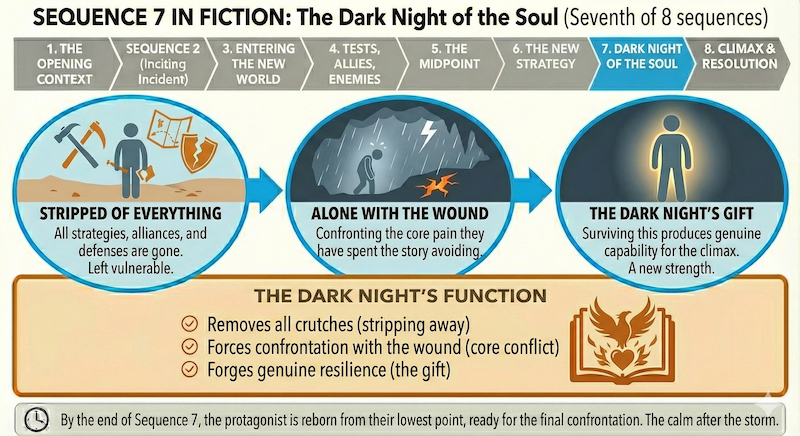
Dramatic Purpose of Sequence 7
The dark night of the soul is the story’s most intimate sequence and its most structurally necessary one. Every element of the preceding six sequences has been building toward this moment — not toward the climax, which is still ahead, but toward this: the protagonist alone with the truth of who they are, stripped of every strategy, every defense, every illusion that has been sustaining them since the story began. The dark night does not merely test the protagonist. It unmakes them. And in the unmaking, it makes the transformation possible.
The sequence’s dramatic job is to bring the protagonist to absolute zero — the point at which they have nothing left to offer the story except who they actually are, beneath the wrong strategy, beneath the new strategy, beneath all performance and management and self-protection. This is the story’s most honest moment, and it is typically its most painful. The protagonist is not failing here in the conventional dramatic sense. They are succeeding at something much harder: they are finally, completely, inescapably themselves.
The dark night differs from the midpoint’s revelation in one crucial respect. The midpoint showed the protagonist that their strategy was wrong. The dark night shows them something deeper: why they built that strategy in the first place, what wound it was protecting, what fear it was managing, and whether that wound and that fear are things they can now face directly rather than organize their life around avoiding. The midpoint was an intellectual revelation. The dark night is an existential one.
In structural terms, the dark night occupies roughly pages 85—100 of a feature screenplay — the final movement before the Act Two break that launches the climax. In the Rossio framework it is often the sequence writers find most difficult to write, because its emotional content is not dramatic in the conventional sense. Nothing explodes. No one attacks. The dark night’s drama is interior: a person sitting with the full weight of who they are and what they have done, deciding whether they have the capacity to change at the deepest level.
The dark night has three movements. The collapse (7a) delivers the blow that removes every remaining support structure — strategy, alliance, identity — and places the protagonist in absolute exposure. The confrontation with the wound (7b) is the sequence’s central event: the protagonist finally, fully facing the formative truth they have been organizing their life around avoiding. And the choice (7c) is the most important decision of the story: whether to remain in the wound’s logic or to move beyond it — not by healing it, not by resolving it, but by choosing to act despite it.
| THE DARK NIGHT’S DEFINING QUALITY |
|---|
The dark night of the soul is not the story’s lowest point in terms of plot — it is the story’s lowest point in terms of identity. The protagonist has less of themselves available here than at any other point in the narrative. The wrong strategy is gone. The new strategy has just been broken. The alliances that sustained both have been stripped away or revealed as insufficient. What remains is the protagonist as they actually are — wounded, scared, uncertain, and finally, unavoidably, facing the thing they have spent the entire story trying not to face. The dark night’s gift to the story is that this confrontation, once survived, produces someone genuinely capable of the climax. |
What Must Be True at the End of Sequence 7
| Was NOT true at the start of Sequence 7 | IS true at the end of Sequence 7 |
|---|---|
The protagonist still had a viable strategy and support structure |
Every strategy has been stripped away and every support structure has been tested to its limit — the protagonist is operating from nothing but who they are |
The wound was visible but not directly confronted |
The wound has been directly confronted — not healed, but faced fully and honestly for the first time |
The protagonist’s fundamental choice was implicit |
The fundamental choice — to remain in the wound’s logic or to act beyond it — has been made explicitly, in full awareness of its cost |
The transformation was partially underway |
The transformation is complete at its deepest level — the protagonist has become, in identity if not yet in action, the person the climax requires |
The climax was structurally imminent but emotionally unavailable |
The climax is now both structurally and emotionally available — the protagonist has the internal resource to meet it |
A sixth condition governs the quality of the transformation the dark night produces: it must be irreversible. The protagonist who emerges from Sequence 7 cannot return to the wrong strategy, cannot retreat to the new strategy’s tentative first steps, cannot unknow what the dark night has shown them. The transformation does not guarantee success — the climax will still be genuinely difficult and genuinely uncertain. But it guarantees authenticity: whatever happens in the climax, the protagonist will be fully present for it.
Section 7a — The Collapse
Section 7a delivers the blow that places the protagonist in absolute exposure. The antagonistic force’s decisive setup from section 6c arrives with full force, and its impact is not merely tactical — it removes the last structural support that was sustaining the protagonist’s ability to operate. Not just the strategy, not just the alliances, but the story’s central relationship, the protagonist’s functional identity, or the last claim they had on the world they were trying to protect.
The collapse is distinguished from every previous setback in the story by its totality. The first cost in section 3c damaged something. The midpoint revelation destroyed the wrong strategy. The dark night’s collapse removes the new strategy’s foundation and strips away the relational and psychological infrastructure that made the new strategy’s operation possible. After the collapse, the protagonist has nothing left to work with except the bare fact of who they are.
The collapse also typically involves a betrayal or loss in the story’s most important relationship — the ally who represented the right path, the person for whom the protagonist was making the transformation, the relationship that the new strategy was most directly protecting. This relational dimension is what makes the collapse personal rather than merely strategic. The protagonist has not just lost their approach; they have lost the thing the approach was in service of.
| THE COLLAPSE AND THE WOUND |
|---|
The collapse of section 7a is specifically engineered — by the story’s logic, not the writer’s arbitrary decision — to land on the protagonist’s wound with maximum force. The wound that the wrong strategy was built to protect, that the midpoint began to expose, that the new strategy was learning to address directly — the collapse targets it precisely. This is why the dark night feels unavoidable: the antagonistic force, or the story’s logic, has found the exact point of maximum vulnerability and applied maximum pressure. The collapse is the wound’s externalization: what was internal becomes catastrophically visible. |
Required Dramatic Ingredients in Section 7a
1. The Antagonist’s Decisive Strike
The antagonistic force deploys the move it has been preparing since section 6c — the action that specifically targets the new strategy’s most vulnerable point and removes its ability to function. This strike is not merely destructive; it is intelligent. The antagonist has been watching the protagonist’s new approach, has identified what makes it different from the wrong strategy, and has found the exact point at which that difference is a vulnerability rather than a strength.
The decisive strike often takes the form of an exposure: something the protagonist has been building on the new strategy’s foundation is revealed to be built on something the antagonist can remove. The protagonist’s honest approach depended on a trust that has now been betrayed. Their vulnerable new position depended on a protection that has now been withdrawn. The very quality that made the new strategy better than the wrong strategy — its honesty, its openness, its genuine relationship — is what the antagonist has found a way to weaponize.
2. The Relational Catastrophe
Alongside or as part of the antagonist’s strike, the protagonist’s most important relationship suffers its most severe damage — a break, a betrayal, a loss, or a revelation that fundamentally changes what the relationship is or can be. This relational catastrophe is the collapse’s personal dimension: it is what makes the blow not just strategically devastating but existentially so.
The relational catastrophe must be the natural consequence of the story’s accumulated pressures — not a random disaster but the specific outcome that the wrong strategy’s costs, the midpoint’s destruction, and the new strategy’s vulnerabilities have been building toward. The audience must be able to trace the line from the story’s beginning to this moment and feel its inevitability.
| RELATIONAL CATASTROPHE: MICRO-PATTERNS |
|---|
The Betrayal Completed: The false ally finally acts on their competing loyalties — the protagonist discovers that the person they trusted most was working against them, either through active deception or through a fundamental incompatibility of values that could not be sustained. |
The Departure: The protagonist’s most important ally leaves — not as punishment but as the natural consequence of what the story has demanded of the relationship. The departure is not hostile; it is simply what honesty requires. |
The Loss That Cannot Be Undone: Someone or something the protagonist was protecting through the new strategy is lost — directly, specifically, and in a way that makes the new strategy’s cost suddenly and fully visible. |
The Revelation of Incompatibility: The protagonist and their most important ally discover that what they each need from the relationship is fundamentally incompatible — not through failure but through full honesty about who they each are. |
The Witness to the Protagonist’s Worst Self: The person who most matters to the protagonist sees them at their worst — doing or being the thing the wound produces when it is under maximum pressure — and the protagonist must reckon with being seen. |
3. The Strategic Void
With the decisive strike landing and the relational catastrophe unfolding, the protagonist finds themselves in a strategic void: every available approach has been either exhausted or destroyed. The wrong strategy is gone. The new strategy has just been broken. The alliances that sustained both have failed or departed. The provisional goal has been lost. The redefined goal is now in serious jeopardy. There is no next move that the protagonist’s current self can make that will improve the situation.
The strategic void is the collapse’s most important structural product: it removes the protagonist’s ability to manage their situation and forces them into the one position the story has always needed them to reach — complete exposure, no armor, no plan, no performance. Only who they actually are.
4. The Protagonist’s Lowest Moment
The collapse produces the protagonist’s moment of maximum despair — the closest thing to giving up that the story permits. This is not suicidal despair (unless the story’s genre and subject matter specifically call for it) but the specific despair of someone who has tried everything available to them and found it insufficient. They have used their competence. They have grown. They have changed. And it has not been enough.
The protagonist’s lowest moment must be rendered with full honesty and full specificity: not generic suffering but the exact form of despair that this particular person, with their particular wound and history, would experience at this particular moment of failure. The lowest moment is the story’s most intimate scene, and its intimacy is what makes the choice of section 7c meaningful. A generic lowest moment produces a generic transformation. A specific lowest moment produces a specific, earned transformation.
5. The Last Temptation
In the aftermath of the collapse, the protagonist is presented with one final temptation: a path back to some version of the wrong strategy’s safety. This is not the easy exit of section 5c — that was an option before the midpoint’s full destruction. The last temptation is something darker: a genuine offer of relief from the dark night’s unbearable exposure, at the cost of betraying everything the new strategy was building toward.
The last temptation takes different forms in different stories. It may be an offer to simply stop — to accept defeat and withdraw from the story’s central conflict. It may be a seductive invitation to return to the wrong strategy’s logic in a new form. It may be an opportunity to blame someone else for the collapse and thereby avoid the full weight of self-confrontation. Whatever its form, it is genuinely tempting — the protagonist is at their most vulnerable, and the offer of relief is real.
How to Render These Ingredients as Scenes
Scene Type 1: The Strike Scene
The antagonistic force makes its decisive move. This scene should arrive with the specific quality of something that has been building invisibly — on first viewing, it may feel sudden; on second viewing, the audience will see that it was prepared throughout Sequence 6. The strike lands on the new strategy’s most vulnerable point, and the audience feels not just the tactical damage but the personal dimension: this was aimed here, specifically.
The strike scene is often constructed in two beats: the external event (what happens) and the protagonist’s first absorption of its meaning (what it means). The first beat may be kinetically intense; the second is almost always still. The stillness is the protagonist realizing what has just happened to them.
Scene Type 2: The Relational Break Scene
The story’s most important relationship sustains its most severe damage. This scene must be given full emotional weight — it cannot be rushed, narratively minimized, or immediately compensated for. The break, departure, betrayal, or loss must be allowed to land with its full force. The audience must feel it as a genuine loss, not as a plot development.
The relational break scene is often the dark night’s most technically demanding scene to write: it must be specific to these two characters and this particular relationship, it must follow logically from everything that has come before, and it must carry both characters' full humanity — the break must be comprehensible from both sides, even if it is devastating for the protagonist.
Scene Type 3: The Lowest Point Scene
The protagonist alone in their lowest moment — the specific form of despair, grief, or numbness that this person experiences when everything has been stripped away. This scene is the dark night’s emotional core. It must not be abbreviated. The protagonist needs time in this scene — time to feel the full weight of where they are, time for the audience to feel it with them.
The lowest point scene is often the most visually spare scene in the story: a single figure, a single location, minimum activity. The drama is entirely internal. In film, the director’s instinct is often to fill this scene with music, visual complexity, or intercutting — to rescue the audience from the protagonist’s stillness. The craft discipline is to resist this instinct. The stillness is the scene. The emptiness is the point.
Scene Type 4: The Last Temptation Scene
The offer of relief — the path back to some version of safety — arrives in a concrete, specific form. This may be another character making an offer, a situation presenting an option, or an internal voice offering the logic of withdrawal. Whatever its form, it must be genuinely tempting: the audience must feel its pull before the protagonist refuses it. A temptation that is obviously resistible is not a temptation; it is a formality.
| 7a SEQUENCE DIAGNOSTIC |
|---|
Ask these questions of any section 7a draft: |
Does the antagonist’s decisive strike specifically target the new strategy’s most vulnerable point? |
Does the relational catastrophe follow logically from the story’s accumulated pressures — is it earned? |
Is the protagonist in a genuine strategic void — every available approach exhausted or destroyed? |
Is the lowest moment rendered with full specificity — the exact form of despair this particular person would experience? |
Is the last temptation genuinely tempting — does the audience feel its pull before the protagonist refuses it? |
Section 7b — The Confrontation with the Wound
Section 7b is the story’s most essential and most difficult sequence to write. It is the moment toward which everything has been building since section 1b planted the wound’s first shadow: the protagonist, stripped of every defense, finally facing the formative experience or belief that has organized their entire psychological life. Not managing it. Not compensating for it. Not building a strategy around avoiding it. Facing it.
This confrontation is the dark night’s central event and the story’s deepest act. It is deeper than the midpoint’s revelation because the midpoint showed the protagonist that their strategy was wrong; the wound confrontation shows them why they built that strategy, what it was protecting, and what their actual relationship to that protected thing needs to be. The midpoint was about the story. The wound confrontation is about the person.
The confrontation takes many forms across different stories — a memory revisited, a truth spoken aloud for the first time, a direct encounter with the person or situation that produced the wound, a recognition of the pattern that the wound has generated across the protagonist’s entire life. What all of these forms share is the quality of irreversibility: once the protagonist has confronted the wound directly, they cannot manage it the way they managed it before. The illusion of the wound’s necessity — the belief that it is simply who they are, that the strategies it generated are simply the only options — has been permanently dissolved.
The wound confrontation is not a healing. The wound does not disappear. What changes is the protagonist’s relationship to it: they move from organized-around-the-wound to acting-despite-the-wound. The wound remains; the power it held over their choices is reduced. This is the transformation the story has been building toward, and it is not triumphant — it is often the most painful, most honest, most human moment in the entire narrative.
| THE WOUND CONFRONTATION’S PARADOX |
|---|
The wound confrontation cannot be planned or controlled by the protagonist — it happens to them at the moment of maximum vulnerability, when all defenses have been removed. But it also cannot happen to them without their participation — they must choose to look, to stay, to remain present with the truth of what the wound has been doing to them and to others. The confrontation requires both complete helplessness (the defenses must be down) and complete agency (the protagonist must choose to receive what the confrontation reveals). This paradox — active surrender — is the dark night’s central challenge and its central gift. |
Required Dramatic Ingredients in Section 7b
1. The Wound’s Full Revelation
The wound that has been shadowing the protagonist since section 1b is now fully revealed — not just its presence (which has been visible since the midpoint) but its origin, its logic, and its specific cost. The protagonist understands, perhaps for the first time, exactly what happened, why it had the effect it did, and what belief about themselves or the world it produced.
The wound’s full revelation is often a reinterpretation of something the audience has already seen or knows about the protagonist: a moment from their past that is now understood differently, a belief they have held that is now recognized as a wound’s artifact rather than a truth about the world, a behavioral pattern whose source becomes suddenly legible. The revelation does not introduce new information; it reorganizes existing information around a new understanding.
| WOUND REVELATION: MICRO-PATTERNS |
|---|
The Memory Revisited: A formative experience from the protagonist’s past is returned to — in memory, in a conversation, or through a direct encounter — and understood differently than it was understood before. The event has not changed; the protagonist’s capacity to see it clearly has. |
The Pattern Recognized: The protagonist sees, for the first time, the full scope of the wound’s influence on their choices — the specific pattern of behavior, relationship, and avoidance that the wound has generated across their life. The recognition is cumulative rather than singular. |
The Lie Named: The false belief the wound installed — 'I am not worthy,' 'I cannot be trusted,' 'love requires sacrifice of self,' 'I must be in control to be safe' — is spoken aloud and recognized as a lie. Not immediately healed, but named. |
The Cost Fully Acknowledged: The protagonist sees, without flinching, the full human cost that the wound-driven strategy has extracted — from themselves and from the people they have loved. The acknowledgment is complete, not partial. |
The Source Encountered: The protagonist directly faces the person, situation, or experience that produced the wound — not to assign blame but to understand, finally, what actually happened and what it actually means. |
2. The Ally Who Witnesses
The wound confrontation almost never happens in complete isolation. Almost always, there is a witness — a character who is present for the confrontation, who sees the protagonist in their most exposed state, and whose presence creates the relational context in which genuine transformation becomes possible. This is the ally who sees clearly from section 4b, finally performing their most essential function: being present without judgment at the moment of maximum vulnerability.
The witnessing ally’s role is not to solve the problem, to offer advice, or to rescue the protagonist from the pain of the confrontation. Their role is to remain present — to not leave, to not look away, to hold the space in which the protagonist can face what they need to face. This quality of sustained, non-judgmental presence is the specific form of love or care that the dark night requires, and it is often the only thing that makes the confrontation survivable.
3. The Protagonist’s Full Self-Confrontation
The protagonist looks at themselves fully — at who they have been, what they have done, what the wound has cost them and others — without the usual defenses of rationalization, reframing, or strategic redirection. This full self-confrontation is the most demanding moment in the entire story, for the protagonist and for the writer: it must be honest enough to be painful, specific enough to be credible, and complete enough to constitute a genuine reckoning.
The full self-confrontation often involves the protagonist articulating, for the first time, the things they have been doing and why — not as justification but as honest account. They name the wrong strategy’s logic. They acknowledge the cost it extracted. They recognize the wound’s role in generating that strategy. And they accept — not with self-flagellation but with clear-eyed honesty — their own authorship of the choices that led to the collapse.
4. The Understanding of What Healing Requires
Through the confrontation, the protagonist arrives at an understanding of what it would actually take to move beyond the wound’s logic — not to heal it completely (that is not this story’s scope) but to act from a place that is not organized around avoiding what the wound fears. This understanding is the dark night’s primary gift: not resolution but clarity about what resolution would require.
The understanding is typically expressed as a choice rather than a realization: the protagonist understands that moving forward will require them to do the specific thing the wound has always prevented — to trust where they have been controlling, to show up where they have been absent, to be seen where they have been hiding, to stay where they have been leaving. The choice is whether to do this thing, knowing what it will cost.
5. The Moment of Choosing
The dark night’s confrontation with the wound culminates in a specific moment of choosing — the protagonist making the story’s most fundamental decision. This is not the climax’s decision (that is still to come) but its psychological foundation: the decision to act from a different place than the wound’s logic, to move toward rather than away from what the story requires, to offer what they have been withholding.
The moment of choosing is often quiet, small, and almost invisible as a dramatic event. It may be a decision to get up. A decision to call someone. A decision to go back to a place they have been fleeing. A decision to say something they have never said. What makes it significant is not its scale but its cost: the protagonist is choosing to do the thing the wound has always told them not to do, in full knowledge of that prohibition, and choosing anyway.
How to Render These Ingredients as Scenes
Scene Type 1: The Revelation Scene
The wound is fully revealed — its origin, its logic, its cost. This scene may be triggered by an external event (a conversation with the witnessing ally, an encounter with a figure from the protagonist’s past, a discovery that reframes the protagonist’s history) or may arise from within through the protagonist’s own reckoning with what the collapse has exposed. Whatever its trigger, the revelation scene must feel genuinely revelatory: something is understood here that was not understood before, even if all the elements were already present.
The revelation scene is often the story’s most dialogue-intensive scene, because the confrontation with the wound almost always requires language — the act of naming what has been unnamed. But the language must be specific and personal, not generic or therapeutic. The protagonist does not speak in the language of psychological insight; they speak in the specific language of their own history and their own loss.
Scene Type 2: The Witnessing Scene
The ally is present for the protagonist’s most exposed moment — not solving, not advising, simply present. This scene is often the most emotionally restrained in the sequence: two people, one of whom is at their most vulnerable and one of whom is holding space, in a dynamic that requires very little dramatic activity. The scene’s power comes from its stillness and from the specific quality of the witnessing relationship — the history of trust that makes this particular person’s presence the right presence at this particular moment.
The witnessing scene is one of the hardest scenes to write well precisely because it resists the instincts that drive dramatic writing. Nothing happens; and yet everything happens. The protagonist is seen, fully, without judgment; and the experience of being fully seen, for this particular protagonist with this particular wound, is transformative in ways that no amount of advice or intervention could be.
Scene Type 3: The Full Self-Confrontation Scene
The protagonist names, aloud or in action, the full scope of what they have been and what it has cost — without defense, without justification, without the strategy of managed disclosure that characterized every previous self-revelation in the story. This scene requires the protagonist to be simultaneously their most vulnerable and their most honest: the defenses that prevented this honesty throughout Act One and Two have been removed by the collapse, and what remains is the raw truth.
The full self-confrontation scene often takes the form of an apology — not a performed apology (which is another form of management) but a genuine one: the protagonist acknowledging harm done, cost extracted, trust violated. Or it takes the form of a confession: something admitted that has never been admitted, something true said that has always been unsaid. Either way, it is the protagonist offering themselves without armor.
Scene Type 4: The Choice Scene
The protagonist makes the choice that reorients their entire being: to move toward what the wound has always forbidden, to act from the place the wrong strategy was built to protect, to trust where they have been controlling. This scene is the dark night’s resolution and the climax’s foundation. It must be small, specific, and concrete — not a grand declaration but a single, definitive action in the new direction.
The choice scene often has a quality of simplicity that feels almost anticlimactic after the emotional intensity that preceded it: the protagonist simply does the thing. There may be no fanfare, no recognition, no immediate confirmation that the choice was right. The protagonist acts from their transformed position for the first time, and the world does not immediately respond. They act anyway. The climax will test whether the transformation holds.
| 7b SEQUENCE DIAGNOSTIC |
|---|
Ask these questions of any section 7b draft: |
Is the wound fully revealed — origin, logic, and cost — or only partially shown? |
Is the witnessing ally present — holding space without solving, advising, or rescuing? |
Is the full self-confrontation genuinely complete — without defense, without justification? |
Does the protagonist arrive at an understanding of what healing requires — not resolution but clarity? |
Is the moment of choosing small, specific, and concrete — the thing the wound has always forbidden? |
Section 7c — The Choice and the Launch
Section 7c closes the dark night of the soul and launches the final act. Its dramatic job is to transform the private choice of section 7b into a public, committed, irreversible act — to take the internal transformation that the wound confrontation produced and make it operative in the story’s world. The dark night is over. The protagonist is no longer in the process of changing; they have changed. Section 7c is the first demonstration of that changed self in action, and the launch into the story’s climax.
The launch differs from every previous act of commitment in the story by its quality: it is made from a position of genuine wholeness rather than strategy. The Act One threshold crossing was made under illusion. The midpoint’s new commitment was made from a position of loss. The dark night’s launch is made from a position of honest self-knowledge — not confidence (the climax is still genuinely uncertain) but clarity. The protagonist knows who they are, what they value, and what they are willing to do. This knowledge is the resource the climax will require.
Section 7c is also the story’s most hope-generating sequence since the false peak of section 5a — but the hope it generates is qualitatively different. The false peak’s hope was built on the wrong strategy’s partial success. The dark night’s launch generates hope built on transformation: the protagonist is not more likely to succeed because they are more competent, but because they are more real. Whatever happens in the climax, they will be fully present for it.
| THE LAUNCH’S DISTINCTIVE QUALITY |
|---|
Every previous launch in the story was accompanied by a strategy — a plan, a goal, a method. The dark night’s launch is accompanied by none of these things. The protagonist moves toward the climax with nothing but who they now are: transformed, honest, willing to face what comes. This absence of strategy is not weakness; it is the story’s most precise definition of courage. The protagonist is not going into the climax with a plan for winning. They are going into the climax as themselves, fully, for the first time. The climax will determine whether that is enough. |
Required Dramatic Ingredients in Section 7c
1. The Rejection of the Last Temptation
The last temptation planted in section 7a is explicitly refused. Unlike the easy exit rejection of section 5c, this refusal is made in full awareness of the wound’s logic: the protagonist understands exactly why the temptation is appealing, exactly what fear it is offering relief from, and chooses against it anyway. The refusal is not heroic — it is honest. The protagonist does not transcend the fear; they act despite it.
The rejection of the last temptation is the first fully free choice the protagonist makes in the story. Every previous choice was made under the influence of the wrong strategy’s logic, the midpoint’s destruction, or the new strategy’s tentative operation. The last temptation’s refusal is made with the wound fully confronted and the fear fully known — and chosen against. This is the story’s definition of courage: not the absence of fear, but the refusal to be organized by it.
2. The Transformed Self-Declaration
The protagonist articulates — through action, dialogue, or a specific gesture that carries the weight of declaration — who they now are, as opposed to who they were. This is not the thematic statement of section 1c (which was spoken in innocence) but its answer: the protagonist, having been tested against the story’s full difficulty, stating what they have discovered to be true about themselves and about the world.
The transformed self-declaration does not need to be explicit. In many stories it is entirely nonverbal — a specific action, a specific choice, a specific way of being present in the story’s world that is visibly different from how the protagonist was present before. What matters is that the transformation is expressed, externally, in a way the audience can see and feel: the protagonist has changed, and the change is now operative.
3. The Rebuilt or Reconciled Alliance
The dark night’s damage to the protagonist’s most important relationship is addressed — not necessarily repaired (some of the dark night’s relational damage is permanent by design) but honestly acknowledged and, where possible, offered reconciliation. This scene is not a resolution; it is a gesture. The protagonist reaches back toward the relationship the collapse damaged, from the new honest position the wound confrontation produced.
The rebuilt or reconciled alliance scene must feel earned: the protagonist is reaching back from a different place than they were before, and the ally must be able to feel that difference. The reconciliation is not a return to what the relationship was; it is a first meeting between the transformed protagonist and the relationship’s surviving possibility. Whether the relationship survives is the climax’s question. That the protagonist is now capable of meeting it honestly is the dark night’s achievement.
4. The Climax-Enabling Decision
The protagonist makes the specific decision that makes the climax possible — the commitment that positions them to face the story’s final confrontation. This decision is always the direct opposite of what the wrong strategy would have done: where the wrong strategy would have managed, the transformed protagonist engages; where the wrong strategy would have controlled, the transformed protagonist trusts; where the wrong strategy would have protected, the transformed protagonist offers.
The climax-enabling decision is the story’s most important logistical beat: it is the moment at which the protagonist points themselves at the climax and commits to what is coming. Everything that has happened in the story has been building toward this decision — not because it was always going to be made, but because the protagonist had to become who they needed to be before they could make it honestly.
5. The Launch Image
Section 7c — and the dark night of the soul — ends on a specific image: the protagonist moving toward the climax from a position of transformed clarity. This launch image is the visual equivalent of the thematic argument embodied: we can see, in a single image, who this person has become and where they are going. The image should carry both the weight of everything that has been survived and the forward momentum of genuine commitment.
The launch image mirrors the end-of-Act-One image of section 2c and the midpoint’s new commitment image of section 5c — but it is qualitatively different from both. The Act One image showed the protagonist crossing into the new world under illusion. The midpoint image showed the protagonist committing to the new direction from a position of loss. The launch image shows the protagonist moving toward the final confrontation as themselves — fully, honestly, transformed. This is the story’s third and final major structural image.
How to Render These Ingredients as Scenes
Scene Type 1: The Temptation Refusal Scene
The last temptation is present and explicitly declined. This scene’s energy is quiet rather than dramatic: the protagonist is not fighting the temptation with force but simply choosing against it with clarity. The choice must be specific — the protagonist must decline the specific offer, in specific terms, with an understanding of exactly what they are refusing and why. Generic refusal produces generic transformation. Specific refusal produces earned transformation.
The temptation refusal scene often contains the story’s most important single line of dialogue — the protagonist’s clearest articulation of their new self. Not a speech, but a sentence. The sentence that, in retrospect, states who this person has become and what the story was about. It is worth finding.
Scene Type 2: The Transformed Self-Declaration Scene
The protagonist acts or speaks from their transformed position for the first time in the world’s presence — not in the privacy of the wound confrontation but externally, where others can witness it. This scene establishes that the transformation is real and operative: it has not just occurred internally; it is changing how the protagonist moves through the world.
The transformed self-declaration scene is often the most tonally complex scene in the sequence: it is simultaneously a moment of genuine hope (the transformation is real) and genuine uncertainty (whether it is enough remains unknown). The protagonist’s tone should reflect this complexity — purposeful without triumphalism, committed without confidence. They are going toward the climax as themselves. Whether that is sufficient is the climax’s question.
Scene Type 3: The Reconciliation Scene
The protagonist reaches toward the damaged relationship — offering honesty where there was management, presence where there was distance, genuine acknowledgment where there was performed apology. This scene does not resolve the relational damage of the dark night; it opens the door to the resolution that the climax will or will not deliver. The protagonist’s gesture must feel genuine — made from the transformed position, not from strategy.
The reconciliation scene is often the most emotionally tender scene in the story’s final movement: a protagonist at their most human, reaching toward someone who matters, without armor. Whether the gesture is received determines whether the climax’s relational stakes are recoverable or permanent loss. Either way, the reaching is the dark night’s final gift: the protagonist able, at last, to reach.
Scene Type 4: The Launch Scene
The protagonist commits to the climax — makes the specific decision, takes the specific action, says the specific thing that points them at the story’s final confrontation. This scene should have a quality of irreversibility: the protagonist has crossed into the climax’s territory. There is no longer any meaningful possibility of retreat. The launch is definitive, and its definitiveness is felt.
The launch scene ends Sequence 7 and positions the story at the entrance to its final movement. The audience should leave this scene with a specific combination of feelings: deep investment in the protagonist’s success (we know who they are now, fully), genuine uncertainty about the outcome (the climax is not guaranteed), and the specific form of readiness that great stories produce before their final acts — the willingness to follow the protagonist into whatever comes next.
| 7c SEQUENCE DIAGNOSTIC |
|---|
Ask these questions of any section 7c draft: |
Is the last temptation refused specifically — declined with understanding of exactly what is being refused and why? |
Is the transformed self-declaration present — the protagonist acting or speaking from the new position externally? |
Is the reconciliation gesture made — the protagonist reaching toward the damaged relationship from the honest new position? |
Is the climax-enabling decision specific and irreversible — the protagonist pointed definitively at the final confrontation? |
Does the launch image carry both the weight of what has been survived and the momentum of genuine commitment? |
Common Failures in Seq. 7
The Abbreviated Dark Night (Section 7a/7b Failure)
The most pervasive failure in Act Two’s second half: a dark night that is acknowledged but not experienced. The protagonist hits bottom briefly, has a realization, and is back in motion within a few scenes — without the full weight of the collapse, without the genuine depth of the wound confrontation, without the earned quality that makes the launch meaningful. The dark night cannot be abbreviated without destroying the climax’s foundation. The climax requires a transformed protagonist; transformation requires time, depth, and genuine darkness. Any attempt to shortcut the dark night produces a climax whose emotional resolution is unearned.
The Explained Wound (Section 7b Failure)
A wound confrontation that proceeds entirely through exposition — a character explains the protagonist’s wound to them, or the protagonist explains it to another character, in analytical rather than experiential terms. The wound confrontation must be felt, not analyzed. When the protagonist or a secondary character explains the wound’s logic in therapeutic language, the audience’s intellect is engaged but their emotion is not. The wound must be confronted in the specific, embodied terms of the protagonist’s particular history and their particular pain — not in the general language of psychological insight.
The Witness Who Rescues (Section 7b Failure)
A witnessing ally who cannot sustain their witnessing role and instead actively intervenes — offering advice, proposing solutions, or attempting to manage the protagonist’s pain. The witness who rescues is a common failure because it reflects the writer’s own discomfort with the dark night’s stillness: it is hard to write a scene in which someone simply sits with another person’s pain without doing something about it. But the rescuing witness undermines the dark night’s central dynamic: the protagonist must face the wound alone, with only the support of another person’s presence — not their assistance.
The Generic Transformation (Section 7b/7c Failure)
A wound confrontation and transformation that could apply to any protagonist in any story — generic self-knowledge produced by generic darkness. 'I learned to trust people,' 'I learned I was wrong,' 'I learned that love matters more than achievement' — these are transformations in concept only. The dark night’s transformation must be specific to this protagonist’s specific wound, this story’s specific argument, and this character’s specific history. Specific transformation is indistinguishable from character; generic transformation is indistinguishable from platitude.
The Triumphant Launch (Section 7c Failure)
A launch into the climax that is characterized by confidence, excitement, or the restored energy of someone who has solved their problem. The dark night’s launch is not triumphant. The protagonist has changed but they have not won — the climax will determine whether the transformation is sufficient, and the protagonist knows that. The launch’s emotional quality should be committed clarity rather than confident triumph: the protagonist moving toward what comes next as themselves, without guarantee of outcome, because this is what they have chosen to be.
The Missing Last Temptation (Section 7a Failure)
A dark night that brings the protagonist to their lowest point without offering the last temptation — the specific offer of relief that would allow them to avoid the wound confrontation entirely. Without the last temptation, the protagonist’s choice to confront the wound is not a choice; it is simply what happens next in the plot. The last temptation is what makes the wound confrontation volitional: the protagonist could avoid it, and they choose not to. That choice is the dark night’s most important dramatic event.
The Dark Night as Plot Delay (Overall Failure)
A Sequence 7 that is structurally present but dramatically inert — going through the motions of the dark night without producing the genuine transformation the climax requires. This failure is recognizable by its effect on the climax: the protagonist enters the final confrontation essentially unchanged from how they entered Sequence 6, and the climax’s resolution feels like a plot event rather than a character culmination. The dark night is not a pause in the story’s action. It is the story’s most essential action, happening at the deepest level. If it is not doing its work, the entire second half of the story collapses.
Cross-Media Examples
Film — Moana (Disney, 2016)
- Section 7a
-
The collapse arrives as Maui’s departure and Moana’s confrontation with Te Ka — the decisive strike targeting the new strategy’s most vulnerable point (Moana’s reliance on Maui’s capability rather than her own). The relational catastrophe is Maui’s departure: the relationship that made the journey possible is gone. The last temptation is the ocean returning her to shore — the literal offer of safe return.
- Section 7b
-
The wound confrontation is Moana’s conversation with her grandmother’s spirit — the revelation that the wound (the belief that she is not enough, that her island-people role is all she is) has been organizing her entire journey. The witnessing is Gramma Tala, present without judgment or rescue. The full self-confrontation is Moana choosing to return the heart not because Maui taught her she could but because she knows, now, who she actually is. The moment of choosing: 'I am Moana of Motunui.'
- Section 7c
-
The last temptation refused — Moana does not retreat to shore. The transformed self-declaration: she faces Te Ka not with the strategy of defeating an enemy but with the understanding that Te Ka is Te Fiti — the wound requires not conquest but recognition. The launch is the approach to Te Ka with the heart, alone, in full knowledge of the risk. The launch image: Moana small against the vast ocean, moving forward without Maui.
Film — Good Will Hunting (Van Sant, 1997)
- Section 7a
-
The decisive strike is the revelation of Will’s abuse history through Sean’s reading of his psychological file — not an external attack but the internal record of the wound made suddenly, fully visible. The relational catastrophe is Will’s sabotage of the Skylar relationship — the direct action of the wound destroying the connection that most threatened it. The last temptation is the Harvard job offer: the path that would allow Will to be extraordinary without being known.
- Section 7b
-
The wound confrontation is the final therapy session — Sean’s 'It’s not your fault' sequence. The witnessing is Sean himself, the ally who has been building toward this specific moment since section 4b. The full self-confrontation is Will’s collapse — the specific breakdown of a person who has been holding a wound’s weight for their entire conscious life, finally setting it down. The moment of choosing: Will chooses to go to Skylar rather than to the NSA job.
- Section 7c
-
The last temptation refused — Will does not take the safe path. The transformed self-declaration is the letter to Sean: 'I had to go see about a girl.' The reconciliation with Sean through the letter. The launch image: Will driving away from everything the wrong strategy had organized his life around, toward the person the new strategy was learning to be worthy of.
Novel — A Little Life (Yanagihara, 2015)
- Section 7a
-
The collapse is the escalating self-harm that the wrong strategy of performance and concealment can no longer contain — the decisive strike is internal, the wound finally breaking through the strategies built to manage it. The relational catastrophe is Willem’s inability, despite his love and presence, to reach Jude across the distance the wound has installed. The last temptation is the option of complete withdrawal — ending the self entirely.
- Section 7b
-
The wound confrontation is Jude’s disclosure to Willem of the full history of his abuse — the full revelation of the wound’s origin, logic, and cost, spoken for the first time in complete honesty. The witnessing is Willem, sustained across the entire disclosure without flinching. The full self-confrontation is not resolution but recognition: the wound did not make Jude worthless; it made him believe he was.
- Section 7c
-
The choice — to remain, to continue, to accept the love being offered — is made not triumphantly but simply. The transformed self-declaration is allowing Willem to stay, allowing himself to be held, allowing care rather than managing it. The launch is not toward a climactic confrontation but toward the sustained act of continuing to live — which, given everything, is the story’s equivalent of heroism.
TV — The Wire (Season 3 — Bunny Colvin arc)
- Section 7a
-
The collapse arrives as Hamsterdam’s exposure — the decisive strike by the institutional antagonistic force that destroys the new strategy’s foundation. The relational catastrophe is the destruction of the community Colvin was protecting, the dispersal of the people whose trust he had earned. The last temptation is the offered deal: quiet retirement with pension, no accountability, the option of simply being done.
- Section 7b
-
The wound confrontation is Colvin’s testimony before the city council — the full self-confrontation of a man who broke the rules he swore to uphold, in public, without defense, without the institutional protection that would have allowed him to manage the narrative. The witnessing is the audience itself, positioned to see Colvin clearly through the framing of the hearing. The moment of choosing: Colvin does not recant, does not perform regret, simply states what he believed and what he did.
- Section 7c
-
The refusal is Colvin declining to apologize for the attempt even as he accepts the consequence. The transformed self-declaration is his statement to the council: not a defense but an honest account. The launch is not into a climax that reverses the consequences — the story’s logic does not permit that — but into the next phase of Colvin’s life as someone who acted honestly once, regardless of outcome, and knows it.