The Martyr - Transformative Sacrifice
The word martyr comes from the Greek martys: witness. The Martyr has witnessed a higher truth — about themselves, about what matters, about what the story has been arguing — and will not retreat from that truth, even at great personal cost. This is not passive suffering. It is the most active thing the protagonist has done in the entire story.
What the Martyr State Actually Is
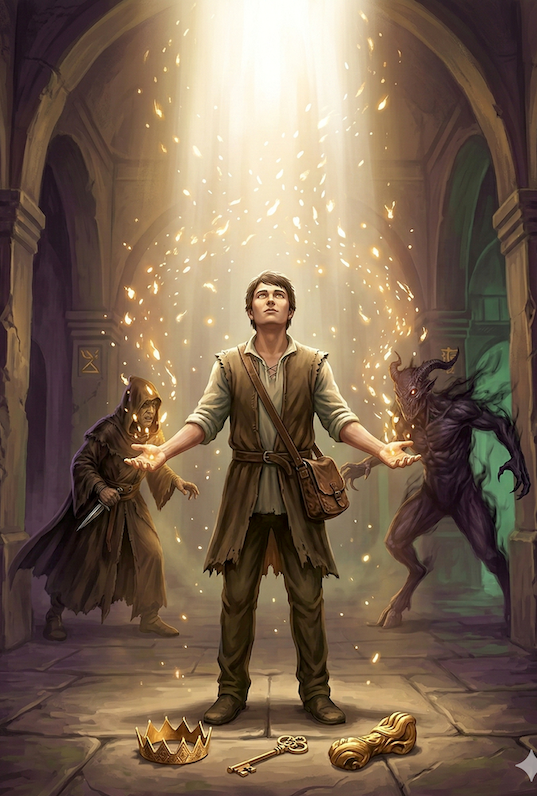
The Martyr willingly gives up something precious — potentially including life itself — for something greater than personal survival or gain. The entire arc exists to make this possible. Everything that happened in Acts 1, 2a, and 2b was preparation for this moment: establishing what the protagonist Wants, building capability through the Wanderer phase, testing that capability through the Warrior phase, and then collapsing it at All Is Lost so that only something deeper can complete the journey.
The Martyr state is not about death. It is about sacrifice — specifically, the sacrifice of the Want in service of the Need.
Recall the Want and the Need: the protagonist has been consciously pursuing the Want (the external goal driven by the Lie) throughout the story. The Need is what they actually require for genuine transformation — the internal change that aligns with the Truth the story has been building toward all along. The Martyr’s task is the arc’s culmination: to give up the Want, or radically redefine it, to receive the Need.
The sacrifice is not a gesture. It is the proof. Every arc claims to be about transformation, but most of them only demonstrate capability growth — the protagonist gets better at handling the problem. The Martyr state is the test of whether anything genuinely changed: whether the protagonist values the Truth more than the Lie, whether the Need has become more important than the Want. You find out by making them choose between the two under genuine pressure.
This sacrifice is the completion of the transformation that began when the Orphan’s ordinary world was shattered. The Orphan was vulnerable and safety-seeking. The Wanderer was learning and identity-forming. The Warrior was capable and proactive. The Martyr is transformed — and transformation is proven, not just claimed.
The Martyr’s Internal Landscape
Goal: The good of others. The Martyr’s orientation has shifted from self-interest — which drove both the Orphan (self-preservation) and the Warrior (self-efficacy) — to something beyond the self. This is not selflessness in the sense of self-erasure. It’s the recognition, finally fully embodied, that the Need — connection, truth, justice, love, the story’s thematic argument — matters more than the Want.
Core fear: Selfishness. The Martyr fears they’ll flinch at the threshold, protect themselves when the situation demands sacrifice, choose the Want at the moment the Need requires surrender. This is the final form of the story’s central tension: between the Lie’s self-protecting logic and the Truth’s demand.
Developmental task: Give up the Want — the thing the protagonist has been chasing since Act 1 — to receive what they actually need. This is not resignation. It’s an act of faith in a new understanding of what matters, made possible by the entire arc’s accumulation of experience, consequence, and transformation. The protagonist doesn’t give up the Want because they’ve stopped caring about it. They give it up because they’ve come to understand that something else matters more.
The Core Mechanism: Want vs. Need
The Martyr state is where the Want/Need distinction becomes unavoidable. The protagonist must choose.
Through the Orphan and Wanderer phases, the Want and Need operated in parallel — the protagonist was unconsciously working toward both, through consequences that revealed the Want’s inadequacy and the Need’s necessity. Through the Warrior phase, the protagonist was actively pursuing the Want with fierce intensity — winning sub-battles while the Need remained unaddressed. At All Is Lost, that pursuit has collapsed.
Now, in the Martyr phase, the choice is explicit. The protagonist understands, at some level — whether through hard-won insight or through the desperate logic of their circumstances — that the Want won’t give them what they actually need. They must decide whether to surrender it anyway.
What makes this dramatically meaningful is the history. The Want was established in Act 1 as something the protagonist cares about deeply. It’s been the engine of their choices through three acts. Giving it up is not irrational — it’s the hardest thing the story has asked of them, made harder by how much it has cost them to pursue it this far. The sacrifice registers as genuinely heroic precisely because it costs something real.
As the arc-states framework frames it: "the abstract want means the world to the character, giving it up or sacrificing it is often ripe with depth, complexity, and emotion, and it’s usually extremely difficult to do, making it very meaningful when the character sacrifices their abstract want to do what is needed."
The Martyr and the Hero’s Journey: Resurrection and Return
In Campbell’s monomyth, the Martyr state corresponds to the Resurrection and the beginning of the Return phase.
Campbell’s Resurrection is the final test before the hero can return home: the hero is "purified by a last sacrifice" and "tested once more on the threshold of home." This is distinct from the Midpoint Ordeal that initiated the Warrior state. The Ordeal tested capability. The Resurrection tests transformation. The hero who faces the Resurrection has already proved they can act; now they must prove they can sacrifice — that the change the arc has been building is genuine, not just accumulated competence.
The Resurrection is the Climax. The sacrifice is the test. After it, Campbell’s hero achieves the Return with the Elixir: the transformed protagonist carries what the journey gave them back into the world the story began in — a boon, a hard-won wisdom, or the completion of the arc that changes everything. In story-structure terms, this is the Resolution: the world after the sacrifice, the demonstration of what the transformation produced.
This Return completes the three-phase monomyth. The Orphan lived in Departure’s ordinary world. The Wanderer and Warrior navigated Initiation’s challenges. The Martyr enacts the Resurrection and achieves the Return. All three phases exist to make this final moment possible — and the Martyr’s willingness to sacrifice is the proof that the Initiation succeeded.
The Literary Cases
The three most-cited examples of Martyr-state sacrifice all follow the same pattern: the protagonist gives up the Want (survival, victory, safety) in service of the Need (the good of others, truth, the completion of something larger than themselves), and the sacrifice enables both transformation and an outcome beyond what the Want alone could have achieved.
Harry Potter walks into the Forbidden Forest knowing he must die. The Want — to live, to have the future he’d been promised, to be with his friends — has to be surrendered. The Need — ending Voldemort’s ability to hurt anyone else — demands it. His willingness to die enables his resurrection and ultimate victory. He didn’t sacrifice himself despite wanting to live; he sacrificed himself because the stakes were higher than his survival.
Luke Skywalker in Return of the Jedi refuses to kill his father. The Warrior response — defeat the enemy by force — is available to him. He’s built toward it for three films. Instead, he surrenders his weapon and accepts potential death rather than cross into the dark side. The Want (destroy the Emperor, end the war by conventional heroic means) is set aside. The Need (save his father, refuse the logic that power justifies everything) takes priority. The sacrifice triggers his father’s own Martyr-state choice — and Vader’s transformation, improbable as it seems, is only possible because Luke’s sacrifice created the conditions for it.
Katniss Everdeen volunteers for the mission to kill President Snow — surrendering what she actually wants (safety, privacy, a quiet life) for what she needs (to finish what she started, to protect the world that came after the revolution). Her sacrifice is not clean heroism. It’s full of doubt, pain, and a profound willingness to give up the life she’d been fighting for. That’s what makes it a Martyr moment rather than a Warrior victory.
In each case: the sacrifice is painful because the Want was real and established. The transformation is complete because the sacrifice proves the Need has been genuinely internalized, not just understood intellectually.
The Alternative: Self-Damnation
Not every protagonist completes the Martyr state. And this is important: the failure to complete it is not the same as cowardice.
The protagonist who refuses the Martyr transition remains a fierce Warrior — capable, determined, proactive — but cannot achieve genuine transformation because they cannot transcend self-interest. They’ve learned to fight. They haven’t learned to sacrifice. They win battles by force of will but cannot give up the Want, and so cannot receive the Need. They remain who they were, only more so.
Carol Pearson frames this as remaining in the Warrior mode beyond its appropriate phase. The arc-states framework calls it "self-damnation": not external defeat, but the internal choice to remain who you are rather than become who the story has made possible. These characters demonstrate that genuine transformation requires transcending self-interest — and that transcendence is precisely what they refuse.
In negative arc stories, this refusal is intentional and tragic. The tragedy lies not in the protagonist’s external defeat but in the internal choice that made transformation impossible: they could have made the sacrifice and didn’t. In positive arc stories, the protagonist must brush against this possibility — must feel the temptation to protect the Want — before choosing the Need. The closer they come to self-damnation, the more meaningful the Martyr moment becomes.
Why the Setup Is Non-Negotiable
The Martyr’s sacrifice only registers if the Want was genuinely important. This is why Act 1’s Orphan-phase work is not optional.
Every scene in Act 1 that establishes the Want — makes it feel real, urgent, and deeply meaningful to the protagonist — is loading a gun. The Martyr fires that gun at the Climax. If the gun is unloaded (the Want was vague, abstract, or never sufficiently dramatized), the sacrifice doesn’t read as sacrifice. It reads as giving up something the protagonist never really cared about — which is not heroism but convenience.
The reverse is also true: if the Want was established too narrowly (only about external achievement) without showing why it matters to the protagonist’s identity and self-understanding, the sacrifice has the wrong emotional color. It feels like strategic surrender rather than genuine sacrifice. The audience needs to feel the loss.
The Martyr’s sacrifice should be, from inside the protagonist’s experience, the worst possible thing the story could have required of them — the thing they would have sworn they could never do in Act 1 — and they do it anyway. That gap between what they once were and what they’re now capable of giving up is the measure of the arc’s completion.
The Martyr’s Sacrifice and Theme
The Martyr state is where the story’s thematic argument becomes undeniable. Themes haven’t been stated — they’ve been argued through the arc, one consequence at a time. But the Martyr’s specific sacrifice makes the argument concrete, demonstrable, and felt.
If the theme is "love requires vulnerability," the Martyr’s sacrifice is an act of vulnerability that love demanded. If the theme is "power without purpose is empty," the Martyr gives up the power they spent three acts acquiring. If the theme is "we are not alone," the Martyr reaches for connection at the moment their Lie would have told them to close off. The sacrifice doesn’t illustrate the theme abstractly — it proves the theme by showing a protagonist for whom the Truth has become more important than the protection the Lie once offered.
This is why the Martyr state feels like the story’s emotional culmination even when the external conflict is still technically unresolved. Every thematic thread, every character arc, every structural setup reaches its payoff in the Martyr’s choice. Nothing in the story is decorative if it connects to what the Martyr ultimately decides.
Common Errors
The Martyr sacrifices something they didn’t actually want. If the protagonist gives up something that wasn’t established as genuinely important — a new possession, a secondary relationship, a goal introduced in Act 2 — the sacrifice doesn’t register. The Martyr must give up the Want, and the Want must have been real and visible since Act 1. Secondary sacrifices feel like bargaining, not transformation.
The Martyr’s sacrifice is easy. If the protagonist makes the climactic sacrifice without visible internal conflict — without a genuine temptation to choose the Want over the Need — the arc hasn’t completed. The sacrifice should be the hardest thing they’ve done. Write the resistance alongside the resolution. Show the protagonist considering the self-damning choice before making the heroic one.
The sacrifice is externally imposed rather than chosen. A Martyr who is forced to sacrifice something is a victim, not a Martyr. The power of the Martyr state comes from choice — the protagonist could have protected the Want and didn’t, because they understood what choosing it would cost. The choice must be available. The protagonist must consciously take the harder path.
The Resurrection is skipped. The Martyr state doesn’t end with sacrifice — it ends with Resurrection and Return. After the sacrifice, the world responds. The transformation is confirmed. The protagonist carries what the journey gave them back into the world the story began in. Without the Resolution’s confirmation, the sacrifice hangs unresolved, and the arc feels incomplete. Even a brief Resolution matters — it’s the evidence that the transformation produced something real.
The Act 1 setup was insufficient. The Martyr fires the gun that Act 1 loaded. If the Want was vague, the sacrifice is painless. If the wound was never felt, the Truth has no weight. If the ordinary world was too comfortable, giving up the fantasy of returning to it costs nothing. Every weakness in the Martyr moment traces back to an Act 1 scene that did insufficient work. The Martyr is only as powerful as the Orphan phase was specific.
Where the Martyr State Ends
The Martyr state ends with the Resolution — the structural event in which the transformed protagonist’s new relationship to the world is established. This might be triumphant (Harry Potter celebrated, Voldemort gone), bittersweet (Katniss scarred but alive, the world changed at enormous cost), or quietly definitive (Frodo departing to the Grey Havens, the hobbit who carried too much and can no longer live normally). What matters is that it’s final: the arc is complete, the transformation is demonstrated, and the world has changed in accordance with what the Martyr sacrificed and received.
The arc is complete. The Orphan’s wound has been addressed. The Wanderer’s identity has been established. The Warrior’s capability has been tested to its limits. And the Martyr’s sacrifice has proven that the Truth is now more important than the Lie. The protagonist who walked into the story seeking safety, uncertain of who they were, proactive but operating from false premises — that protagonist has become someone the story’s events made possible and the sacrifice made real.
That’s the shape of the positive arc from the inside.