Sequence 1 - The Opening Context
Establish the emotional foundation of the story by showing the protagonist in a settled routine. While they appear stable, they are driven by a "lie" or misbelief that keeps them in an unfulfilling status quo that they cannot yet see. This sequence establishes the protagonist in their ordinary world before it is disrupted.
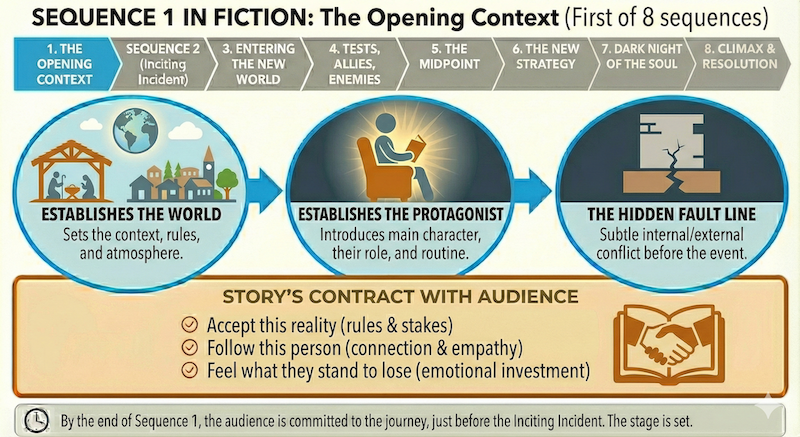
Dramatic Purpose of Sequence 1
Sequence 1 carries the heaviest burden of any sequence in the story: it must make the audience care before anything has happened. Every subsequent sequence depends on the emotional foundation Sequence 1 builds. If it fails, the entire film is working against itself from minute one.
The sequence’s core function is to establish three things simultaneously: the world the story inhabits, the protagonist who will be transformed by that world, and the fault line running through both — the hidden instability that makes disruption not just possible but inevitable. The audience doesn’t need to know the plot yet. They need to be inside a specific reality, attached to a specific person, and vaguely aware that something cannot last.
This is why the opening sequence is often described as the story’s contract with the audience. It promises a particular kind of experience — a tone, a genre register, a scale of stakes, a type of protagonist — and the audience will hold the film to that promise for the next ninety minutes. Sequence 1 must make and keep that promise simultaneously.
| THE SEQUENCE 1 CONTRACT |
|---|
By the end of Sequence 1, the audience has implicitly agreed to: |
Sequence 1 typically occupies 0-12.5% of a story. In screenplays, Sequence 1 is the first 10—15 minutes of a feature film (roughly pages 1—15). In animated films, it often runs slightly longer because world-building requires more visual time. The three sections within it — 1a, 1b, and 1c — each carry out a distinct portion of this contract.
What Must Be True at the End of Sequence 1
The transformation that Sequence 1 produces is not a plot transformation — the protagonist’s external situation has barely changed. The transformation is perceptual: the audience now lives inside this story’s world. Specifically, four things must be true at the end of Sequence 1 that were not true at the beginning:
| Was NOT true at the start | IS true at the end |
|---|---|
The audience had no world to inhabit |
The world is real, specific, and textured — the audience can feel its logic |
The protagonist was a stranger |
The protagonist is known — their competence, their flaw, their desire, their wound |
The stakes were abstract |
The stakes are personal — we know what this person stands to lose |
Disruption felt unpredictable |
Disruption feels inevitable — we can sense the fault line even if we can’t name it |
Section 1a — World Establishment
Section 1a has one primary obligation: make the world real before the protagonist arrives. The audience must feel the specific logic, texture, and tone of this story’s reality. Genre, scale, emotional register — all of it is established here, often before a single word of dialogue. The world is not backdrop. The world is argument. It tells us what kind of story we are about to watch and what kind of rules govern survival within it.
This sequence is frequently wordless or near-wordless, relying on image, music, and behavior to communicate what exposition cannot. In animation, 1a is almost always a pure visual sequence — a landscape, a society in motion, a natural system operating according to its own logic. In live action, it often takes the form of a procedural observation of daily life in a specific milieu.
The key discipline of 1a is restraint: the world must be established without explanation. The writer shows; the audience infers. If the writer explains, the world feels artificial. If the writer shows too little, the world feels thin. The craft lies in finding the details that imply the whole.
| Section 1a: Core Function |
|---|
section 1a answers the question: What world does this story take place in, and what are its rules? The audience must leave 1a with a felt sense of the world’s logic — its social order, its physical reality, its emotional weather — even if they cannot articulate what they know. |
Required Dramatic Ingredients in Section 1a
1. The Opening Image
The opening image is the story’s first statement. It is both literal (a specific image on screen) and symbolic (an argument about the world’s current state). Great opening images compress the story’s entire thematic concern into a single visual moment. They are the story’s thesis in pictorial form.
The opening image must be specific enough to be surprising and universal enough to be immediately legible. A generic opening image (a city skyline at dawn, a car on an empty road) tells us nothing. A specific opening image (a toy cowboy sitting forgotten on a bed while a boy’s sneakers walk past below frame) tells us everything.
| OPENING IMAGE: MICRO-PATTERNS |
|---|
Compression: The image contains the entire story’s thematic arc in miniature — beginning state visible, end state implied. |
Contrast: Something is paired that creates immediate tension (large/small, past/present, belonging/exclusion). |
Movement: Something moves through or past something that is still — time passing through a static world. Scale mismatch: The protagonist’s world shown at the wrong scale (too large, too small) to foreshadow their struggle. The thing that cannot last: The image shows something beautiful, ordered, or complete — and the composition subtly suggests it is fragile. |
2. World Rules Made Visible
Within the first few scenes of 1a, the story must show — not tell — how this world operates. Who has power? What is valued? What is forbidden? What does success look like here, and what does failure look like? These rules are established through behavior: how characters treat each other, what they compete over, what they fear.
In a workplace film (The Devil Wears Prada), 1a shows the brutal social hierarchy of fashion through small behavioral signals — how people move, what they avoid touching, how they speak to each other. In an adventure film (Raiders of the Lost Ark), 1a shows how this world rewards quick thinking and physical courage and punishes hesitation. The rules are never stated; they are performed.
3. Tone Calibration
Section 1a establishes the story’s emotional register — how seriously we are meant to take what we are watching. Tone is fragile and difficult to repair once broken. A single misaligned joke in a serious drama, or a single moment of unearned gravity in a comedy, ruptures the audience’s trust.
Tone is communicated through the rate of events (slow = serious, fast = playful), the consequence of small actions (high consequence = drama, low consequence = comedy), and the distance at which we observe characters (close = empathy, far = irony). Every element of 1a — music, cutting, performance style, production design — is calibrating tone simultaneously.
4. The Genre Signal
Genre is a promise: I will give you this kind of experience. The audience must be able to identify the genre contract within the first 90 seconds. They use this identification to calibrate their emotional investment, their narrative expectations, and their tolerance for certain kinds of story events.
Genre signals are often deliberately playful — genre-aware storytellers will signal the genre through a specific visual shorthand (the establishing overhead shot of a city for a crime thriller, the specific quality of light in a fantasy world) before complicating it. But the signal must come first. Subversion only works against a baseline expectation.
5. The World’s Central Tension
Every compelling story world has a structural tension built into it — two forces that are in fundamental conflict regardless of the plot. In a caste-stratified society, the tension between ambition and belonging is structural. In a high-stakes workplace, the tension between loyalty and self-preservation is structural. In a family story, the tension between love and individuation is structural.
Section 1a plants the seed of this structural tension visually, before the protagonist makes it personal. We see the world’s fault line before we see the person who will fall into it.
How to Render These Ingredients as Scenes
Section 1a typically contains 2—4 scenes. Their function is observational rather than dramatic — the protagonist has not yet appeared, or has just appeared on the periphery. The camera (or in animation, the story reel) is exploring, not following. The scenes are organized to move from large to small: world → community → individual detail.
Scene Type 1: The World-Establishing Scene (often wordless)
This is a scene without conflict or dialogue that simply shows the world in operation. It might be a landscape sequence (the land, the weather, the scope), a society-in-motion sequence (a marketplace, a school, a workplace), or a ritual sequence (a ceremony, a daily routine, a repeated behavior that signals how this world organizes time).
The craft challenge: Every image must be earning its place. Ask of every shot: What does this tell us about the world’s rules? Cut anything that is merely pretty. Keep anything that implies social logic, power structure, or emotional atmosphere.
Scene Type 2: The First Social Transaction
This is the first scene in which characters interact, usually minor characters or background players. Its purpose is to demonstrate how social exchange works in this world — the register of speech, the power dynamics, the unspoken rules of behavior. The protagonist may witness this exchange or be absent from it entirely.
The craft challenge: The exchange must feel authentic to this specific world, not generic. Two coworkers talking in a break room tells us nothing. Two coworkers negotiating over a resource that only exists in this specific workplace — that tells us everything.
Scene Type 3: The World’s Flaw or Injustice
This optional scene — present in about 60% of well-structured openings — shows something wrong with the world before we meet the protagonist. A small injustice, a structural cruelty, a thing that should not be accepted but is. This plants the thematic argument before the protagonist embodies it. It also creates a subliminal investment: we are now hoping for something to change, even before we know who will change it.
Examples: The opening of WALL-E shows the ruined Earth before it shows WALL-E — the world’s flaw is visible before the protagonist. The opening of Coco shows the living world’s suppression of music before it shows Miguel — the injustice precedes the hero.
| 1a SEQUENCE DIAGNOSTIC |
|---|
Ask these questions of any section 1a draft: |
Can someone describe this world’s logic after watching 1a, without any dialogue having explained it? |
Is the tone established by the end of the first scene? |
Is there at least one image that compresses the story’s entire thematic arc? |
Have we seen the world’s structural fault line, even obliquely? |
Is every scene doing double work (establishing world AND tone AND social logic simultaneously)? |
Section 1b — Protagonist Introduction
Section 1b introduces the protagonist into the world that 1a has established. Its job is to create attachment — to make the audience want to follow this specific person through the difficulty that is coming. Attachment is not the same as liking. Audiences will follow a character they find repellent if the character is sufficiently compelling. But they will not follow a character they find boring, passive, or opaque.
The sequence must answer five questions about the protagonist, not through exposition but through action and behavior: What is this person good at? What do they want? What are they missing? What are they afraid of? And — most important — what is the decision they are about to be forced to make?
The last question is not a plot question. It is a character question. The decision the protagonist will ultimately be forced to make at the climax of the story — the impossible choice that defines them — is rooted in a flaw or fear that section 1b must establish. The audience will not consciously recognize this seed, but they will feel it. Their curiosity about the character is actually curiosity about how this person will handle the thing they are not yet equipped to handle.
| THE PROTAGONIST INTRODUCTION PARADOX |
|---|
The protagonist must be introduced as simultaneously competent (so we believe they can succeed) and flawed (so we believe they might fail). Too much competence and the story feels like a demonstration rather than a drama. Too much flaw and the story feels like a case study rather than an adventure. The balance point is a character who is genuinely good at something in the world they currently inhabit — and genuinely unprepared for the world they are about to enter. |
Required Dramatic Ingredients
1. The Competence Display
The protagonist must be shown doing something well — something specific to this world that establishes their credibility in it. This display serves a dual function: it makes us admire them (creating attachment) and it establishes what they will lose or have to abandon when the story forces them to change (creating stakes).
Competence displays are most effective when they are unexpected or idiosyncratic — not just 'she’s a good fighter' but 'she reads a room’s power dynamics from body language in under three seconds.' The specificity of the competence tells us about the character’s inner life, not just their outer skills.
| COMPETENCE DISPLAY: MICRO-PATTERNS |
|---|
Problem-solving under pressure: Protagonist faces a small crisis and resolves it elegantly, revealing their specific intelligence. |
Social mastery: Protagonist navigates a difficult social dynamic with an ease that others around them cannot manage. |
Perceptual gift: Protagonist notices something that no one else notices — establishing their unique way of seeing. |
Physical grace: In genre stories, the protagonist’s relationship to their own body is established — how they move, how they occupy space. |
Creative solution: Protagonist solves a problem with an unexpected approach, signaling unconventional thinking. |
2. The Wound or Ghost
Behind every compelling protagonist is a past event that shaped their present behavior — a wound, a loss, a mistake, a formative experience that explains why they are the way they are. Section 1b does not explain this wound. It merely makes its presence felt through behavior: a hesitation, an avoidance, an overreaction, a blind spot.
The wound operates as a shadow. We cannot see it directly, but we can see where the protagonist is reluctant to go, what they are overprotective of, what they refuse to name. The audience senses the gap between the protagonist’s public competence and their private fear. That gap is where the story lives.
3. The Conscious Desire vs. The Unconscious Need
The protagonist’s conscious desire is what they want in the world — what they are actively pursuing, what they believe will make their life complete. The unconscious need is what they actually need to become the person they are meant to become — which is almost always in tension with, or in direct opposition to, the conscious desire.
Section 1b establishes the conscious desire clearly. The unconscious need is planted obliquely — through behavior that reveals the cost of the protagonist’s current path. In Up, Carl’s conscious desire is to reach Paradise Falls. His unconscious need is to let himself love life again. Section 1b shows us both: the adventure book (desire) and Carl’s stubborn refusal to engage with his neighbors (the cost of the path he’s on).
4. The Key Relationship
Every protagonist is defined in relationship to others. Section 1b must establish at least one relationship that reveals character — preferably the relationship that will be most transformed by the story. This relationship serves as a relational baseline: we need to know what it looks like at the beginning so that we can measure how it has changed at the end.
The key relationship is also frequently the story’s primary emotional stake. We are not just watching to see if the protagonist achieves their goal. We are watching to see if this relationship survives — or is transformed into something truer and better. Section 1b must make us care about this relationship before anything threatens it.
5. The Ordinary World’s Internal Logic
The protagonist must be shown operating within the world’s logic in a way that feels right to them — as if this is the life they have chosen and believe in, even if it is a life built on avoidance or denial. This is the Ordinary World: not just a physical location but a psychological arrangement. The protagonist has made peace (or made an uneasy truce) with this arrangement.
This internal logic is crucial because the Inciting Incident in Sequence 2 will violate it. The disruption will force the protagonist to abandon the psychological arrangement they have built. We must first see the arrangement functioning — however imperfectly — before we can feel the weight of its destruction.
How to Render These Ingredients as Scenes
Section 1b typically contains 3—5 scenes. Unlike 1a, these scenes have clear subject positions (we are following the protagonist) and often involve direct dialogue and interpersonal conflict. The scenes move from surface (what the protagonist does) to depth (why they do it) — though this movement is implicit, not stated.
Scene Type 1: The Arrival or Entrance Scene
The protagonist enters the world (or enters a specific context within the world they already inhabit). This scene establishes how they carry themselves, how others respond to their presence, and what their social position is. The entrance is often the competence display — the protagonist’s manner of arrival tells us who they are.
The craft challenge is to make the entrance feel like a continuation of the world rather than a disruption of it. The protagonist belongs here. They are not a visitor. Their presence is expected, and the world accommodates them — which is precisely what makes the disruption of Sequence 2 so significant.
Scene Type 2: The Relationship Scene
A scene between the protagonist and their primary relationship — the person who knows them best, the person who depends on them, or the person who will most directly bear the cost of the protagonist’s flaw. This scene must feel comfortable enough to establish the relationship’s baseline while containing at least one moment that reveals its hidden strain.
The hidden strain is not a fight or a crisis — those come later. It is a small moment of misalignment: a question not quite answered, a need not quite met, a word chosen that slightly misses the mark. The audience registers this without knowing why. That slight discomfort is the wound, made visible in miniature.
Scene Type 3: The Problem-Solving Scene
The protagonist faces a small problem — a challenge appropriate to their world and their skill set — and solves it. This scene exists primarily to show the protagonist in action rather than in relation. It demonstrates their specific intelligence, their decision-making style, their tolerance for risk. It also often contains the first hint of the unconscious need: the solution they choose reveals something about what they are actually afraid of.
Scene Type 4: The Aspiration Scene (Optional)
A scene in which the protagonist expresses or reveals what they want — not directly (which would feel like exposition) but obliquely, through action or behavior. They stare at something they want. They make a small move toward something that represents their desire. They do something that makes sense only if you understand what they are building toward.
This scene is most powerful when the aspiration is placed in contrast to what the protagonist already has — so that we can see both the desire and the cost of pursuing it simultaneously.
| 1b SEQUENCE DIAGNOSTIC |
|---|
Ask these questions of any section 1b draft: |
By the end of 1b, can we name what the protagonist is good at? What they want? What they are afraid of? |
Is the wound present in behavior — not explained, but felt? |
Does the key relationship have both warmth and hidden strain? |
Is the ordinary world internally logical — does it make sense that this person has built this life? |
Is there something the protagonist is not yet ready to face that the story will eventually require them to face? |
Section 1c — Status Quo and Foreshadowing
Section 1c has the most subtle and technically demanding job in the opening movement: it must simultaneously complete the establishment of the status quo (so that the audience fully inhabits the ordinary world) and begin the systematic undermining of that world (so that the inciting incident feels inevitable rather than arbitrary).
This is the hinge between stability and disruption. The ordinary world reaches its peak state — it is most fully itself — in 1c. And in reaching its peak, it reveals its breaking point. The flaw that 1b showed us in miniature is now visible at full scale. The world’s structural tension that 1a planted is now, if we squint, beginning to resolve in one direction. The protagonist’s unconscious need, after 1b’s oblique planting, is now clearly visible in the gap between what they have and what they need.
The dramatic craft required in 1c is the art of the quiet alarm. Nothing loud happens. Nothing obviously threatens the protagonist. But something in the texture of the sequence communicates that this equilibrium is overextended — that it has been maintained by a kind of willful blindness that cannot continue. The audience does not necessarily know what is coming. But they feel it coming.
| THE FORESHADOWING PRINCIPLE |
|---|
Effective foreshadowing in 1c does not hint at specific plot events. It establishes the emotional logic that makes those events feel necessary. We do not see the specific storm coming. We feel the air pressure change. The audience’s experience of the inciting incident as 'inevitable' — that felt rightness — is built entirely in 1c. |
Required Dramatic Ingredients
1. The False Equilibrium
The protagonist’s status quo must be shown at its most complete and most precarious simultaneously. This is the moment of highest false security — the protagonist believes everything is fine, has never believed it more fully, and is in precisely this belief most vulnerable to what is coming.
False equilibrium is often rendered as a moment of success, celebration, or comfort. The protagonist has achieved something, is enjoying something, is at peace with something. The irony — which the audience senses but the protagonist does not — is that this is the moment just before everything changes. In dramatic terms, this is the last moment of the story that will ever feel like this.
| FALSE EQUILIBRIUM: MICRO-PATTERNS |
|---|
The victory that costs: Protagonist wins something small in 1c that will be directly implicated in the inciting incident. |
The comfort that blinds: Protagonist takes refuge in something — a relationship, a routine, a belief — that will be the first thing the story destroys. |
The completed plan: Protagonist finishes arranging something — a scheme, a deal, a domestic arrangement — that is immediately about to be disrupted. |
The expression of confidence: Protagonist says or thinks something that will ring ironic in retrospect ('This is the best it’s ever been'). |
The thing they don’t check: Protagonist deliberately does not look at something — a relationship, a truth, a situation — that the story is about to force them to look at. |
2. The Structural Foreshadow
A piece of information, an image, a line of dialogue, or a small event in 1c that the audience will only fully understand in retrospect — after the inciting incident or later plot events — but that creates a subliminal unease in the moment. Structural foreshadowing works below the level of conscious attention; it creates the feeling that something is slightly wrong without triggering the audience’s analytical mind.
The craft of structural foreshadowing lies in its invisibility. If it is too obvious, it becomes telegraphing (we know exactly what’s coming) and drains the tension from the inciting incident. If it is too obscure, it fails to create any emotional effect. The target is the uncanny register: something feels off, but we cannot name what.
3. The Thematic Statement
In many strong openings, 1c contains a line of dialogue — spoken by the protagonist, a mentor figure, or even a minor character — that states the story’s central theme in plain, direct terms. This is the thematic statement: the movie’s argument announced before the story has tested it.
The thematic statement is most powerful when it is spoken with complete conviction by someone who is about to be proven wrong, or when it is spoken casually, as an obvious truth, by someone who does not yet realize how non-obvious it actually is. The protagonist will spend the rest of the film discovering whether the statement is true, false, or more complex than either.
Examples: 'People don’t really change' (spoken at the start of a film entirely about change). 'Family is all that matters' (spoken by someone about to sacrifice their family for ambition). 'I can handle anything alone' (spoken by someone about to desperately need other people). The statement creates thematic tension by anticipating the argument the story will make.
4. The Point of No Return Approach
In the final beats of 1c, the story moves its protagonist into position for the inciting incident — not yet triggering it, but placing them precisely where and when the disruption must occur. This is the approach vector: the protagonist makes a choice, takes an action, or arrives in a location that makes the inciting incident logically inevitable.
The point of no return approach is often not recognizable as significant in the moment. The protagonist makes what seems like an ordinary choice — they take a particular job, they go to a particular place, they say yes to a particular invitation. Only in retrospect does it become clear that this ordinary choice was the last fork in the road — that any other choice would have produced a different story entirely.
5. The Last Quiet Moment
Just before the inciting incident, 1c almost always contains a brief beat of stillness — the protagonist in a moment of ordinary, unguarded life. They are simply themselves, doing something small and private, before the story begins to demand things of them. This beat exists to create emotional contrast with what is about to happen, and to plant the image of the protagonist at their most human and most vulnerable.
This is the moment we will remember during the hardest parts of the story. When the protagonist is at their lowest point in Act Three, a subliminal echo of this last quiet moment will remind us of who they were — and who we want them to return to being, transformed.
How to Render These Ingredients as Scenes
Section 1c typically contains 2—4 scenes. They are denser than the scenes of 1a and 1b — more is happening in shorter space — because the story is now accelerating toward disruption. The tone shifts almost imperceptibly: something in 1c feels slightly more urgent, slightly more weighted, than the ease of the ordinary world in 1a and 1b.
Scene Type 1: The Peak of the Ordinary World
The protagonist is shown in the fullest expression of their ordinary life — doing what they do best, in the company of the people they care about, in the place that means most to them. This scene must be genuinely beautiful or genuinely warm — it must feel worth preserving. The audience must feel that there is something real here to lose.
The craft paradox: This scene must be warm enough to create stakes but charged enough with subliminal tension that the attentive viewer senses the fragility. The technique is to give the scene everything it needs to feel complete — and then add one small thing that doesn’t quite fit.
Scene Type 2: The Thematic Argument Scene
A conversation or confrontation in which the story’s central theme is articulated — often indirectly, as an argument about something more specific. Two characters disagree about how to handle a situation, and their disagreement is actually an argument about the story’s core question. The protagonist takes one position. Someone else takes the opposing position. Both positions are given genuine weight.
The craft challenge: The thematic argument must feel like a real argument about a real thing, not a lecture about ideas. The characters are not aware they are debating a theme. They are arguing about something specific and urgent to them. The thematic content is a byproduct of genuine dramatic conflict.
Scene Type 3: The Foreshadowing Incident
A small event — almost a non-event — that plants the specific emotional or logical seed of the inciting incident. Something is mentioned, glimpsed, or hinted at that the protagonist does not take seriously. They dismiss it, misread it, or simply fail to notice it. The audience may or may not catch it, but it registers subliminally either way.
This scene is often very short — two to three beats — and can be embedded within another scene rather than standing alone. Its purpose is to create the structural inevitability of the inciting incident: when it arrives, the audience will feel that it was always coming.
Scene Type 4: The Final Setup Position
The last scene of Sequence 1 — and therefore the last scene before the inciting incident — must place the protagonist in exact position for disruption. This scene usually involves the protagonist making a choice, arriving at a location, or committing to a course of action that sets the inciting incident in motion.
The tonal quality of this scene is crucial: it must feel normal. Not ominous, not charged with dramatic portent — simply normal. The protagonist is going about their day. The extraordinary event is about to interrupt the ordinary. The ordinariness of this final scene is what makes the interruption land.
| 1c SEQUENCE DIAGNOSTIC |
|---|
Ask these questions of any section 1c draft: |
Is the protagonist at peak false security — their most comfortable, their least suspicious? |
Is the thematic statement present — spoken casually, with conviction, by someone about to be tested on it? |
Is there at least one structural foreshadow — something that feels slightly off without being legible? |
Does the final scene of 1c place the protagonist in exact position for the inciting incident? |
Is the last quiet moment present — the brief, unguarded beat of ordinary humanness before everything changes? |
Common Failures in Seq. 1
The Explained World (Section 1a Failure)
The most common failure in 1a is explanatory world-building: dialogue or narration that tells us about the world rather than showing the world in operation. Voice-over that describes the setting, characters who explain rules to each other that both of them already know, title cards that orient us geographically or temporally when images could do the same work. The moment the world needs to be explained, it stops feeling real.
The Passive Protagonist (Section 1b Failure)
A protagonist who is introduced as a witness to events rather than an agent within them is a passive protagonist — and passive protagonists create passive audiences. The protagonist must be introduced doing something, choosing something, wanting something. They must be in motion from the first moment we see them. Even a contemplative or introverted protagonist can be introduced in active mode: contemplation can be active if it is directed toward something.
The Explained Wound (Section 1b Failure)
A protagonist who explains their own wound — in dialogue, in voice-over, or through a flashback — has not established a wound. They have established a backstory. Wounds work through behavior, not statement. The moment the protagonist says 'I don’t trust people because my father left,' the wound becomes intellectual rather than visceral. Show us the behavior that the wound produces. Let the audience infer the source.
The Obvious Foreshadow (Section 1c Failure)
Heavy-handed foreshadowing — dark music when we see a seemingly innocent object, a character saying 'Don’t worry, nothing could go wrong now,' a camera lingering ominously on something the audience immediately identifies as significant — tells the audience exactly what is coming and drains the inciting incident of its power. The audience spends the sequence waiting rather than experiencing.
The Missing Thematic Statement (Section 1c Failure)
Some writers, aware of the risk of being on-the-nose, omit the thematic statement entirely from their opening sequence. This is an overcorrection. Without a thematic anchor, the story feels like a sequence of events rather than an argument. The thematic statement does not need to be obvious — it can be buried in casual dialogue, spoken by a minor character, or embedded in an image. But it must be there.
The Rushed Sequence 1
Writers eager to get to the inciting incident often compress Sequence 1 to the point where the world feels thin, the protagonist feels generic, and the disruption feels arbitrary. The audience’s emotional investment in the inciting incident is entirely a product of what Sequence 1 has built. A disruption of a world we don’t care about disrupts nothing. The discipline is to make Sequence 1 as long as it needs to be — and to resist the pressure to 'get to the good stuff' before the good stuff has anything to attach to.
Cross-Media Examples
Film — Up (Pixar, 2009)
- Section 1a
-
The wordless montage of Carl and Ellie’s life together establishes a world where adventure and love are the highest values — and shows what it costs to let life’s practical demands override those values. The world’s fault line is Carl’s tendency to defer the dream.
- Section 1b
-
The elderly Carl is introduced as a man of exquisite bitterness — competent at being difficult, expert at closing the world out, clearly in mourning for the life he and Ellie never got to live. His wound (Ellie’s death) is never explained; it is present in every interaction.
- Section 1c
-
Carl’s confrontation with the construction company peaks his false equilibrium — this is the moment at which the ordinary world becomes fully untenable. The thematic statement is implicit in the adventure book: adventure still exists, but only for those brave enough to stop waiting.
Film — The Dark Knight (Nolan, 2008)
- Section 1a
-
The opening bank heist is a masterclass in world-establishment through action — we learn the Joker’s world (one where planning is undermined from within, where the rule of the clown prevails) before we see his face. The world’s logic: in Gotham, every plan to establish order is subverted by chaos.
- Section 1b
-
Batman is introduced through his relationship with the criminals he fights — he is respected and feared, but the sequence’s subtext is that what he represents (law maintained through illegal means) is inherently unstable.
- Section 1c
-
The meeting between Batman, Gordon, and Dent establishes the thematic argument explicitly: can Gotham be saved legally, or does saving it require methods that corrupt the savior? The Joker’s playing card is the structural foreshadow.
Novel — Normal People (Rooney, 2018)
- Section 1a
-
The first pages establish the social world of an Irish school through the specific texture of Connell and Marianne’s interactions — the invisible hierarchy, the cost of visibility, the way intelligence is both currency and liability.
- Section 1b
-
Connell is introduced through his relationship to his own popularity — he is entirely at ease in the social world, but that ease reveals itself as a form of cowardice. He is good at being liked and afraid of being seen.
- Section 1c
-
The developing attraction between Connell and Marianne creates the false equilibrium of a secret — it is perfect precisely because no one knows. The story’s foreshadow is the impossibility of keeping it secret: desire that intense cannot stay contained.
TV — Breaking Bad (Season 1, Episode 1)
- Section 1a
-
The cold open places us in a world where things are out of control — the RV, the bodies, the pants falling from the sky — before rewinding to show the ordinary world that preceded it. This inverted structure makes the ordinary world uncanny from the start.
- Section 1b
-
Walter White is introduced through accumulated humiliation — the car wash job, the students who mock him, the surprise birthday party that reveals how invisible he has become. His competence (chemistry) is shown as something the world has refused to value.
- Section 1c
-
The cancer diagnosis is the inciting incident that ends Sequence 1, but the foreshadowing of 1c is everything that precedes it — the systematic demonstration that Walter’s ordinary life offers him nothing worth preserving. The false equilibrium is the domesticity that has killed him slowly before the cancer had the chance.