Sequence 8 - The Climax and Resolution
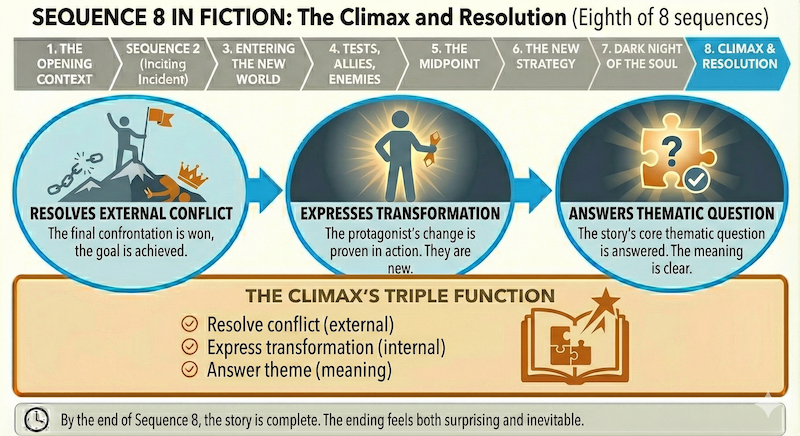
Sequence 8 is the story’s final movement, simultaneously resolving the external conflict, expressing the protagonist’s completed transformation, and delivering the thematic answer the story has been building toward since Sequence 1. Its three sections move through the final confrontation with the antagonistic force at maximum intensity (section 8a), the demonstration of the transformation’s real-world effects on relationships and the wound (section 8b), and the establishment of the new equilibrium that replaces the ordinary world destroyed in Sequence 2 (section 8c).
Dramatic Purpose of Sequence 8
Sequence 8 is the story’s final movement, and its dramatic job is unlike any preceding sequence: it must simultaneously resolve the external conflict, demonstrate the transformation at full expression, and answer the thematic question the story has been asking since Sequence 1. These three tasks are not separate — they must occur through the same events, in the same scenes, as a single unified dramatic action. A climax that resolves the plot without demonstrating the transformation is an action sequence. A climax that demonstrates the transformation without resolving the external conflict is a meditation. Only when all three tasks are accomplished through the same moment is the climax genuinely earned.
The climax is the story’s answer to the question the inciting incident activated in Sequence 2. That question was always both external (will the protagonist achieve or survive the thing the story requires?) and internal (can this person become who they need to become?). The climax answers both questions simultaneously, through the same action. The external victory or defeat is the vehicle through which the internal transformation is expressed and tested — and the internal transformation is what gives the external outcome its meaning.
This is why the climax must be genuinely uncertain right up until the moment it resolves. If the transformation guarantees success, the story becomes a demonstration rather than a drama. The climax must be genuinely threatening — the antagonistic force must have a real chance of winning — and the protagonist must achieve the resolution not despite the danger but through the specific quality that the transformation produced. The transformation is not insurance against failure; it is the specific resource the final confrontation requires.
Sequence 8 occupies roughly pages 100—120 of a feature screenplay — the story’s final fifteen to twenty pages. In the Disney sequence book structure it is often developed last, because its content is entirely determined by what the preceding seven sequences have built. The climax cannot be designed in advance; it must be discovered through the building of the story that precedes it. The writer who knows their climax before they know their Act One has not yet found their story.
The three movements of Sequence 8 are the final confrontation (8a), the transformation’s test (8b), and the new equilibrium (8c). The final confrontation stages the external conflict at its maximum intensity. The transformation’s test reveals whether the internal change is real and sufficient. And the new equilibrium establishes the world the transformation has made possible — the story’s answer to its own opening image.
| THE CLIMAX’S TRIPLE OBLIGATION |
|---|
Every climax must accomplish all three of the following, through the same event: 1. EXTERNAL RESOLUTION: The story’s central external conflict is definitively resolved — the antagonistic force is defeated, accommodated, or transcended; the protagonist’s fate in the new world is determined. 2. TRANSFORMATION EXPRESSED: The protagonist’s internal transformation is demonstrated at its highest level — they do the thing they could not have done at the story’s beginning, make the choice they were incapable of making, or see the truth they were constitutionally blind to. 3. THEMATIC ANSWER: The story’s central question — the thematic statement of section 1c, now tested against the full weight of everything that has happened — receives its definitive answer. If any of these three obligations is unfulfilled, the climax is structurally incomplete, regardless of how dramatic or emotionally powerful it may be in other respects. |
What Must Be True at the End of Sequence 8
| Was NOT true at the start of Sequence 8 | IS true at the end of Sequence 8 |
|---|---|
The external conflict was unresolved and the antagonistic force was operative |
The external conflict has been definitively resolved — the antagonistic force has been defeated, transformed, or rendered inoperative |
The protagonist’s transformation was complete internally but untested externally |
The transformation has been tested at maximum intensity and has held — expressed through the specific action the story required |
The story’s central thematic question was active |
The thematic question has been answered — not abstractly but through the specific outcome of the protagonist’s final choice and its consequences |
The protagonist’s relationship to the new world was contested |
The protagonist’s place in the new world has been established — they have a position, a relationship, a way of being that reflects who they have become |
The opening image’s world was the story’s baseline |
The closing image answers the opening image — the world the story has made is visible, specific, and emotionally resonant against the world the story began with |
A final condition — the most elusive and the most essential — governs the quality of the resolution the climax produces: it must feel both surprising and inevitable. Surprising because the specific form of the resolution could not have been predicted with certainty; inevitable because, in retrospect, no other resolution was possible given who the protagonist has become and what the story has been arguing. The combination of surprise and inevitability is the signature of a truly earned climax. It is what separates the climax that the audience feels from the climax that the audience merely watches.
Section 8a — The Final Confrontation
Section 8a stages the story’s final external conflict — the protagonist’s last, fully committed engagement with the antagonistic force at maximum intensity. The sequence’s dramatic job is to make this confrontation the story’s most dangerous moment: the antagonistic force must be at its most capable, the protagonist must be at their most exposed, and the outcome must be genuinely uncertain. Only a climax in which the antagonist has a real chance of winning can produce the specific tension the resolution requires.
The final confrontation is the external expression of everything the story has built internally. The antagonist represents, in concrete form, the specific quality the protagonist has been transforming away from — the opposing force embodies what the wound produced: control without relationship, ambition without empathy, power without accountability, or whatever the story’s specific thematic opposition requires. Defeating the antagonist in the climax is therefore not just a plot event; it is the story’s external demonstration of the internal transformation.
The confrontation must be the protagonist’s most fully committed action in the entire story. Not their most competent — the wrong strategy may have produced more tactically skilled moments. But their most committed: the protagonist acting from the deepest, most honest place they have ever operated from, with the full weight of the transformation behind every choice. This quality of deep commitment is what distinguishes the climax’s action from every previous action in the story.
| THE CONFRONTATION’S STRUCTURAL REQUIREMENT |
|---|
The final confrontation must place the protagonist in a position where they cannot win using any capability, strategy, or resource they possessed before the dark night’s transformation. The climax is specifically designed to require the thing the transformation produced. If the protagonist could have won the final confrontation with their Act One self, the transformation was not necessary — and a transformation that was not necessary is a transformation that was not earned. The antagonist must be defeated, accommodated, or transcended specifically through the protagonist’s transformed capacity. |
Required Dramatic Ingredients in Section 8a
1. The Antagonist at Full Strength
The final confrontation begins with the antagonistic force operating at maximum capacity — fully resourced, fully committed, with no remaining inhibitions about deploying its specific power. Every previous engagement between protagonist and antagonist has been a partial expression of the conflict; the climax is its complete expression. The antagonist’s full strength must be felt by the audience as genuinely threatening: this is not a weakened opponent; this is the force at its peak.
The antagonist at full strength also reveals, one final time, the specific nature of what the protagonist is opposing. The antagonist’s full expression is the clearest articulation of the thematic opposition: this is what the story is arguing against. The protagonist’s defeat of it — or accommodation of it — is the story’s final statement about what the protagonist’s transformed values produce when brought to bear against the story’s central opposing force.
2. The Protagonist’s Transformed Engagement
The protagonist enters the final confrontation from the transformed position established by the dark night — not with the wrong strategy, not with the new strategy’s tentative first steps, but with the full expression of who they have become. The transformed engagement is the climax’s central dramatic event: we are watching a different person face the same antagonistic force that has been opposing them throughout the story, and the difference in how they engage is the measure of the story’s transformation.
The transformed engagement is often marked by a specific quality that distinguishes it from every previous engagement: the protagonist is not trying to win in the same sense they were trying to win before. They are not managing, controlling, or strategizing. They are simply being who they are, fully, in direct confrontation with what the story required them to face. The antagonist’s defeat, accommodation, or transcendence flows from this quality of full presence rather than from tactical superiority.
| TRANSFORMED ENGAGEMENT: MICRO-PATTERNS |
|---|
The Offer Instead of the Attack: The protagonist confronts the antagonist not with force but with genuine recognition — seeing what the antagonist actually is rather than what the wrong strategy needed it to be, and responding to that truth. |
The Sacrifice That Wins: The protagonist achieves the resolution by giving something up rather than taking something — surrendering the thing the wrong strategy was organized to protect, and discovering that the surrender is what makes resolution possible. |
The Truth That Disarms: The protagonist defeats the antagonistic force not through superior capability but through superior honesty — stating the thing the antagonist cannot survive being stated. |
The Connection That Resolves: The protagonist resolves the conflict through genuine relationship — reaching toward the antagonistic force (which is sometimes a person, sometimes a system, sometimes the protagonist’s own worst self) with the transformed capacity for authentic connection. |
The Acceptance That Transforms: The protagonist achieves resolution not by defeating the antagonistic force but by accepting something about it — a truth, a limitation, a reality — that the wrong strategy was specifically organized to deny. |
The Chosen Vulnerability: The protagonist deliberately exposes themselves to the antagonistic force’s greatest power, trusting that the transformation has made them capable of surviving what would previously have destroyed them. |
3. The Climactic Decision
At the center of the final confrontation is a single, defining decision — the climax’s most important beat. This decision is the external expression of the protagonist’s internal transformation: it is the specific choice that only the transformed protagonist can make, that the pre-transformation protagonist was constitutionally incapable of, and that determines the resolution’s outcome. Every other element of the climax — the action, the stakes, the antagonistic force’s response — is organized around creating the conditions in which this decision becomes necessary.
The climactic decision is the story’s most precise test of the transformation: it places the protagonist in a situation where the wrong strategy’s logic points in one direction and the transformed self’s values point in another. The decision between these two directions is the climax’s central dramatic event. The protagonist chooses the transformed direction, and the resolution follows from that choice.
4. The Moment of Maximum Danger
Before the resolution, the climax must produce a genuine moment of maximum danger — the point at which the antagonistic force is closest to winning, the protagonist’s defeat appears most credible, and the audience most fears the wrong outcome. This moment is the climax’s dramatic apex: the tension at its highest, the stakes at their most personal, the outcome at its most uncertain.
The moment of maximum danger serves a structural function beyond generating tension: it is the final, most intense test of the protagonist’s transformed commitment. At the moment when defeat appears most likely, the protagonist must make the choice to continue from the transformed position rather than retreating to the wrong strategy’s safety. This choice — maintaining transformation under maximum pressure — is the proof that the change is real rather than performed.
5. The Resolution’s Specific Form
The climax resolves in a specific form that is directly determined by the story’s particular transformation arc — not a generic victory or defeat but the precise outcome that follows logically from who the protagonist has become and what the thematic argument requires. The resolution’s form is the story’s most definitive statement: it shows, in concrete external terms, what the protagonist’s transformation has made possible.
The resolution does not need to be a victory in the conventional sense. Stories that resolve in defeat, loss, or ambiguity can produce climaxes as earned and as resonant as stories that resolve in triumph — provided the resolution is the specific consequence of the protagonist’s transformed choices rather than of arbitrary external forces. What matters is not whether the protagonist wins but whether the resolution is the story’s honest answer to its own central question.
How to Render These Ingredients as Scenes
Scene Type 1: The Final Approach Scene
The protagonist moves into position for the final confrontation — the last scene before the central climactic exchange. This scene establishes the stakes with maximum clarity: we see what the protagonist is moving toward, what will be lost if they fail, and the specific quality of their transformed commitment. The scene should be charged with the energy of everything the story has built — not explosive, but dense with accumulated meaning.
The final approach scene often contains a brief moment of stillness — the protagonist alone, or with one ally, in the last moment of quiet before the confrontation. This moment mirrors the last quiet moment of section 1c: the same technique of stillness before disruption, now freighted with everything that has happened between then and now. The contrast — what that earlier stillness meant then versus what this stillness means now — is one of the story’s most powerful structural echoes.
Scene Type 2: The Central Confrontation Scene
The protagonist and antagonistic force engage in the story’s final, complete confrontation. This scene must contain the climactic decision — the choice that only the transformed protagonist can make — and must demonstrate the transformed engagement in its fullest expression. The antagonist must be at full strength; the protagonist must be operating from the transformed position without retreat; and the outcome must emerge from the collision of these two forces at their respective peaks.
The central confrontation scene is the story’s most complex scene to construct because it must accomplish the most: external resolution, transformation expressed, and thematic answer — all in the same dramatic space. Writers who struggle with the climax often struggle specifically with this scene’s compression. The discipline is to find the single action or decision that accomplishes all three simultaneously.
Scene Type 3: The Resolution Scene
The conflict resolves. The antagonistic force is defeated, transformed, accommodated, or transcended. The protagonist’s transformed choice has produced its specific consequence. This scene must be clear — the audience must understand definitively what has happened and why — but it need not be simple. Resolutions that carry genuine complexity, that acknowledge the cost of what was sacrificed alongside the achievement of what was gained, are more honest and more resonant than clean triumphs.
The resolution scene should carry the weight of the story’s full emotional range: the joy or relief of resolution alongside the grief of what was permanently lost, the satisfaction of transformation alongside the honest acknowledgment of what the transformation required. The best resolutions hold these multiple registers simultaneously, refusing to let any single emotion simplify what the story has earned.
| 8a SEQUENCE DIAGNOSTIC |
|---|
Ask these questions of any section 8a draft: |
Is the antagonist at full strength — genuinely capable of winning, not a weakened opponent being defeated by attrition? |
Is the protagonist’s engagement visibly transformed — acting from a different place than any previous engagement? |
Is the climactic decision present — the specific choice only the transformed protagonist can make? |
Is there a moment of maximum danger — the point at which defeat appears most credible? |
Does the resolution’s specific form follow logically from the protagonist’s transformation and the story’s thematic argument? |
Section 8b — The Transformation’s Test
Section 8b delivers the proof. If the climax’s confrontation resolves the external conflict, 8b demonstrates that the resolution was genuinely the product of transformation rather than of plot mechanics. The transformation must be visible in its effects — not just on the protagonist but on the world the story has been inhabiting. The people who knew the protagonist before must see the change. The relationships that were damaged by the wrong strategy must show the signs of their healing or their permanent alteration. The world that has been under the antagonistic force’s influence must show the first signs of what the resolution has made possible.
8b is the sequence most writers underinvest in, because once the central confrontation has been resolved, the story feels essentially over. The instinct is to close quickly — a few brief scenes of aftermath, the new status quo established, credits. But the transformation’s test is not merely epilogue; it is the story’s final dramatic movement and the sequence most directly responsible for the audience’s emotional satisfaction.
The transformation’s test asks: is the change real? The story has shown the protagonist changing internally across seven sequences. 8b shows the change operating in the world — in the specific texture of relationships, in the specific quality of choices, in the specific way the protagonist inhabits a world that is now genuinely different because they are different. The test is not a crisis; it is a demonstration. But its stakes are the story’s highest: if the transformation is not visible in the world, it did not really happen.
| THE PROOF PRINCIPLE |
|---|
The transformation’s test operates on a simple principle: show don’t tell, applied to change rather than to description. The protagonist should not say 'I have changed.' The world around them — their relationships, their choices, their way of being present — should demonstrate the change without announcement. The audience should be able to identify the specific ways the protagonist is different from who they were in Sequence 1 without being told what those differences are. The proof is in the texture of ordinary moments in the transformed world. |
Required Dramatic Ingredients in Section 8b
1. The Relational Aftermath
The story’s key relationships — the alliances that were built, damaged, tested, and sometimes broken across the story’s eight sequences — are shown in their post-resolution state. Some relationships are restored, strengthened, or newly possible in ways they were not before. Some are permanently altered — casualties of the transformation’s cost. Some reveal unexpected new forms, neither what they were before the story nor what either party expected them to become.
The relational aftermath is the transformation’s most direct evidence: how the protagonist relates to others in the aftermath of the climax is the clearest measure of who they have become. The wrong strategy generated a specific relational pattern — controlling, managing, using people as resources. The transformed protagonist’s relational pattern is different in specific ways. Those differences are what 8b demonstrates through scene.
2. The Wound’s New Status
The protagonist’s wound — the formative experience or belief that generated the wrong strategy — is shown in its new relationship to the protagonist’s present life. The wound has not disappeared; wounds do not disappear. But the protagonist’s relationship to it has changed: they are no longer organized around it, no longer building strategies to avoid it, no longer paying its costs in the currency of damaged relationships and forgone possibilities.
The wound’s new status is sometimes shown directly — the protagonist engaging with the person, place, or memory of the wound from the new position — and sometimes indirectly — through the specific texture of the protagonist’s choices in 8b that would have been impossible under the wound’s former authority. Either way, the wound must be present in 8b as a transformed element of the story’s world rather than as a continuing source of damage.
3. The Thematic Resonance
The story’s central theme is answered, not through dialogue but through the specific texture of the world the resolution has produced. The thematic statement of section 1c — the casual claim about how the world works that the story has been testing ever since — receives its final evaluation: was it true, was it false, or was it more complex than either? The answer is not stated; it is visible in the specific form of the new equilibrium.
The thematic resonance is the story’s most intellectual achievement — the sense that the narrative has been a sustained argument about something, and that the argument has been answered honestly. Not moralistically (a clear didactic answer betrays the story’s complexity) but with the specific moral clarity that comes from having tested a belief against the full weight of human difficulty and arrived at a position that is more honest than the one the story began with.
4. The Cost Acknowledged
The resolution is not cost-free. Section 8b must acknowledge, specifically and honestly, what the transformation and the resolution required. What was permanently lost cannot be pretended away; what the protagonist sacrificed in the climax must be honored as a real sacrifice. The cost acknowledgment is the story’s integrity: it refuses the false comfort of a resolution in which everything is restored and nothing was permanently taken.
The cost acknowledged in 8b is often the story’s most emotionally complex beat: the audience is asked to hold the resolution’s achievement alongside the cost it required. The best stories earn this complexity by making both the achievement and the cost specific — not abstract losses and abstract gains, but the particular person who is gone, the particular possibility that was foreclosed, set against the particular thing that is now available that was not available before.
5. The Protagonist’s New Capability
The transformation produces a specific new capability — a way of being, relating, or acting that was inaccessible to the pre-transformation protagonist. Section 8b demonstrates this capability in action: the protagonist doing something that was previously impossible, handling something that previously produced the wrong strategy’s defensive response, engaging with something that previously activated the wound.
The new capability is the story’s most direct proof of transformation because it is the most concrete: we can see the protagonist doing something they could not do before. Its appearance in 8b completes the story’s transformation arc: from the wound’s first shadow in section 1b, through the wrong strategy’s defense, through the midpoint’s revelation and the dark night’s confrontation, to this — the transformed protagonist, new capability operative, inhabiting the world as they could not inhabit it before.
How to Render These Ingredients as Scenes
Scene Type 1: The Relational Resolution Scene
The protagonist’s most important relationship — the one most central to the story’s emotional stakes — is shown in its post-resolution form. This scene does not need to be dramatically active; it may be as simple as two people together in a new way, or a conversation that has a quality it could not have had before the transformation. What it must demonstrate is the specific difference that the transformation has made to how these two people relate.
The relational resolution scene is often the most emotionally resonant scene in section 8b because it is the most personal proof: not an abstract demonstration of transformation but a specific, human encounter between two people the audience has been watching across the story’s entire arc. The change visible in how they are together is the story’s most intimate achievement.
Scene Type 2: The Wound Encounter Scene
The protagonist encounters the wound — its source, its embodiment, or its specific form in their current life — from the new position. This may be a direct meeting with the person or place associated with the wound, a return to a context that previously activated the wrong strategy, or a choice made in circumstances that would previously have produced the wound’s characteristic response. The scene demonstrates, through specific action, that the protagonist’s relationship to the wound has changed.
The wound encounter scene requires careful calibration: it must show genuine change without claiming complete healing. The wound’s presence should still be felt — the protagonist is not impervious to what it represents — but its authority over their choices has been reduced. They can feel it and still act freely. This is the transformation’s most honest expression: not the absence of the wound but the refusal to be governed by it.
Scene Type 3: The New Capability Scene
The protagonist demonstrates the specific new capability the transformation produced — doing the thing that was previously impossible, engaging with what previously activated the wrong strategy, being present in a way they were previously constitutionally incapable of. This scene should feel both triumphant and natural: it is a demonstration of who the protagonist now simply is, not a performance of who they are trying to be.
The new capability scene completes the story’s internal arc: the protagonist established in section 1b as someone with a specific competence and a specific blind spot is now shown as someone whose competence is intact and whose blind spot has been, if not eliminated, then genuinely reduced. The story has not created a new person; it has freed the person who was always there.
Scene Type 4: The Cost Scene
The story acknowledges, with full honesty, what was permanently lost. A relationship that cannot be restored. A possibility that is now foreclosed. A version of the world that was available before the climax and is not available after. This scene does not dwell in grief; it simply names the cost and allows it to be felt. The story’s resolution is not diminished by the cost; it is made more honest by it.
The cost scene is often very brief — a single beat, a specific image, a moment of quiet acknowledgment. But its presence is essential. A story that resolves without acknowledging cost is a story that has not been fully honest about what transformation requires. The cost scene is the story’s final act of integrity.
| 8b SEQUENCE DIAGNOSTIC |
|---|
Ask these questions of any section 8b draft: |
Is the relational aftermath specific — how exactly are the key relationships different from how they were in Sequence 1? |
Is the wound’s new status demonstrated — the protagonist in relation to the wound’s source or embodiment, from the new position? |
Is the thematic resonance visible — the story’s central question answered in the texture of the new world? |
Is the cost acknowledged — what was permanently lost honored as a real loss, not dismissed or forgotten? |
Is the new capability demonstrated — the protagonist doing something the pre-transformation protagonist could not do? |
Section 8c — The New Equilibrium
Section 8c closes the story by establishing its final state — the new equilibrium that the protagonist’s transformation and the climax’s resolution have made possible. This is not a return to the ordinary world of Sequence 1. The ordinary world is gone; the inciting incident destroyed it, the story’s long traversal transformed it, and the climax resolved it into something new. The new equilibrium is a world that has been changed by everything that happened — a world in which the protagonist, their relationships, and the story’s central conflict all occupy different positions than they did at the story’s beginning.
The sequence’s dramatic job is to make the new equilibrium feel both earned and specific. Earned: it must be the direct, logical consequence of everything the story has produced — not a generic happy ending or a generic tragedy, but the specific outcome that follows from this transformation, this conflict, this thematic argument. Specific: it must be rendered in concrete, particular detail rather than in the abstract terms of resolution. The audience must be able to see and feel the new world, not just understand that it exists.
The closing image of section 8c — and of the story as a whole — is the story’s final statement. It answers the opening image of section 1a the way a question is answered: not by repeating it in different terms but by offering the specific truth that the story’s entire journey has been moving toward. The closing image should be the story’s most resonant single moment: the place where everything the story has meant is compressed into a single visual, emotional, or narrative fact.
| THE NEW EQUILIBRIUM’S DEFINING QUALITY |
|---|
The new equilibrium must be different from the ordinary world in a specific, legible way — not merely the ordinary world with the problems solved, but a genuinely new configuration of the protagonist, their relationships, and their world. The difference must be traceable to the transformation: this equilibrium exists because the protagonist became who the story required them to become. A new equilibrium that could have been reached without the story’s transformation is not a new equilibrium; it is a restoration of the ordinary world under different conditions, which means the story did not ultimately change anything. |
Required Dramatic Ingredients in Section 8c
1. The New World’s Texture
The world in which the story ends must be rendered with the same specificity and attention that section 1a gave to the ordinary world. We must be able to feel the texture of this new world — its social logic, its emotional atmosphere, its specific qualities — and understand how it differs from the world that was established at the story’s beginning. The new world’s texture is the transformation made external: it is the concrete form of what the protagonist’s change has made possible.
The new world’s texture is often most powerfully conveyed through the same elements that established the ordinary world in section 1a: visual grammar, social behavior, the specific quality of ordinary life. Showing the story’s world in its new state through the same lens used in its initial state is one of the most elegant structural techniques available to the storyteller — the comparison reveals the transformation without stating it.
2. The Protagonist’s New Position
The protagonist occupies a specific new position in the world the story has made — a role, a relationship, a way of being that was not available to them at the story’s beginning and that is the direct product of the transformation. This new position is neither a return to the ordinary world’s status quo nor an entirely alien condition; it is the logical next step for someone who has become who this protagonist has become.
The protagonist’s new position should feel both right and specific: not the most comfortable possible position, not the most triumphant possible position, but the honestly earned position that follows from who they now are. The best closing positions carry a quality of rightness that resists easy description — a sense that this is where this person was always going, that the story was always going to end here, that the transformation pointed to this specific place from the very beginning.
3. The Closing Image
The final image of the story — the last thing the audience sees or experiences before the story ends — must answer the opening image of section 1a. This is the story’s most important single creative decision after the climactic choice: what is the last image, and what does it say? The closing image must carry the full weight of the story’s meaning while remaining specific enough to be felt rather than merely understood.
The closing image answers the opening image in one of three ways. It may echo the opening image with a transformation: the same location, the same character, the same type of moment — but visibly, specifically changed in the way the story has changed them. It may invert the opening image: the thing that the opening image showed as broken, absent, or fragile is now present, whole, or strong. Or it may complete the opening image: something the opening image implied or gestured toward without showing is now fully realized.
| CLOSING IMAGE: MICRO-PATTERNS |
|---|
The Echo with Difference: The same visual element from the opening image reappears — a location, an object, a type of moment — but the protagonist’s relationship to it is visibly, specifically transformed. |
The Answered Question: The opening image posed an implicit question (what will become of this? what does this mean?) and the closing image provides its answer — not in words but in the specific form of the world the story has made. |
The Completed Thing: Something begun in the opening image — a journey, a relationship, a gesture — is completed in the closing image. The story is structurally whole. |
The New Ordinary: The protagonist inhabiting a new version of ordinary life that could not have existed without the story’s transformation — not triumphant, not tragic, but specifically and honestly alive in a way the opening could not have shown. |
The Promise Kept or Broken: The story’s implicit promise to its audience — made in Sequence 1 through genre, tone, and emotional contract — is either honored or deliberately, meaningfully violated. Either way, the closing image makes the story’s final commitment visible. |
4. The Thematic Final Statement
The closing movement of 8c contains the story’s final thematic statement — not in dialogue (which would be too explicit) but in the specific outcome of the protagonist’s new position and the new world’s texture. The audience should be able to articulate what the story was about — what it believed, what it argued, what it discovered — from the specific form of the ending. The thematic statement is fully legible in the closing image without being announced.
The thematic final statement is the story’s answer to the question it posed in the thematic statement of section 1c. That statement was made with casual conviction; this answer is made with earned knowledge. The story has not merely repeated the opening claim or simply reversed it; it has tested it against everything, found the truth that survives the test, and expressed that truth in the specific form of how this world and this person end.
5. The Emotional Resonance
The final sequence must land with emotional resonance — the specific feeling that this story, with these people, in this world, was worth the journey it required. This resonance is not a product of happy endings or tragic endings; it is a product of honest endings. A story that ends honestly — that has been true to its characters, true to its world, and true to the cost of its transformation — will resonate regardless of whether its resolution is joyful or devastating.
Emotional resonance in the closing movement comes from the accumulation of everything the story has built: the attachment created in Sequence 1, the investment generated by the inciting incident, the deepening through the tests and alliances of Act Two, the devastation of the dark night, the earned quality of the transformation. The resonance of 8c is not created in 8c; it is released by it. The closing sequence harvests what the entire story has been planting.
How to Render These Ingredients as Scenes
Scene Type 1: The New World Establishing Scene
The world in its new state is shown — using the same visual and narrative logic that established the ordinary world in section 1a, but revealing the specific differences the transformation has produced. This scene may be brief; it does not need the extended establishment of section 1a because the audience already knows this world. What it needs to show is the difference — the specific ways in which the world has been changed by what happened.
The new world establishing scene often mirrors the ordinary world’s most characteristic moment: the thing that was most vividly ordinary in section 1a is now vividly transformed. The comparison between the two versions of this moment — what it was, what it is now — is the story’s most elegant structural demonstration of its own meaning.
Scene Type 2: The New Position Scene
The protagonist in their new position — inhabiting the world the story has made, from the place the transformation has brought them to. This scene should feel both settled and alive: the protagonist is not in motion toward a new goal but at rest in a new place, and the rest feels earned rather than static. They are someone who has arrived, not someone who is waiting to move again.
The new position scene is often the story’s most quietly powerful scene: the protagonist simply being, in a specific place, in a specific way, after everything that has happened. Its power comes from contrast — the audience knows who this person was when the story began, and can see, in the specific texture of how they now inhabit their place in the world, how much has changed.
Scene Type 3: The Relational Closing Scene
The story’s most important relationship is shown in its final state — the version of this connection that the transformation and the resolution have made possible. This scene may be warm or bittersweet, restored or newly formed, complete or deliberately unresolved. What it must be is honest: the specific form this relationship has taken, given everything the story has done to it.
The relational closing scene is often the most emotionally complex scene of 8c: it holds the full history of the relationship — what it was, what it cost, what it survived — in a single present moment. The audience carries that history into the scene; the writer’s task is to create a present moment worthy of it.
Scene Type 4: The Closing Image Scene
The story’s final scene — the specific image, moment, or beat that ends everything. This scene should be approached with the same care the opening image received in section 1a, and with an additional awareness of everything the story has placed between them. The closing image is the story’s last act of meaning-making: the final, specific thing it has to say.
The closing image scene is often very short — a single moment, sometimes wordless, sometimes a single line or action. Its brevity is its strength: after everything the story has put its audience through, the closing image does not need to do much. It only needs to be exactly right. The audience will provide the rest.
| 8c SEQUENCE DIAGNOSTIC |
|---|
Ask these questions of any section 8c draft: |
Is the new world’s texture rendered with the same specificity the ordinary world received in section 1a? |
Does the protagonist’s new position feel both earned and specific — the logical consequence of who they have become? |
Does the closing image answer the opening image — echo, invert, or complete it? |
Is the thematic final statement legible in the closing image without being announced? |
Does the ending produce genuine emotional resonance — the specific feeling that this story was worth the journey it required? |
Common Failures in Seq. 8
The Unearned Resolution (Section 8a Failure)
A climax whose resolution does not follow logically from the protagonist’s transformation — in which the antagonistic force is defeated by plot mechanics, good luck, or a capability the protagonist already possessed before the dark night’s transformation. The unearned resolution produces the most precisely described disappointment in narrative criticism: the sense of 'but they didn’t do anything differently.' The audience can feel when a climax’s resolution could have happened without the transformation it claims to express. The specific test: could the Act One protagonist have achieved this resolution? If yes, the transformation was not required, and the story has not yet found its real climax.
The Missing Climactic Decision (Section 8a Failure)
A climax that resolves through action without containing a specific decision — a protagonist who succeeds through sustained effort rather than through the particular choice that only the transformed self could make. Action without decision produces a climax that demonstrates competence rather than transformation. The climactic decision is the moment in which the story’s thematic argument is concretely enacted: the protagonist choosing, in specific terms, the values the transformation has produced over the values the wrong strategy defended. Without this decision, the climax has no moral center.
The Abbreviated Proof (Section 8b Failure)
A transformation’s test that moves too quickly from the climax’s resolution to the closing image, without the scenes that demonstrate the transformation’s specific effects on relationships, on the wound’s status, and on the protagonist’s new capabilities. The proof cannot be abbreviated without destroying the resonance it is meant to generate. The audience needs to see the change in the texture of ordinary life — in how the protagonist relates, chooses, inhabits their world — before the closing image can carry its full weight. A story that moves directly from climax to closing image has told rather than shown its transformation.
The Generic New World (Section 8c Failure)
A closing state that could belong to any story with a similar genre and resolution — a romantic comedy that ends in any couple’s happy togetherness, a hero story that ends in any hero’s triumphant return, a tragedy that ends in any character’s isolated grief. The new equilibrium must be specific to this story: this particular protagonist, these particular relationships, this particular transformation. Specific endings are the hardest to write and the most necessary. Generic endings suggest that the story has not yet discovered what it is specifically about.
The Unacknowledged Cost (Section 8b Failure)
A closing movement that achieves resolution without acknowledging what was permanently lost in achieving it. The story implies that everything turned out fine — that the cost of the transformation was merely temporary difficulty, now resolved. This is the most dishonest form of resolution, and the audience feels the dishonesty even when they cannot articulate it. Permanent loss must be permanently present in the story’s final state. The thing that cannot be recovered must be absent from the closing image, and that absence must be felt.
The Wrong Closing Image
A closing image that does not specifically answer the opening image — that is powerful in isolation but does not complete the structural arc the opening image initiated. The closing image must be in conversation with the opening image: it must be legible as the story’s destination given the story’s origin. A closing image that could belong to any story, or that does not specifically recall the opening image’s thematic content, is technically complete but structurally incomplete. The opening and closing images are the story’s frame, and the frame must be visible as a single, unified structure.
The Premature Resolution
A story that reaches its effective resolution before Sequence 8 — in which the climax’s outcome is essentially decided before the final confrontation, and Sequence 8 is merely the playing out of an already-determined result. The climax must be genuinely uncertain at its beginning. If the audience can see the outcome clearly before the confrontation reaches its maximum intensity, the story has peaked too early and Sequence 8 will feel anticlimactic regardless of its execution. The climax’s uncertainty must be maintained through the moment of maximum danger, which means it must be structurally preserved across all of 8a.
Cross-Media Examples
Film — Coco (Pixar, 2017)
- Section 8a
-
The final confrontation is Miguel’s return to the Land of the Dead to restore Mamá Coco’s memory of Héctor before sunrise. The antagonistic force — Ernesto de la Cruz — is at full strength in the realm of the dead; the transformed engagement is Miguel acting from love rather than ambition. The climactic decision: Miguel chooses to sing 'Remember Me' to Mamá Coco not as performance but as genuine act of familial connection — the thing the wrong strategy (pursue music at any cost) specifically prevented.
- Section 8b
-
The transformation’s proof is Mamá Coco remembering — the relational consequence of Miguel’s transformed choice extending beyond the story’s world into the living world through Mamá Coco’s restored memory of her father. The wound’s new status: Miguel’s family’s prohibition on music is permanently lifted, not through force but through the truth the transformation revealed. The cost acknowledged: Héctor is still in the Land of the Dead — the loss that preceded the story cannot be undone.
- Section 8c
-
The new world’s texture is the family playing music together — the specific ordinary moment that was impossible in the opening sequence, now made real. The closing image answers the opening image precisely: where the story began with music suppressed, it ends with music shared. The protagonist’s new position is as the inheritor of both sides of his heritage — musician and family member, the false opposition dissolved.
Film — The Shawshank Redemption (Darabont, 1994)
- Section 8a
-
Andy’s escape is the final confrontation — the wrong strategy (institutional compliance, slow patience) deployed for the last time as cover for the transformed strategy (self-directed freedom). The transformed engagement is Andy’s decision to go through the tunnel — an act that requires accepting the full cost of what is required rather than continuing to manage within the institution’s logic. The climactic decision: to leave, now, in full knowledge of what the exit requires.
- Section 8b
-
Red’s parole hearing is the transformation’s test — the moment in which Red’s internal change (from institutional dependence to genuine hope) is demonstrated in the specific texture of his answer. 'I look back on the way I was then: a young, stupid kid who committed that terrible crime' — the full self-confrontation made externally visible. The wound’s new status is the direct product: Red is paroled. The cost: the years that cannot be returned, the friends who did not survive, the life that was lived in the institution.
- Section 8c
-
The beach at Zihuatanejo is the new world — specific, earned, precisely the image the story established as the destination in the story’s first movement. The closing image answers the opening image of an institution-bound existence with the most expansive space the story could offer. Red walking toward Andy across the beach is the story’s thematic final statement made visual: hope, sustained through the full weight of institutional despair, arriving.
Novel — Beloved (Morrison, 1987)
- Section 8a
-
The final confrontation is the community of women driving Beloved away — the antagonistic force finally named and faced collectively rather than privately. Sethe’s transformed engagement is allowing others in rather than managing the wound alone: the new strategy’s full expression. The climactic decision: Sethe striking Mr. Bodwin rather than Beloved — the transformation of who she sees as the real threat, the wrong strategy finally and publicly redirected.
- Section 8b
-
The transformation’s proof is Paul D returning to 124 — the relational consequence of the community’s action extending into the possibility of genuine connection. The wound’s new status is Denver’s emergence into the world: the next generation freed by what Sethe’s transformation made possible. The cost acknowledged: Beloved is gone, and the specific form of her loss — the child who could not be named, who cannot be held — cannot be recovered.
- Section 8c
-
'This is not a story to pass on' — the thematic final statement in its most complex form: a statement about the wound’s necessary acknowledgment and its necessary release simultaneously. The closing image is the dissolution of Beloved’s footprints in the creek: the wound present, honored, and released. The new equilibrium is not comfort but the specific form of livability that comes after sustained encounter with the unlivable.
TV — Breaking Bad (Series Finale — 'Felina')
- Section 8a
-
Walt’s return to New Mexico and the execution of his plan constitute the final confrontation — the wrong strategy deployed one last time in service of the transformed goal. The transformed engagement is Walt acting from honesty rather than self-deception: he tells Skyler the truth about why he did it, acknowledges what it cost, and moves toward resolution without the wrong strategy’s justifications. The climactic decision: releasing Jesse rather than directing his fate — the act of genuine surrender that the transformation required.
- Section 8b
-
The transformation’s proof is Walt dying in the meth lab — the specific form of the wound’s acknowledgment. The wound’s new status: Walt names what the wrong strategy was protecting ('I did it for me. I liked it. I was good at it. And I was really — I was alive') — the full self-confrontation the story has been building toward since Sequence 1. The cost: every cost. Hank, the family, the years, the life that could have been.
- Section 8c
-
Walt dying among his equipment is the closing image — not triumphant, not tragic in the classical sense, but specifically right for this story. It answers the opening image of a man in his underwear in the desert with the truth the story discovered: this is where the wrong strategy always led, and he sees it clearly, and it is, in its way, enough. The new equilibrium is not a world made better but a world made honest — the specific achievement of a story that was always about the cost of self-deception.