The Wanderer - Exploration and Reactive Learning
The Wanderer is in motion but not yet in command. They’ve been pushed out of the ordinary world by the First Plot Point and are now navigating an unfamiliar landscape — new rules, new threats, new allies — primarily by reacting to what the new world does to them. They don’t yet have the insight or the will to operate from a deliberate plan. The Wanderer is the protagonist in the story’s laboratory phase, where consequence teaches what intention hasn’t yet grasped.
What the Wanderer State Actually Is
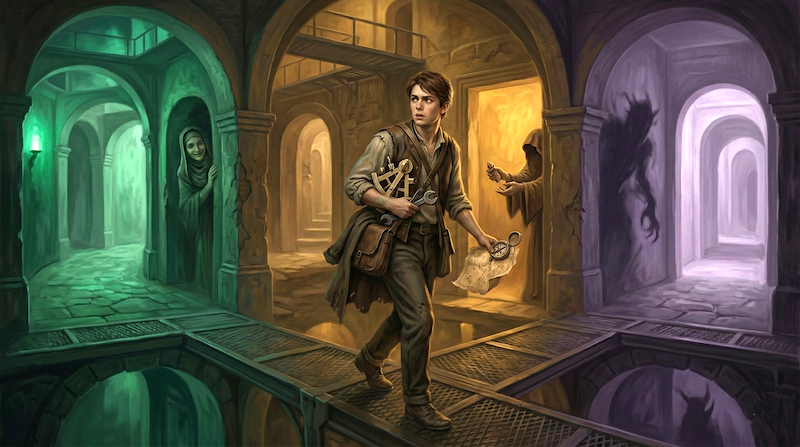
Getting the Wanderer state right is one of the most important craft decisions in your second act. This is where readers either commit to your protagonist or lose patience with them. Reactive characters can feel passive and frustrating. Wanderers done well feel like someone actively trying to survive and understand a situation they weren’t prepared for — which, done honestly, is one of the most compelling things you can put on a page.
The word "wandering" suggests aimlessness, and that’s part of the Wanderer’s condition — but not all of it. A Wanderer is not passive. They’re doing things: exploring, testing, failing, adjusting, gathering allies, following leads, retreating from dangers they can’t face yet, and learning through every consequence they accumulate. What they’re not doing is operating from a clear, deliberate plan aimed at reshaping their circumstances.
September Fawkes puts it precisely: "A wanderer doesn’t know exactly what she is doing or where she is going… she’s largely responding and reacting." The Wanderer is running, hiding, analyzing, observing, planning, adapting — but all in reaction to what the world presents rather than what the protagonist has decided to pursue.
This reactive mode is not a weakness to apologize for. It’s the psychologically honest portrait of someone who has been thrust into an unfamiliar situation they didn’t choose and don’t fully understand. It’s also why the Wanderer phase works structurally: every mistake the protagonist makes feels earned rather than contrived, every ally they gather makes sense because they genuinely need help, and every lesson registers because the consequences demanded it.
The Wanderer’s Internal Landscape
Goal: Autonomy and identity. The Wanderer is, consciously or not, working out who they are in the new world — what they believe, what they’ll fight for, what kind of person they can become once they’re no longer protected (or constrained) by the structures of the ordinary world.
Core fear: Conformity. Being absorbed into the new world’s expectations and losing themselves in the attempt to survive or fit in. This is the mirror of the Orphan’s fear: where the Orphan feared abandonment (being cut off from connection), the Wanderer fears dissolution — becoming what the world requires of them rather than who they actually are.
Developmental task: Integrate into the new world’s demands without surrendering authentic selfhood. The Wanderer must learn which of the new world’s rules to accept and which to resist — and that judgment requires more self-knowledge than they currently possess. This is what the individuation process in Jungian psychology describes: differentiation from collective demands in favor of a genuine individual identity.
What the Wanderer Phase Produces in Narrative
Act 2a is the story’s laboratory. The protagonist is testing hypotheses about the new world and about themselves, and the new world is running experiments on them in return. This phase serves several structural functions simultaneously:
Justified learning sequences. The Wanderer doesn’t know the rules. When they make mistakes — misread an ally, choose the wrong strategy, underestimate an opponent — those mistakes are earned rather than contrived. An audience forgives a Wanderer’s errors more readily than they forgive a Warrior’s, because the Wanderer’s situation honestly explains the ignorance.
Ally and mentor integration. The Wanderer gathers help because they genuinely need it. The mentor figure appears so often in Act 2a because the Wanderer’s honest vulnerability is what makes mentorship possible. A character who already had all the answers would have no use for a mentor. The Wanderer’s reactive mode creates openings for other characters to enter the story with purpose.
Identity formation through consequence. The Wanderer doesn’t understand themselves well enough to make the proactive choices the Warrior will make. They learn who they are through what happens when they’re tested. Each consequence tells them something about what they value, what they’re capable of, and where the Lie’s strategies break down.
Character vulnerability on display. The Wanderer operates at reduced capacity — below their eventual capability. Showing that gap makes the Warrior’s later effectiveness feel earned rather than convenient. The audience needs to see how far the protagonist has come.
The Wanderer and Identity: The Individuation Problem
Carol Pearson’s archetypal framework frames the Wanderer’s core tension as individuation: the psychological process of becoming a fully realized individual rather than simply a product of one’s background, conditioning, and social role. The Wanderer has been separated from the identity structures the ordinary world provided. Now they have to figure out who they actually are without those structures.
This is the hero’s journey’s central question, asked in practical terms: Who are you when your family isn’t watching? When your community’s approval is unavailable? When the rules you grew up with no longer apply? The Wanderer’s reactive learning is the process of answering that question through lived experience rather than reflection.
The fear of conformity maps onto this precisely. The new world has its own demands, its own pressures toward a particular kind of identity. The Wanderer is not just learning to survive — they’re learning to survive as themselves, not as whoever the new world wants them to be. When a Wanderer overcorrects and becomes what the situation demands of them without question, they’ve failed the developmental task even if they’ve temporarily succeeded on the new world’s terms.
The Wanderer in the Hero’s Journey
In Campbell’s monomyth, the Wanderer state corresponds to the beginning of the Initiation phase: the Road of Trials. Having crossed the threshold into the special world, the hero faces a series of tests, tasks, and ordeals that simultaneously challenge them and prepare them for the story’s central confrontation.
Campbell’s Road of Trials is not a single event — it’s an accumulation. Each trial teaches something. Each failure reveals a limitation. Each ally or enemy encountered adds information and changes the protagonist’s understanding of their situation. The Wanderer state is this accumulation in action: learning through experience and consequence, gathering what they’ll need before the Midpoint transforms them into something capable of deliberate action.
The Midpoint — Campbell’s "Ordeal" in some frameworks — is where the Wanderer phase ends. The protagonist encounters something that reorganizes their perception: a revelation that makes passive response no longer viable. Before it, they’re accumulating experience. After it, they’re acting from a new understanding. This is the shift point; the Warrior is born here.
Writing the Wanderer State Well
Make the wandering active, not passive. The Wanderer reacts, but reacting means doing things: testing strategies, taking risks, making moves that don’t pan out. The problem isn’t that the Wanderer lacks a clear plan — it’s that they’re not yet capable of sustaining one. Fill the Wanderer phase with action. The actions just shouldn’t work out cleanly, completely, or without cost.
Let consequences teach rather than letting the protagonist figure things out. The Wanderer learns through experience, not through insight. Resist scenes where the protagonist sits quietly and works things out. Instead, have them try something — and let the world respond in a way that forces a revision. Learning-by-doing rather than learning-by-thinking is the Wanderer’s mode. The lesson is in the consequence, not the reflection.
Use allies and mentors purposefully. The people the Wanderer gathers should each represent something the protagonist doesn’t yet have: a skill, a piece of information, a perspective, a quality they need to develop. The mentor doesn’t just offer support — they model a possible version of the protagonist who has already addressed some aspect of the Lie. Every ally is a mirror and a resource simultaneously.
Show the identity question under pressure. At some point in Act 2a, the new world should demand that the Wanderer become someone they’re not — conform to an expectation, adopt a role, compromise something they believe. Their response to that demand (resistance, capitulation, negotiation) reveals where they are in the developmental task. Don’t skip this pressure. It’s the Wanderer’s core challenge, not just texture.
Plant the Midpoint’s conditions. The Wanderer-to-Warrior transition requires a revelation. For that revelation to land, you need to have established what the protagonist doesn’t yet understand — the wrong assumption the revelation will overturn, the piece of information they’re missing, the misread relationship that the Midpoint will correct. The Midpoint’s power is proportional to how well the Wanderer phase prepared its conditions.
Common Errors
The Wanderer is passive rather than reactive. There’s a critical difference between responding to events and not responding to events. A Wanderer who simply endures, hides, and waits is a victim, not a protagonist. The Wanderer must be doing things — testing, trying, engaging. The actions don’t yield control, but the character is not inert.
The Wanderer phase goes too long. Some writers mistake the Wanderer’s reactive mode for "the story before the story gets going." The Wanderer phase is not the story idling — it’s the story’s learning sequence. If your protagonist is still primarily in reactive mode past 45%, something has gone wrong. The shift to the Warrior state should be underway by the Midpoint, not just beginning there.
The Wanderer has no allies. The Wanderer is, by definition, someone who needs help they don’t yet have the capacity to provide for themselves. A protagonist who operates entirely alone through Act 2a has no relationships to complicate their choices, no one to lose when the stakes rise, and no model for what transformation might look like. Give the Wanderer people — and make those people matter.
The learning doesn’t accumulate. If each Wanderer-phase scene resets to roughly the same level of knowledge and capability, Act 2a has no internal momentum. Each scene should build on the last. The Wanderer at 40% should demonstrably know more and be capable of more than the Wanderer at 30% — even if they’re still not capable of the deliberate action the Warrior will eventually take.
The identity question is skipped. A Wanderer who never faces pressure to conform, never has to decide who they are when the new world’s expectations conflict with their authentic self, has avoided the Wanderer phase’s core developmental work. The arc from Wanderer to Warrior requires that this identity question be at least partially engaged — the protagonist needs to know something true about themselves before they can act from it.
Where the Wanderer State Ends
The Wanderer state ends at the Midpoint — the structural event at approximately 50% of the story. A revelation, confrontation, or moment of recognition shifts the protagonist’s operating mode in a way that makes passive response insufficient. They now understand something they didn’t before — about the antagonist, about the world, about the stakes, about themselves — that demands intentional action.
This is the arc’s most important single transition: the reactive protagonist becomes a proactive one. Before the Midpoint, the protagonist responds to events. After it, they begin shaping them. They become a Warrior.
The shift isn’t immediate or total. But the Midpoint marks the moment it becomes irreversible. The Wanderer who walked into the Midpoint’s confrontation cannot walk back out as a Wanderer. Something in their understanding has permanently changed — and that change produces the Warrior.