Sequence 4 - Tests, Allies, and Enemies
Sequence 4 is the engine of mid-Act Two, driving the protagonist deeper into the new world’s conflict while sorting the social landscape into its permanent configuration of true allies, false friends, and individuated enemies. Across three sections, the protagonist is tested relentlessly in physical, relational, and moral registers — simultaneously gaining competence and accumulating the contradictions that will make the midpoint’s revelation inevitable. Every test, every alliance development, and every enemy action must reveal something about character that advances the story’s central argument.
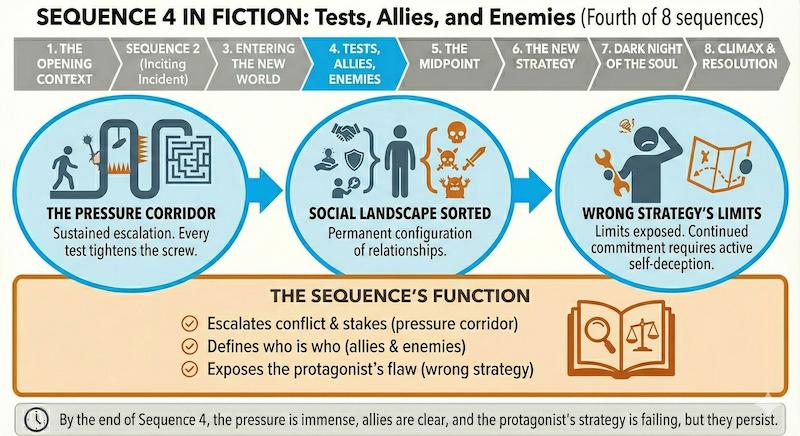
Dramatic Purpose of Sequence 4
Sequence 4 is the engine of mid-Act Two — the sequence that drives the protagonist deeper into the new world’s conflict while simultaneously sorting the social landscape into its permanent configuration. Tests, allies, and enemies are not merely plot events; they are the story’s process of revealing character under sustained pressure. What Sequence 3 established as the new world’s initial conditions, Sequence 4 tests relentlessly, refining who will help the protagonist, who will oppose them, and what the protagonist themselves is made of.
The sequence’s structural position is precisely between two poles: the first cost of section 3c (which ended the protagonist’s period of naive engagement) and the midpoint revelation of Sequence 5 (which will break the wrong strategy open entirely). Sequence 4 is the escalating corridor between these two events — a sustained period of increasing pressure in which the protagonist is simultaneously gaining competence in the new world and accumulating the contradictions that will make the midpoint’s revelation inevitable.
Three things are happening in parallel during Sequence 4. The tests deepen the protagonist’s understanding of the new world and expose the limits of their current capabilities. The allies solidify into genuine relationships that carry real emotional stakes — people the protagonist can now lose, not just lose the benefit of. And the enemies clarify into specific opposing forces whose methods, motivations, and capabilities the protagonist must understand to have any chance of defeating them.
In the Rossio framework, Sequence 4 occupies roughly pages 45—60 of a feature screenplay — the central mass of Act Two’s first half. It is often the densest sequence in terms of plot event, but its craft requirement is not density for its own sake. Every test, every alliance development, every enemy action must reveal something about character that advances the story’s central argument. Plot without revelation is noise. Sequence 4 converts experience into knowledge — painful, partial, essential.
| THE PRESSURE CORRIDOR |
|---|
Sequence 4 is the story’s pressure corridor: a sustained period of escalating difficulty in which the protagonist cannot find relief, retreat, or resolution. Each test makes the next test harder. Each ally relationship deepens the protagonist’s investment and therefore their vulnerability. Each enemy action strips away another layer of the protagonist’s false confidence. By the end of Sequence 4, the protagonist is not yet broken — that is Sequence 5’s work — but they are fully committed, fully exposed, and running out of room. The midpoint will not surprise them so much as confirm what they have been sensing since section 3c: the wrong strategy cannot hold. |
What Must Be True at the End of Sequence 4
| Was NOT true at the start of Sequence 4 | IS true at the end of Sequence 4 |
|---|---|
Allies were provisional acquaintances |
Allies have become genuine relationships with real emotional stakes — people the protagonist has invested in and can now truly lose |
Enemies were general opposing forces |
Enemies have been individuated — they have specific methods, specific motivations, and a specific claim on what the protagonist needs |
The protagonist’s capabilities were untested |
The protagonist has been tested repeatedly and has a clear, honest map of what they can and cannot do in the new world |
The wrong strategy was under stress but viable |
The wrong strategy is visibly failing — its costs have accumulated to the point where continued commitment requires active self-deception |
The midpoint was distant |
The midpoint revelation is imminent — the conditions that will make it devastating have been fully assembled |
Section 4a — The Tests
Section 4a subjects the protagonist to a series of escalating trials that test not just their competence but their character. Each test is designed by the story’s logic to target a specific aspect of the protagonist’s wrong strategy or unresolved wound — not randomly, not as generic obstacle, but as a precisely calibrated probe of the thing the protagonist has not yet been willing to examine.
The tests of 4a are distinct from the first cost of 3c in one crucial respect: the protagonist has now had time to absorb the first cost and has made an active choice to continue. The tests of 4a are therefore testing that choice — they are asking, repeatedly and in different registers, whether the protagonist’s commitment to the wrong strategy is still defensible given everything they now know. Each test tightens the screw. Each test makes the answer less comfortable.
The sequence’s emotional texture is one of mounting strain beneath surface competence. The protagonist is managing — they are still advancing, still achieving partial results — but the management is becoming more expensive. They are spending more to accomplish less. The audience can feel the approach of a threshold beyond which management will no longer be possible.
| THE TEST TAXONOMY |
|---|
Physical/Tactical Tests: Challenges to the protagonist’s skills and capabilities in the new world’s specific domain — the tests that reveal what they can and cannot do. |
Social/Relational Tests: Challenges that force the protagonist to navigate competing loyalties, betrayals, or misalignments — the tests that reveal who they are in relationship. |
Moral/Identity Tests: Challenges that force the protagonist to choose between their conscious desire and their deeper values — the tests that reveal what they are ultimately made of. All three registers are needed. A story with only physical tests produces action without character. A story with only moral tests produces paralysis without momentum. |
Required Dramatic Ingredients in Section 4a
1. The Escalating Trial Series
4a presents a sequence of at least three distinct tests, each more demanding than the last. The escalation must be felt as structural rather than arbitrary — each test arrives because the protagonist’s response to the previous test has changed the situation in a way that generates the next, harder test. The story is not throwing obstacles at the protagonist randomly; it is following the logic of consequence.
The escalating trial series typically moves from external to internal: the first test is primarily a practical challenge, the second introduces a relational or social complication, and the third confronts the protagonist with something that calls their deepest assumptions into question. By the third test, the protagonist is no longer just solving problems; they are being asked who they are.
2. The Test That Reveals the Wound
Within the trial series, one test must specifically and directly implicate the protagonist’s wound — the formative experience that explains their wrong strategy. This test is structured so that the wrong strategy’s response to it will make the wound’s influence visible: the protagonist reacts in a way that is out of proportion to the immediate situation, too defensive, too aggressive, too closed, in a way that reveals the shadow of the wound operating beneath the surface.
The wound-revealing test is often the most quietly devastating scene in section 4a. It does not need to be dramatic in the conventional sense — it can be a small moment of overreaction, a small moment of shutdown, a small moment of misreading. But it is the moment when the audience understands, with new precision, what the story’s real problem is: not the external conflict but the internal one.
3. The Demonstration of Growth
Not all tests in 4a go badly. The protagonist must demonstrate genuine growth — at least one test must show them doing something they could not have done in Sequence 3, handling something with a capability or a wisdom that was not available to them before. This demonstration of growth serves two functions: it maintains the story’s forward momentum (the protagonist is becoming someone) and it makes the wrong strategy’s failure more heartbreaking (they are genuinely getting better, but in the wrong direction).
The demonstration of growth is most powerful when it occurs in the domain of the protagonist’s weakness rather than their strength. They do not merely get better at what they were already good at; they develop a new capability that they did not previously possess. This development is a down payment on the transformation the story requires — evidence that the transformation is possible, even if it is not yet complete.
4. The Test That Cannot Be Passed
One test in 4a must be genuinely unpassable with the protagonist’s current toolkit — a situation that the wrong strategy cannot handle and that reveals, more clearly than any previous moment, the fundamental inadequacy of the protagonist’s current approach. The protagonist may find a workaround, a temporary patch, a way to survive the test without passing it. But the test has registered: there is something here that they cannot solve by being who they currently are.
The unpassable test is the structural precursor to the midpoint revelation. It plants the seed of the midpoint’s breaking point. When the midpoint arrives, the audience will remember this test and understand why the revelation was inevitable.
5. The Raised Cost of the Wrong Strategy
Each test in 4a should increase the cumulative cost of the wrong strategy — the price the protagonist is paying for pursuing the provisional goal in the wrong way. By the end of 4a, the cost should be substantially higher than it was at the end of section 3c. The protagonist is aware of the cost; they are choosing to pay it. But the audience should be increasingly concerned: the strategy that was merely insufficient in Sequence 3 is becoming genuinely destructive in Sequence 4.
How to Render These Ingredients as Scenes
Scene Type 1: The Practical Competence Test
A direct challenge to the protagonist’s operational capabilities in the new world — a problem that requires the specific skills they have been developing since entering the new world. This scene should show the protagonist at their most competent: problem-solving, adapting, making decisions under pressure. The test is passed, or partially passed, but at a cost that is not immediately apparent.
The craft function of this scene is to establish the protagonist’s genuine growth while embedding the cost of the wrong strategy within the success. They solve the problem — and in solving it, they do something that will matter negatively later. The audience may or may not catch this; either way, it is planted.
Scene Type 2: The Relational Stress Test
A test that places a key relationship under pressure — an ally is asked to choose between the protagonist and something else, or the protagonist’s behavior puts the alliance at risk, or a misunderstanding creates temporary rupture. This scene reveals both the depth of the relationship (how much does it withstand?) and its specific vulnerability (what is the thing that could break it?).
The relational stress test should not break the alliance — that comes later, at or after the midpoint. Its function is to show the audience exactly what the breaking point would be, so that when the story approaches that breaking point, the audience recognizes it and fears the outcome.
Scene Type 3: The Moral Forcing Function
A test that forces the protagonist to choose between two competing values — between loyalty and self-preservation, between honesty and expedience, between the wrong strategy and something they care about more deeply. The protagonist’s choice in this scene is one of the story’s most important character revelations: it tells us what they will and will not sacrifice for the wrong strategy’s goal.
If the protagonist makes the wrong choice here — sacrifices the more important value for the provisional goal — the scene plants a debt that the story will eventually demand be repaid. If they make the right choice, the scene shows the first crack in their commitment to the wrong strategy. Either way, the moral forcing function is the scene from which much of the rest of Act Two’s emotional logic flows.
Scene Type 4: The Unpassable Wall
The test that reveals the ceiling of the protagonist’s current capabilities — the situation that the wrong strategy cannot navigate. The protagonist encounters this wall and responds with whatever improvisational resources they have: a workaround, a deflection, a temporary retreat. The wall is not breached. It is noted. Its existence will inform everything that follows.
| 4a SEQUENCE DIAGNOSTIC |
|---|
Ask these questions of any section 4a draft: |
Do the tests escalate — is each one harder or more revealing than the last? |
Does one test specifically and visibly implicate the protagonist’s wound? |
Is genuine growth demonstrated — something the protagonist can do now that they could not do in Sequence 3? |
Is there a test that cannot be passed with the current toolkit — the first clear sight of the midpoint wall? |
Has the cumulative cost of the wrong strategy increased meaningfully since section 3c? |
Section 4b — The Allies
Section 4b deepens the protagonist’s alliances until they carry genuine emotional weight. The provisional relationships formed in Sequence 3 — useful, guarded, still transactional — must now become something more: bonds of real trust, real mutual investment, real shared risk. This deepening is essential because it raises the personal stakes of everything that follows. When the midpoint breaks the protagonist’s strategy open, it must also threaten the relationships that have become genuinely valuable to them.
The sequence’s central dramatic task is differentiation: by the end of 4b, the audience must be able to clearly distinguish between the protagonist’s true allies (who will stay through the worst of it), their fair-weather alliances (who will break under sufficient pressure), and the figures who appear to be allies but are not — the false friends whose true allegiances remain hidden. This differentiation is rarely explicit; it is communicated through the specific texture of each relationship under the stress of the sequence’s tests.
Section 4b also develops the allies as full characters in their own right — people with their own desires, wounds, and wrong strategies, whose presence in the story matters beyond their functional utility to the protagonist. The best ally characters in Act Two are never merely resources; they are mirrors, foils, and arguments. They show the protagonist what they could become, what they are at risk of becoming, or what they have already given up without realizing it.
| THE ALLY DIFFERENTIATION PRINCIPLE |
|---|
By the end of section 4b, the story’s relational map must be legible. Not to the protagonist — they will still be misreading relationships at this stage — but to the audience. We should be able to see who will be there at the lowest point and who will not. We should be able to see the hidden tensions that will break some alliances and the hidden strengths that will sustain others. This legibility is what makes the midpoint’s relational consequences feel earned rather than arbitrary. |
Required Dramatic Ingredients in Section 4b
1. The Deepening of the Primary Alliance
The protagonist’s most important new-world relationship — the alliance that most directly supports their provisional goal and most directly mirrors their transformation arc — deepens in 4b through a shared experience of genuine difficulty. The bond is tested and survives the test, emerging stronger. The shared difficulty must be specific: not a generic hardship but a challenge that specifically reveals who each character is to the other.
The primary alliance deepening often involves a moment of mutual vulnerability: each character reveals something to the other that they have not shown anyone else in the new world. This exchange of vulnerability is the foundation of genuine trust, and it distinguishes the primary alliance from the story’s other, more transactional relationships.
| ALLY DEEPENING: MICRO-PATTERNS |
|---|
The Shared Secret: Protagonist and ally exchange information or reveal vulnerabilities that bind them in mutual risk — what one knows about the other creates both trust and exposure. |
The Test Survived Together: A challenge that required both characters' capabilities to overcome, establishing that each needs the other in a specific and non-replaceable way. |
The Conflict Resolved: A disagreement or tension between protagonist and ally that could have broken the alliance instead deepens it — how they handle conflict reveals the relationship’s real quality. |
The Sacrifice Made: One character sacrifices something of value for the other, establishing a debt of reciprocal obligation that will matter when the story’s stakes are highest. |
The Past Revealed: The ally’s own wound or history is shared, establishing them as a full character whose investment in the protagonist’s situation is personal rather than merely functional. |
2. The False Ally Revealed
Not all alliances in Sequence 4 are genuine. At least one relationship that appeared to offer support must reveal itself — or begin to reveal itself — as something more complicated: a figure with competing loyalties, a hidden agenda, or a fundamental misalignment of interest that has been masked by surface warmth. The false ally is one of the story’s most important structural devices because they concentrate betrayal into a single relationship, making the eventual break personal rather than merely strategic.
The false ally’s revelation must be ambiguous in 4b — not a full unmasking (that typically comes at or after the midpoint) but a moment of visible misalignment that the protagonist rationalizes away. The audience sees it; the protagonist explains it. This gap between what the audience knows and what the protagonist allows themselves to know is one of the primary generators of dramatic irony in Act Two.
3. The Ally Who Represents the Right Path
Among the protagonist’s new-world relationships, there is typically one figure who embodies — in their own life and choices — the transformation the protagonist needs to undergo. This ally has already faced the choice the protagonist is approaching and has chosen differently from how the protagonist is currently oriented. They do not lecture or advise; they simply exist as a living demonstration that another way is possible.
The protagonist typically cannot fully appreciate this ally’s significance in section 4b — the wrong strategy is still too dominant, the provisional goal too urgent, for the deeper lesson to land. But the relationship is being built now precisely so that when the protagonist is ready to receive the lesson — at the dark night of the soul — the ally will be available to provide it.
4. The Alliance Under the Wrong Strategy’s Strain
The wrong strategy is extracting relationship costs, and section 4b makes those costs specific. At least one alliance is visibly stressed by the protagonist’s commitment to the wrong approach — the ally can see something the protagonist cannot see, wants something the protagonist is not providing, or is being asked to support a strategy they privately doubt. This strain is not yet a break; it is the structural preparation for a break.
The strain under the wrong strategy’s strain is the relationship equivalent of the unpassable wall in 4a: it shows the audience where the breaking point is, so that when the story approaches it, the audience recognizes and fears the outcome. The protagonist, committed to the wrong strategy, cannot fully perceive the damage they are doing to the relationships that matter most.
5. The Ally Who Sees the Protagonist Clearly
The most dramatically essential alliance of section 4b is the relationship in which the protagonist is seen clearly — in which someone in the new world perceives both their genuine qualities and their specific blindness, and values them in full knowledge of both. This is the relationship that will matter most in the dark night of the soul, because it is the only relationship in which the protagonist cannot hide.
The ally who sees clearly is often the story’s most important secondary character — the one whose arc most directly parallels and illuminates the protagonist’s. Their presence in the story is a constant, quiet argument: you are not what you think you are, and that is not a condemnation. The relationship must be established in section 4b before it can do its most important work later.
How to Render These Ingredients as Scenes
Scene Type 1: The Alliance Deepening Scene
A scene in which the protagonist and a key ally pass through a shared difficulty and emerge with a stronger bond. The difficulty must be genuine — a real test of the relationship, not a manufactured bonding exercise. The scene should contain at least one moment of mutual vulnerability: a confession, a fear admitted, a truth shared that neither character has shared with anyone else.
The alliance deepening scene is often the most emotionally generous scene in Sequence 4 — a moment of real warmth and connection in the midst of increasing pressure. Writers should resist the temptation to undercut it with irony or to use it primarily as setup for future betrayal. The relationship must be real now, regardless of what happens later.
Scene Type 2: The False Ally Scene
A scene that reveals a misalignment in what appeared to be a supportive relationship — a moment where the false ally’s competing interests briefly surface before being masked again. This scene works best when the misalignment is entirely plausible — when the audience can understand why the false ally has the interests they have — rather than when it is coded as obvious villainy.
The craft challenge: the false ally’s behavior in this scene must be legible as both loyal (which is how the protagonist reads it) and compromised (which is how the audience reads it). The scene must work on two levels simultaneously, with the gap between those readings creating the dramatic irony.
Scene Type 3: The Mirror Alliance Scene
A scene between the protagonist and the ally who embodies the right path — a scene in which the contrast between their approaches to the central challenge becomes visible. The mirror ally does not argue for the better approach; they simply live it. The protagonist observes something in the ally’s behavior that creates a moment of cognitive dissonance — a sense, quickly suppressed, that there might be another way.
This scene often has a quality of wistfulness or longing on the protagonist’s part — a brief, unacknowledged wish that they could be more like the ally, before the wrong strategy’s logic reasserts itself. It is one of the quietest and most important scenes in section 4b.
Scene Type 4: The Strained Alliance Scene
A scene in which the wrong strategy’s cost to a key relationship becomes visible — a moment of friction, disappointment, or withheld truth between the protagonist and someone who matters to them. The protagonist manages the strain rather than addressing it. They smooth it over, deflect, or rationalize. The ally accepts the management for now. But the scene has shown the audience what is accumulating beneath the surface.
| 4b SEQUENCE DIAGNOSTIC |
|---|
Ask these questions of any section 4b draft: |
Has the primary alliance deepened through shared difficulty and mutual vulnerability? |
Is there a false ally — a figure whose competing interests have become partially visible? |
Is there an ally who embodies the right path — a living demonstration of the transformation the protagonist needs? |
Is the wrong strategy visibly straining at least one alliance that matters? |
Is there one relationship in which the protagonist is seen clearly — known in full, valued in full? |
Section 4c — The Enemies
Section 4c individuates the story’s antagonistic forces — transforming what were general opposing pressures in Sequence 3 into specific, fully characterized enemies with intelligible motivations, genuine capabilities, and a direct personal claim on the protagonist. This individuation is essential: a story can sustain indefinite conflict with a structural force or a system, but only a characterized enemy can provide the specific personal stakes that the climax requires.
The sequence’s secondary dramatic job is to demonstrate, conclusively, that the antagonistic force is not merely an obstacle to be overcome but a genuine threat to the protagonist’s survival — in whatever sense survival is defined by this story. The enemy must be shown doing something in 4c that the protagonist cannot yet counter. The protagonist must see the enemy’s best move and understand that their current strategy has no answer for it.
The enemy sequences of Act Two are often where writers make the greatest craft errors — either by making the antagonistic force too powerful (the protagonist seems helpless) or too weak (there is no real threat). The enemy in 4c must be exactly matched to the protagonist’s current capabilities: stronger than what the protagonist can currently handle, but not so strong that the audience loses hope. The enemy’s specific power must be visible, comprehensible, and deeply threatening without being absolute.
| THE WORTHY ENEMY PRINCIPLE |
|---|
A worthy enemy is not merely a more powerful version of the protagonist. A worthy enemy is someone whose specific strengths target the protagonist’s specific weaknesses — whose methods, values, and capabilities are in direct opposition to the protagonist’s. The best antagonistic figures in Act Two are not stronger at the same things; they are strong at the exact things the protagonist is weak at. This is what makes the confrontation genuinely dramatic: the protagonist cannot win by doing more of what they do. They must become someone different. |
Required Dramatic Ingredients in Section 4c
1. The Enemy’s Intelligible Motivation
The antagonistic force must reveal, in 4c, a motivation that is comprehensible even if it is not sympathetic. We must understand why they want what they want — not as a moral endorsement but as a logical explanation. An enemy whose motivation is simply 'evil' or 'power' is not yet fully characterized. An enemy whose motivation grows from a specific wound, a specific history, a specific logic of the world is a dramatic force.
The enemy’s intelligible motivation often creates a disturbing parallel with the protagonist: both are pursuing something they genuinely want, using methods they genuinely believe in, and paying costs they have decided are worth paying. The difference between protagonist and antagonist is frequently not intent but method, not desire but choice. This parallel is the source of the story’s moral complexity.
2. The Enemy’s Specific Power
The antagonistic force demonstrates, in 4c, the specific capability that makes them a genuine threat to the protagonist — the method, resource, or advantage that the protagonist’s current strategy cannot counter. This specific power must be concrete: not a general sense of menace but a particular thing the enemy can do that the protagonist cannot defend against.
The specific power is often a direct inversion of the protagonist’s wrong strategy: if the protagonist is pursuing control, the enemy excels at creating chaos. If the protagonist is pursuing visibility, the enemy excels at concealment. If the protagonist is pursuing speed, the enemy has the patience of someone who knows they will win eventually. The enemy’s power is the story’s argument that the wrong strategy is specifically and personally matched against a force designed to defeat it.
| ENEMY POWER: MICRO-PATTERNS |
|---|
The Preemptive Strike: The enemy acts before the protagonist can establish a defensive position, demonstrating superior intelligence or information. |
The Corrupted Alliance: The enemy targets the protagonist’s relationships rather than the protagonist directly — turning allies, creating doubt, poisoning trust. |
The Revealed Vulnerability: The enemy demonstrates that they know the protagonist’s specific weakness and are prepared to exploit it at the moment of maximum effect. |
The Resource Advantage: The enemy reveals a depth of resource — time, money, institutional power, social capital — that makes the protagonist’s position seem untenable. |
The Superior Moral Claim: In stories with moral complexity, the enemy makes a claim that is partially correct — that the protagonist’s pursuit of their goal is causing harm, is hypocritical, or is built on a foundation the enemy can expose. |
3. The Personal History Between Protagonist and Enemy
The best antagonistic relationships in Act Two are not merely structural — they are personal. There is a history between protagonist and enemy, a specific connection that makes the conflict more than a contest between competing interests. This history may be explicit (they knew each other before the story began) or implicit (the enemy represents something in the protagonist’s own past or psychology).
The personal history raises the stakes of every confrontation: this is not just about who wins but about what each character represents to the other. The enemy may know something about the protagonist that they would prefer to keep hidden. The protagonist may see in the enemy a version of themselves that they are afraid of becoming. The personal dimension transforms external conflict into internal drama.
4. The Enemy’s Countermove
In response to the protagonist’s wrong strategy, the antagonistic force makes a specific countermove in 4c — an action that directly targets the weakness in the protagonist’s approach and advances the enemy’s position. This countermove is the first time in the story that the enemy has responded specifically to the protagonist rather than operating on their own agenda. It signals escalation: the enemy has now engaged directly, and the conflict has become personal.
The countermove must be intelligent — the audience must be able to follow its logic and understand why it is effective. An enemy who makes arbitrary or incomprehensible moves is not a worthy antagonist. An enemy who has analyzed the protagonist’s strategy and found its specific vulnerability, and who is now exploiting that vulnerability with precision, is terrifying.
5. The Glimpse of What Winning Would Require
By the end of 4c, the protagonist — and the audience — must have a glimpse of what defeating the antagonistic force would actually require. Not a clear path (that remains hidden until after the midpoint’s transformation) but a sense of the territory: the protagonist would have to become someone the enemy cannot read, someone who operates by different rules, someone who is not bound by the wrong strategy’s logic.
This glimpse is not yet actionable — the protagonist is not yet ready to change — but it is a seed of knowledge that will germinate through the midpoint and the dark night of the soul. The enemy, paradoxically, is the protagonist’s teacher: by showing them exactly what they cannot do with their current self, the enemy is defining exactly who they need to become.
How to Render These Ingredients as Scenes
Scene Type 1: The Enemy Characterization Scene
A scene that reveals the antagonistic force’s motivation, history, and logic — ideally a scene in which the enemy is not actively opposing the protagonist but simply existing in their own world according to their own values. This scene humanizes the antagonist without softening the threat: we understand them, and we understand precisely why their existence makes the protagonist’s goal so difficult to achieve.
The enemy characterization scene is often more effective when the protagonist is absent or peripheral — when we see the antagonist operating without reference to the protagonist. This establishes that the enemy is not simply a reaction to the protagonist but an independent force with their own history and momentum.
Scene Type 2: The Direct Confrontation Scene
The protagonist and the antagonistic force meet directly — in conflict, in negotiation, or in the charged space between them. This confrontation must reveal the specific power differential: the protagonist brings their best current capability and it is insufficient. They survive the confrontation — but they do not win it, and the audience understands why.
The direct confrontation scene should end with the protagonist shaken but not destroyed. They have encountered the enemy’s specific power and survived. They have also learned something — about the enemy’s capabilities, their own limitations, or the specific nature of the conflict — that they did not know before. The confrontation is not a defeat; it is intelligence gathered under fire.
Scene Type 3: The Enemy’s Countermove Scene
A scene in which the antagonistic force makes a specific move against the protagonist’s strategy or relationships — advancing their own position while directly targeting the protagonist’s weakness. This scene often does not include the protagonist directly: the protagonist learns about the enemy’s move after the fact, discovering that the board has shifted while they were focused elsewhere.
The countermove scene raises the sequence’s tension to its highest point. The enemy is operating with intelligence and precision. The protagonist’s position is worse than it was at the beginning of Sequence 4. And the midpoint — the moment at which all of this pressure must finally produce a breaking point — is now clearly imminent.
Scene Type 4: The Glimpse Scene
A brief, often quiet scene in which the protagonist catches a glimpse of what defeating the enemy would actually require — a moment of clarity in which the transformation the story demands becomes, if not yet accessible, at least visible. This scene is often the most tonally subdued scene in section 4c: the protagonist is not in immediate danger, not solving an immediate problem, simply seeing something they have not seen before.
The glimpse scene ends Sequence 4 and positions the protagonist at the entrance to the midpoint. They are fully committed to the wrong strategy, under maximum pressure from an enemy they cannot yet defeat, their alliances deepened but strained, their tests revealing both genuine growth and genuine ceiling. They are ready — in the structural sense — for the midpoint’s breaking point, even if they are not yet ready in the psychological sense.
| 4c SEQUENCE DIAGNOSTIC |
|---|
Ask these questions of any section 4c draft: |
Does the antagonistic force have an intelligible motivation — one that the audience can understand even if they cannot endorse? |
Is the enemy’s specific power concrete and demonstrated — not just implied? |
Is there a personal history or parallel between protagonist and enemy that deepens the conflict? |
Has the enemy made a specific countermove that directly targets the weakness in the protagonist’s strategy? |
Does the sequence end with a glimpse of what winning would actually require — the first sight of the transformation the story demands? |
Common Failures in Seq. 4
The Generic Trial Series (Section 4a Failure)
A sequence of tests that could apply to any protagonist in any story — obstacles that test generic competence rather than this specific protagonist’s specific wound and specific wrong strategy. Generic tests produce generic drama: the audience is engaged but not invested, because nothing in the trials is personally targeted. The tests of 4a must be calibrated to this protagonist’s specific vulnerabilities, or they fail their structural purpose entirely.
The Static Alliance (Section 4b Failure)
Alliance relationships that do not develop across section 4b — that are the same at the end of the sequence as they were at the beginning. Alliances must deepen or strain under the pressure of Act Two; they cannot simply hold steady. A relationship that does not change under stress either has no stakes (in which case it should not be in the story) or has not been written with sufficient specificity to respond to the pressures the story is placing on it.
The Cartoonish Enemy (Section 4c Failure)
An antagonistic force whose motivation is reduced to simple malice or whose methods are implausibly effective. The cartoonish enemy removes moral complexity from the story (there is nothing interesting about opposing someone who is simply evil) and removes credibility from the threat (an enemy who is unambiguously monstrous cannot be the protagonist’s mirror or teacher, only their obstacle). The antagonistic force must be humanly comprehensible — capable of being understood even while being opposed.
The Disconnected Tests, Allies, and Enemies
Sequence 4 fails when its three components — tests, allies, enemies — operate independently of each other rather than in concert. The tests should implicate the alliances (the protagonist’s relationships should be changed by what the tests reveal about them). The allies should illuminate the enemies (the contrast between how allies and enemies treat the protagonist should reveal the story’s moral argument). The enemies should make the tests harder (the antagonistic force should be actively complicating the protagonist’s trials, not merely existing in parallel). When all three components are in dynamic relationship, Sequence 4 achieves its maximum dramatic density.
The Resolution Without Revelation (Section 4a Failure)
Tests that are resolved without revealing anything about the protagonist’s character — challenges overcome through competence alone, without any moment in which the protagonist’s wound, wrong strategy, or latent transformation becomes visible. Tests in Act Two are not plot checkboxes; they are diagnostic instruments. Every test should leave the protagonist and the audience knowing something they did not know before. A test that is simply solved is a test that has been wasted.
The Enemy Who Waits (Section 4c Failure)
An antagonistic force that exists in the story but does not act — that is established as a threat in concept while remaining passive in practice. The enemy who waits removes the urgency that Sequence 4 is meant to generate. The antagonistic force must be actively pursuing its goal in 4c, making moves that complicate the protagonist’s position. If the enemy is not doing something to the protagonist’s situation, the story is not yet in genuine conflict; it is in anticipation of conflict, which is a fundamentally weaker dramatic position.
Cross-Media Examples
Film — Mulan (Disney, 1998)
- Section 4a
-
The training camp trial series escalates from physical tests (the arrow/pole sequence) to relational tests (Shang’s contempt, the other soldiers' exclusion) to the moral test of maintaining the disguise under conditions of genuine intimacy. The wound-revealing test is the moment Mulan realizes that being the best soldier is not the same as being the right person for this fight. The unpassable wall: she cannot be herself and succeed within the army’s existing logic.
- Section 4b
-
The alliance deepening occurs through the soldiers' shared incompetence and eventual shared progress — the training montage is simultaneously a bonding sequence and a demonstration of the wrong strategy’s partial success. The false ally is the patriarchal structure itself: it appears to offer a path but cannot ultimately accommodate who Mulan is. Mushu represents the ally who sees clearly — and who, crucially, has his own wrong strategy running in parallel.
- Section 4c
-
Shan Yu is individuated through the mountain sequence — his specific power (he reads military strategy better than anyone, and he is specifically undeceivable) is demonstrated in direct action. His countermove — surviving the avalanche — directly targets Mulan’s greatest success, transforming victory into exposure. The glimpse of what winning would require: not disguise but revelation.
Film — Parasite (Bong, 2019)
- Section 4a
-
The Ki-taek family’s escalating infiltration of the Park household constitutes a trial series whose tests move from practical (maintaining the con) to relational (developing genuine feeling for the Parks) to moral (what is being done to the people they are replacing). The wound-revealing test is Ki-woo’s growing investment in the Parks' emotional world — the test of whether the con is separable from real relationship.
- Section 4b
-
The alliances within the Ki-taek family strain under the wrong strategy’s demands — each member is playing a different version of the con, and their individual adaptations are beginning to diverge. The false ally is the Parks themselves: warm, generous, and structurally oblivious to the harm their wealth produces. The ally who sees clearly is Moon-gwang, the previous housekeeper — though her clarity will not emerge fully until Sequence 5.
- Section 4c
-
The enemy in Parasite is the system of class itself — and 4c individuates it through the Parks' specific behaviors: the smell that marks class difference, Park’s casual cruelty dressed as generosity, the moment when the family’s performance of lower-class servility begins to cost them self-respect. The countermove is structural: the system does not need to act; it simply needs to continue existing.
Novel — Pachinko (Lee, 2017)
- Section 4a
-
Sunja’s trials in Osaka escalate from practical survival (food, housing, work) to relational (her relationship with Isak’s family, the church community) to moral (the pressure to compromise her identity for economic survival). The wound-revealing test: every success Sunja achieves is shadowed by the cost of being Korean in Japan — a structural vulnerability the wrong strategy of assimilation cannot protect against.
- Section 4b
-
The alliance with Isak deepens through shared adversity and mutual witness — the deepening is specifically established through his illness, which places the relationship under maximum stress and reveals both its depth and its fragility. The ally who represents the right path is Kyunghee: her acceptance of limitation and her cultivation of dignity within constraint models a form of survival Sunja cannot yet access.
- Section 4c
-
The Japanese bureaucratic and social system is the enemy, and 4c individuates it through specific actors: the landlord, the employer, the neighbor who reports. Each represents the system’s specific power — its capacity to define who is acceptable, who belongs, who has rights. The countermove is the arrest of Isak: the system targeting the one relationship that has been sustaining Sunja’s wrong strategy.
TV — Game of Thrones (Season 1)
- Section 4a
-
Ned Stark’s investigation trials in King’s Landing escalate from practical (navigating court politics) to relational (who to trust in a court where trust is weaponized) to moral (whether justice is possible within an unjust system). The unpassable wall: Ned’s honor-based strategy cannot function in an environment where honor is a liability rather than an asset.
- Section 4b
-
The alliance with Littlefinger reveals its false nature through a series of small misalignments — moments where his advice is technically correct but structurally self-serving. The alliance with Varys deepens precisely because Varys acknowledges what he is while Littlefinger denies it. The contrast between them is a direct demonstration of the difference between useful complexity and genuine betrayal.
- Section 4c
-
Cersei’s countermove — the systematic dismantling of Ned’s position, beginning with Robert’s hunting accident — demonstrates the specific power of the antagonistic force: the willingness to act without moral constraint that Ned’s wrong strategy explicitly refuses. The glimpse of what winning would require: the same ruthlessness Ned is constitutionally incapable of.