The 4 Heroic Act States (Orphan, Wanderer, Warrior, Martyr)
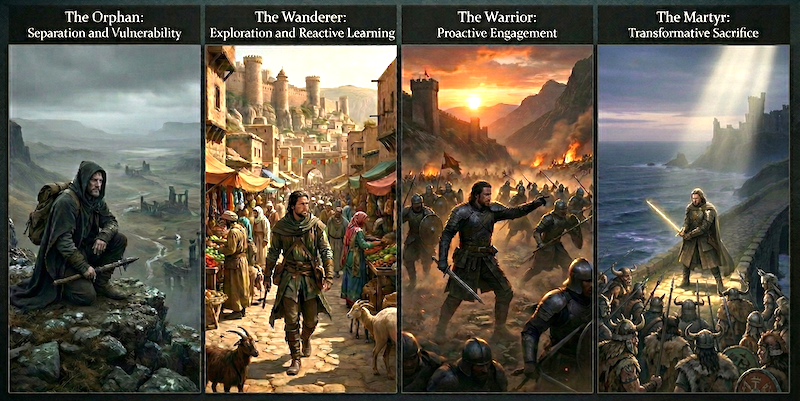
Your protagonist doesn’t change in a smooth, continuous curve. They change in phases — and each phase has a specific psychological character that determines what they’re capable of, what they’re avoiding, and what they need to learn before the story can move forward. In this article, we’ll look at the four phases of the heroic arc — Orphan, Wanderer, Warrior, and Martyr — and how you can use them to structure your story.
Origin of this Framework
The framework of four heroic arc states — Orphan, Wanderer, Warrior, Martyr — gives you a named vocabulary for those phases. It was synthesized from Larry Brooks’s story structure work (Story Engineering) and Carol Pearson’s archetypal psychology (The Hero Within), and it maps directly onto Joseph Campbell’s monomyth (The Hero with a Thousand Faces). If you’ve studied three-act or four-act structure, you already know the architecture. This framework tells you what the protagonist’s internal stance should be within that architecture — what psychological work each phase is supposed to accomplish.
Why This Framework Exists
Most structure advice tells you what should happen in each act: introduce the world, disrupt it, escalate the conflict, resolve it. That’s external plotting. The arc-states framework tells you what should be happening inside the protagonist while the external events unfold.
The gap between external plotting and internal transformation is where most character arcs fail. The protagonist is threatened, they fight back, they win or lose — but nothing fundamental about them changes, because the writer never specified what state the character was in or what psychological work the phase was supposed to accomplish. The four arc states close that gap.
This framework is compatible with — not a replacement for — the hero’s journey. Campbell identified the external shape: Departure, Initiation, Return. The arc-states model identifies the internal stance that corresponds to each:
-
Orphan → Departure
-
Wanderer + Warrior → Initiation
-
Martyr → Return
Use them together and you get both the external adventure and the internal transformation that gives it meaning.
The Four States at a Glance
| State | Act | % Range | Goal | Core Fear | Developmental Task |
|---|---|---|---|---|---|
Orphan |
Act 1 |
0—25% |
Safety |
Abandonment |
Risk abandonment to face the world independently |
Wanderer |
Act 2a |
25—50% |
Autonomy / Identity |
Conformity |
Integrate into the new world while maintaining authentic selfhood |
Warrior |
Act 2b |
50—75% |
Strength / Capability |
Weakness |
Act despite inadequacy; learn that true courage is taking necessary action, not performing strength |
Martyr |
Act 3 |
75—100% |
Good of others |
Selfishness |
Give up the Want — surrender what they’ve been chasing to receive what they actually need |
The Orphan: Separation and Vulnerability (Act 1, 0—25%)
The Orphan is your protagonist’s opening condition. They begin the story in a state of meaningful disconnection — from support systems, from belonging, from a secure sense of who they are. This doesn’t require literal orphanhood, though many iconic heroes are physically orphaned (Harry Potter, Luke Skywalker, Katniss Everdeen, Frodo Baggins). What it requires is the absence of anchoring: the protagonist lacks the thing that would allow them to simply stay where they are and be fine.
The Orphan’s goal is safety. Their core fear is abandonment. Their developmental task is to risk the very abandonment they fear in order to engage with the world as an independent agent — to discover that staying safe was never really an option, and facing the world honestly is the only path forward.
The Orphan state ends at the First Plot Point — the moment the ordinary world is shattered and the protagonist is forced into motion. Before this threshold, they’re seeking safety. After it, they become a Wanderer.
Campbell’s "Departure" phase corresponds to this state: the hero in the ordinary world, the Call to Adventure, and the initial (often failed) attempt to refuse it. The Orphan’s refusal of the call makes complete psychological sense — answering it means risking exactly the abandonment they’ve built their life around avoiding.
The Wanderer: Exploration and Reactive Learning (Act 2a, 25—50%)
The Wanderer has been forced into motion but doesn’t yet have direction. They’re moving — exploring the new world, testing strategies, gathering allies, following leads — but primarily reacting to events rather than initiating them. They don’t yet have the insight or the will to operate from a deliberate plan. This is the story’s laboratory phase, where consequence teaches what intention hasn’t yet grasped.
The Wanderer’s goal is autonomy and identity. Their core fear is conformity — being absorbed into the new world’s expectations and losing themselves in the attempt to survive. Their developmental task is learning to integrate into the new world’s demands without surrendering who they actually are: the individuation process, in Jungian terms.
The Wanderer state ends at the Midpoint. A revelation or confrontation reorganizes the protagonist’s understanding in a way that makes reactive survival no longer sufficient. Before the Midpoint, the protagonist responds to events. After it, they begin shaping them. They become a Warrior.
This corresponds to Campbell’s Initiation phase beginning — the Road of Trials, the gathering of allies and enemies, the accumulation of experience that prepares the hero for the story’s central confrontation.
The Warrior: Proactive Engagement (Act 2b, 50—75%)
The Warrior stops surviving and starts fighting. This is the shift from being acted upon to acting deliberately — the protagonist now has a plan, a target, and the will to pursue both. "Fighting" here is not about physical combat; it’s the psychological shift from responding to events to generating them.
The Warrior’s goal is strength and capability. Their core fear is weakness — the discovery that they don’t have what it takes. Their developmental task is the one most Warriors fail to complete: to discover that capability and determination are not enough, that the deeper conflict cannot be resolved by force or strategy alone.
The reactive-to-proactive shift at the Midpoint is the arc’s most important single transition. After it, your protagonist should be making plans and executing them. If your Act 2b protagonist is still primarily running, hiding, and waiting for events to guide them, something has gone wrong. The Warrior doesn’t have to win — but the Warrior has to choose.
The Warrior state ends at the All Is Lost / Second Plot Point — when the Warrior’s best efforts collapse and the protagonist hits their lowest point. The approach is exhausted. Only the Martyr can finish the story.
The Martyr: Transformative Sacrifice (Act 3, 75—100%)
The Martyr willingly gives up something precious — potentially including life itself — for something greater than personal survival or gain. The word comes from the Greek martys: witness. The Martyr has witnessed a higher truth and will not retreat from it, even at personal cost.
The Martyr’s goal is the good of others. Their core fear is selfishness — that they’ll flinch at the threshold and protect themselves when the situation demands sacrifice. Their developmental task is the arc’s culmination: giving up the Want (the external goal driven by the Lie, established in Act 1 and pursued through Acts 2a and 2b) in order to receive the Need (the internal transformation the story has been building toward all along).
This is Campbell’s Resurrection — the final test before the Return, operating at a higher level of consciousness than anything that came before. After it, the protagonist can return with the Elixir: the transformation is complete, demonstrated, and irreversible.
The Transitions Matter as Much as the States
The states don’t snap into place — they’re gradual shifts anchored to specific structural events:
| Transition | Structural Trigger | What Changes |
|---|---|---|
Orphan → Wanderer |
First Plot Point |
Ordinary world shattered; protagonist forced into motion |
Wanderer → Warrior |
Midpoint |
Revelation makes reactive survival insufficient; protagonist commits to action |
Warrior → Martyr |
All Is Lost |
Warrior’s approach collapses; protagonist must access something deeper |
Each transition is not a switch but a threshold. The protagonist has been moving toward it before it happens; the structural event makes the shift irreversible.
What These States Are Not
They’re not rigid containers. The model describes dominant phases, not airtight boxes. An Act 2 protagonist can exhibit Orphan vulnerability under stress; a strong Act 3 protagonist can show Warrior aggression. The arc is the direction of travel, not the elimination of prior states.
They’re not descriptions of individual scenes. A scene can have an Orphan feel in the middle of Act 3 — that doesn’t mean the protagonist has regressed. What matters is the protagonist’s dominant operating mode for the phase: which fear is controlling them, which goal is driving them, which developmental challenge they’re actively working to overcome.
They’re not a replacement for plot. The arc-states framework describes internal psychological work, not external events. Your plot is what exerts pressure on the protagonist; the arc states describe how the protagonist is responding to that pressure at each phase.
The Practical Payoff
You can use the four states as a diagnostic tool at any point in revision. At any moment in your story, ask:
-
What state is my protagonist in?
-
Are their actions consistent with that state’s dominant goal and fear?
-
Is the developmental challenge of this state actively present — being worked, failed, or partially resolved?
-
If they seem stuck in a prior state: what’s preventing the transition?
If you can answer those questions confidently, you know where you are and what needs to happen. If the answers are murky — if the protagonist’s internal stance is unclear — that’s why the scene isn’t working. The external problem isn’t the problem. The internal stance is.
Articles in This Series
-
The Orphan: Separation and Vulnerability — Act 1, 0—25%
-
The Wanderer: Exploration and Reactive Learning — Act 2a, 25—50%
-
The Warrior: Proactive Engagement — Act 2b, 50—75%
-
The Martyr: Transformative Sacrifice — Act 3, 75—100%