Sequence 2 - The Inciting Incident
Introduce a disruption that permanently ends the world established in the first sequence. The protagonist experiences a “point of no return” where attempts to restore their old life fail, proving that the old world is gone forever and forcing them into the unknown.
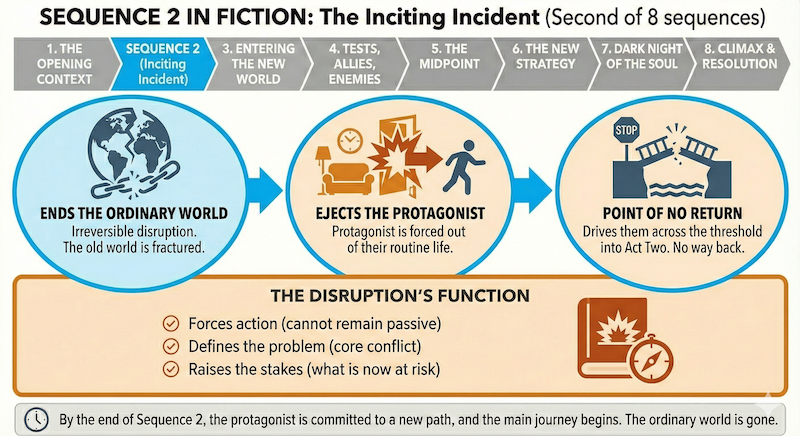
Dramatic Purpose of Sequence 2
If Sequence 1 is the story’s infrastructure, Sequence 2 is the earthquake that tests it. The Inciting Incident sequence does one irreversible thing: it ends the ordinary world. Not gradually, not conditionally — it ends it. After Sequence 2, the protagonist cannot return to the life established in Sequence 1, and the audience knows it.
This irreversibility is the sequence’s defining quality and its most demanding craft requirement. Many writers mistake the inciting incident for a problem the protagonist must solve. It is not a problem. It is a permanent disruption of the protagonist’s psychological and social equilibrium. Problems have solutions. The inciting incident does not have a solution — it has only a response, and the response will determine the rest of the story.
The inciting incident sequence is structured around three movements: the disruption itself (section 2a), the immediate consequences of the disruption (section 2b), and the protagonist’s first attempt to restore or deny equilibrium — which inevitably fails, driving them across the threshold into Act Two (section 2c). These three movements are not equal in weight. The disruption is a single event. The consequences are a cascade. The failed response is a choice — and it is the most important choice the protagonist has made yet.
The sequence typically occupies pages 15—30 of a feature screenplay — roughly the back half of Act One. In animation and genre films, it often arrives earlier; in literary and character-driven drama, it may arrive later. But the function is identical regardless of when it lands: the story’s original equilibrium ends here, and the protagonist must now become something they are not yet equipped to be.
| THE IRREVERSIBILITY TEST |
|---|
The true test of an inciting incident is irreversibility: if the protagonist could plausibly return to their Sequence 1 life within five minutes of the disruption, the inciting incident is not yet strong enough. The disruption must close a door permanently. The protagonist may try to go back — and section 2c is often that attempt — but the attempt must fail. The door must be locked from the other side. |
What Must Be True at the End of Sequence 2
The transformation Sequence 2 produces is categorical rather than gradual: the protagonist’s world has been categorically altered. Four specific things must be true at the end of Sequence 2 that were not true at its beginning:
| Was NOT true at the start of Sequence 2 | IS true at the end of Sequence 2 |
|---|---|
The ordinary world was intact |
The ordinary world has been irreversibly disrupted — something has been lost, changed, or set in motion that cannot be undone |
The protagonist was living within the world’s logic |
The protagonist has been ejected from or made incompatible with the world’s original logic |
The story’s central question was latent |
The story’s central question has been activated — the protagonist must now answer it, whether they want to or not |
The protagonist’s flaw was invisible to them |
The protagonist’s flaw has been implicated — the disruption has exposed it, even if they cannot yet see this |
A fifth condition — less often articulated but equally important — is that the audience’s curiosity has shifted from 'what is this world and who is this person?' to 'what will this person do next?' The first half of Act One creates attachment. The inciting incident converts attachment into investment. The audience is no longer comfortable observers; they are now waiting, leaning forward, emotionally committed to the outcome.
Section 2a — The Disruption
Section 2a delivers the inciting incident itself — the single event that breaks the protagonist’s ordinary world open. Its job is to be specific, unexpected, and irreversible simultaneously. Specific: not a general misfortune but a particular event that targets this protagonist’s particular vulnerability. Unexpected: even when foreshadowed, the disruption should arrive at a moment and in a form that the protagonist (and ideally the audience) did not fully anticipate. Irreversible: the event creates a condition that cannot simply be undone by good fortune or by refusing to engage.
The most common failure of 2a is a disruption that is too external — that happens to the protagonist rather than happening at the exact intersection of who they are and what they fear. A car accident can disrupt anyone. An inciting incident must disrupt this specific protagonist in a way that is inseparable from their specific flaw, desire, or wound. The disruption must be, in retrospect, the thing that was always going to happen to this particular person living this particular life.
The second most common failure is a disruption that is too gentle — something the protagonist could reasonably refuse or ignore. The inciting incident must create a compulsion. The protagonist may resist, delay, or attempt to deny what has happened, but they cannot simply step around it. The story has now required something of them, whether they accept the requirement or not.
| THE SPECIFICITY PRINCIPLE |
|---|
An inciting incident that could happen to any protagonist in any story is not yet an inciting incident — it is a plot event. The inciting incident must be legible as inevitable given what we know about this particular protagonist from Sequence 1. It should feel, on second viewing, like it could not have happened to anyone else in quite this way. The protagonist’s specific competence, flaw, desire, and wound must all be implicated in the disruption. |
Required Dramatic Ingredients in Section 2a
1. The Triggering Event
The triggering event is the external fact of the inciting incident — the thing that happens in the world. It is the most visible component of the sequence, and often the one writers focus on exclusively, to the detriment of the sequence’s other ingredients. The triggering event can be almost anything: a death, an arrival, a discovery, an offer, a loss, a meeting, a revelation. Its content matters less than its structural function: it must make the protagonist’s previous life untenable.
The triggering event almost always involves an intrusion: something enters the protagonist’s world that did not belong there, or something that was part of the protagonist’s world is suddenly and permanently removed. In either case, the boundary of the ordinary world has been violated. The protagonist’s sense of what is possible — and what is safe — has been destabilized.
| TRIGGERING EVENT: MICRO-PATTERNS |
|---|
The Arrival: A person, an object, or a piece of information enters the protagonist’s world and cannot be uninvited (a stranger with a claim on the protagonist, a letter that reveals a hidden truth, a job offer that changes everything). |
The Loss: Something the protagonist’s ordinary world was organized around is suddenly absent — a death, a departure, a theft, a failure that removes the structural support of their daily life. |
The Discovery: The protagonist learns something that makes their current way of living impossible to continue in good faith — a lie revealed, a secret exposed, a truth that cannot be unknown. |
The Offer: The protagonist is presented with a choice that, once made, cannot be reversed — an opportunity that requires abandoning the ordinary world to pursue. |
The Demand: Something external requires the protagonist to act in a way that conflicts with their ordinary life — a threat, a call for help, an obligation that overrides their current arrangement. |
The Collision: Two aspects of the protagonist’s world that have been kept separate collide — a secret life meets a public one, a past identity meets a present one, a private need meets a public role. |
2. The Personal Implication
The triggering event alone does not make an inciting incident. What makes it an inciting incident is the personal implication — the moment at which the protagonist understands (or the audience understands, even if the protagonist does not yet) that this event targets them specifically. Not just their circumstances, but their identity — who they believe themselves to be, what they have built their life around, what they most fear losing.
The personal implication is the emotional payload of the disruption. It is the moment the audience feels the bottom drop out — not just for the protagonist’s plot, but for their sense of self. A death in the family is an external event. A death that exposes the protagonist’s long-standing failure to be present is an inciting incident. The personal implication transforms external event into internal crisis.
3. The Point of No Return
The inciting incident must contain — or must clearly generate — a point of no return: a specific moment at which the protagonist’s old life becomes inaccessible. This is the door closing. It may be a literal physical threshold (leaving home, losing a job, making a public commitment), a relational threshold (a relationship ending or being fundamentally changed), or an informational threshold (learning something that cannot be unlearned).
The point of no return is the sequence’s most important structural element because it is what gives the disruption its irreversibility. Without it, the inciting incident is a problem that could be solved by simply choosing not to engage. The point of no return eliminates that choice. The protagonist is now, whether they like it or not, inside the story.
4. The Emotional Truth of the Disruption
Every inciting incident has a surface logic (what happens externally) and a deeper emotional truth (what it means for this protagonist). The surface logic is the plot; the emotional truth is the drama. A skilled storyteller ensures that the disruption’s emotional truth is visible to the audience even if the protagonist cannot yet articulate it.
The emotional truth is typically a direct confrontation of the protagonist’s wound. The inciting incident arrives at the exact pressure point that the protagonist has been protecting. The thing they have been avoiding, the truth they have been denying, the fear they have been managing — the disruption reaches in and finds it. This is why the inciting incident feels inevitable on second viewing: it was always going to find this particular person at this particular place.
5. The Question Activated
The inciting incident activates the story’s central dramatic question — the question whose answer will be the climax of the film. This question is almost always a variant of 'Will the protagonist succeed or fail at the thing the story requires of them?' But its deeper form is always a character question: 'Can this person become who they need to become?' The inciting incident is the moment this question becomes live.
The activated question must be present by the end of 2a, even if it is not yet consciously understood by the protagonist. The audience must be able to articulate what the story is now about. Not the plot — the dramatic question. What is at stake, for whom, and why does it matter?
How to Render These Ingredients as Scenes
Scene Type 1: The Arrival-in-Position Scene
Immediately before the disruption, the protagonist arrives in the specific position — physical, social, emotional — that makes them maximally vulnerable to what is about to happen. This is the last scene of the ordinary world: the protagonist is doing something ordinary, something characteristic of their Sequence 1 life, and the disruption interrupts it.
The craft function of this scene is contrast. The disruption will be more powerful for arriving at a moment of ordinary engagement. The more relaxed, comfortable, or confident the protagonist is in this final ordinary moment, the more violent the disruption will feel — even if the disruption itself is quiet.
Scene Type 2: The Disruption Scene
The inciting incident itself. This is the story’s first scene of genuine dramatic extremity — the first scene in which something irreversible happens. Its construction should be clean and unambiguous: the audience must understand exactly what has happened, even if the protagonist does not yet understand its full implications.
The disruption scene is often brief — sometimes a single beat, sometimes a full scene. What it must never be is muddy. Confusion about what has happened short-circuits the emotional response. The audience needs clarity about the external event in order to feel the emotional impact of the personal implication.
Scene Type 3: The First Confrontation with the Personal Implication
Immediately after the disruption, the protagonist encounters the personal implication for the first time. They may not fully understand it yet — denial is common at this stage — but the audience sees it clearly. This scene establishes the gap between what the protagonist consciously registers about the disruption and what the disruption actually means for them.
This gap — between the protagonist’s perception and the audience’s understanding — creates dramatic irony that will sustain the sequence’s tension through 2b and into 2c. We know more than the protagonist knows. We can see what they cannot yet see. This is the beginning of the story’s central emotional engagement.
| 2a SEQUENCE DIAGNOSTIC |
|---|
Ask these questions of any section 2a draft: |
Is the disruption specific to this protagonist — would it hit anyone else differently or not at all? |
Is there a clear point of no return — a moment after which the ordinary world is inaccessible? |
Does the disruption target the protagonist’s wound or flaw, even if they don’t realize it? |
Is the emotional truth of the disruption visible to the audience even if not to the protagonist? |
Has the story’s central dramatic question been activated? |
Section 2b — The Cascade of Consequences
Section 2b does the work that many writers underestimate or skip: it shows the world responding to the disruption. The inciting incident does not merely affect the protagonist — it sends ripples through their entire world, changing relationships, altering power dynamics, and creating new pressures from multiple directions simultaneously. Section 2b maps these ripples.
The cascade is structurally essential because it establishes the full scope of what has changed. Without 2b, the inciting incident feels like a single problem to be solved. With 2b, it becomes a systemic disruption — something that has fundamentally altered the rules of the protagonist’s world and made the old strategies for navigating that world inadequate or unavailable.
2b also intensifies pressure. The inciting incident creates an opening; 2b ensures the opening cannot be closed. Secondary consequences arrive before the protagonist has fully processed the primary disruption. New actors enter the story with competing claims on the protagonist’s response. Time pressure appears — the protagonist cannot indefinitely defer action. By the end of 2b, the protagonist is under pressure from multiple directions simultaneously, and the audience feels the impossibility of the situation with them.
| THE CASCADE PRINCIPLE |
|---|
A single disruption does not make an inciting incident sequence — it makes a scene. What makes a sequence is the cascade: the primary disruption generates secondary consequences, which generate tertiary pressures, which make the protagonist’s attempt to simply ignore the disruption increasingly untenable. Each beat of 2b should make the situation worse, more complicated, or more urgent. The protagonist is not solving a problem in 2b; they are watching it grow. |
Required Dramatic Ingredients in Section 2b
1. The Ripple Effect
The disruption affects not just the protagonist but their entire social world. In 2b, we see at least two or three of the protagonist’s key relationships responding to what has happened — and their responses create additional pressures that the protagonist must now navigate alongside the primary disruption. Different characters interpret the disruption differently, offering competing claims on what it means and what must be done.
The ripple effect reveals the world’s stake in the protagonist’s situation. The inciting incident is not just the protagonist’s problem — it is everyone’s problem, and each person’s response to it tells us something about their character and their relationship to the protagonist. The web of responses creates the social texture of Act Two before Act Two begins.
2. The Antagonistic Force Defined
Section 2b is where the story’s opposing force — whatever stands between the protagonist and the resolution of the inciting incident — becomes concrete and personal. In earlier sequences, the antagonistic force may have been structural (a social system, a set of circumstances, a world’s logic). In 2b, it acquires a face, a will, and a direct relationship to the protagonist.
The antagonistic force is not always a villain. In character-driven stories, it is often the protagonist’s own flaw, operating at full strength now that the disruption has removed the ordinary world’s scaffolding. In relational stories, it is a person the protagonist loves who wants incompatible things. In genre stories, it is an external adversary who represents the opposite of everything the protagonist values. In every case, it must be worthy — capable of genuinely preventing the protagonist from achieving what the story requires of them.
| ANTAGONISTIC FORCE: MICRO-PATTERNS |
|---|
The Worthy Opponent: The antagonistic force is at least as competent as the protagonist in the domain where they must compete, establishing that the protagonist’s success is not guaranteed. |
The Mirror: The antagonistic force represents what the protagonist could become if they fail to grow — a version of themselves without the transformation the story requires. |
The System: The antagonistic force is a social or institutional structure that predates the protagonist and will outlast them — impersonal but implacable. |
The Beloved Obstacle: The antagonistic force is someone the protagonist loves, whose needs are genuinely incompatible with the protagonist’s needs — creating a situation where victory requires hurting someone who matters. |
The Internal Enemy: The antagonistic force is the protagonist’s own wound, flaw, or fear, now operating at full strength in the absence of the ordinary world’s containing structures. |
3. The Raised Stakes
2b must make explicit what the protagonist stands to lose if the disruption is not resolved — or if it is resolved in the wrong way. The stakes established here are the story’s emotional engine. They are what the audience will hold in mind through every subsequent complication: this is what matters, this is what cannot be lost.
Stakes are most powerful when they are both external (something in the world) and internal (something about who the protagonist is or will become). Pure external stakes (money, status, physical safety) engage the audience’s tension but not their investment. Pure internal stakes (identity, integrity, self-worth) engage investment but can feel abstract. The combination — where the external and internal stakes mirror each other — creates the most sustained emotional engagement.
4. The Protagonist’s Initial Response and Its Inadequacy
In 2b, the protagonist makes their first substantive response to the disruption — an attempt to manage, contain, or deny what has happened using the strategies and resources of their ordinary world. This response is always inadequate, for a specific reason: the tools the protagonist has available in 2b are the tools of the person they were before the disruption. The disruption requires them to become someone different. They cannot yet do that.
The inadequacy of the initial response is not a failure of intelligence or competence — it is a structural feature of the inciting incident. The disruption has specifically targeted the protagonist’s blind spot. Their competence is real and considerable, but it is competence in the wrong domain. A character who excels at controlling their environment cannot control this. A character who excels at relationship will find that relationship cannot solve this. The disruption was designed to find the limit of the protagonist’s existing toolkit.
5. The Ticking Clock or Escalating Pressure
By the end of 2b, the protagonist must be facing some form of intensifying pressure — a situation that is actively getting worse rather than remaining stable. This pressure may be temporal (a deadline approaching), relational (a key relationship deteriorating under the strain of the disruption), physical (circumstances worsening), or internal (the protagonist’s emotional capacity for denial reaching its limit).
The ticking clock is not always literal. In many of the most effective inciting incident sequences, the pressure is atmospheric — a growing sense that something must give, that the current situation is inherently unstable, that the protagonist’s attempt to hold things together is costing them more than it is worth. The pressure does not have to be announced; it has to be felt.
How to Render These Ingredients as Scenes
Scene Type 1: The Immediate Aftermath Scene
The first scene following the disruption — the protagonist processing what has just happened, in real time, within the world that has just changed. This scene is often the most emotionally raw scene in the sequence: the protagonist’s defenses are down, their ordinary competence is not yet available to them, and we see their most unguarded response to the new reality.
The craft challenge is to render this scene truthfully without making the protagonist merely reactive. Even in shock, the protagonist must be doing something — thinking, deciding, reaching for something. The immediate aftermath is the first test of character: how someone behaves in the first minutes after their world has been upended tells us something essential about who they are.
Scene Type 2: The Social Ripple Scene
A scene in which at least one secondary character responds to the disruption — offering help, making demands, withdrawing support, or complicating the situation in ways the protagonist did not anticipate. This scene establishes the social dimension of the disruption and begins to sketch the landscape of Act Two: who will be the protagonist’s allies, who will be their antagonists, who will be their unexpected resources.
The social ripple scene often contains the clearest statement of the external stakes: what other people need from the protagonist, what they will lose if the protagonist fails, what pressure they are willing to apply. It transforms the disruption from a private crisis into a social emergency.
Scene Type 3: The Attempted Return to Normalcy
The protagonist tries to act as though the disruption has not fundamentally changed their world — to perform normalcy, to maintain their ordinary routines, to treat the inciting incident as a problem with a solution. This scene is often slightly surreal: the protagonist is attempting to inhabit a world that no longer exists. Their ordinary competence is applied to a situation that is no longer ordinary.
The craft function of this scene is to demonstrate the inadequacy of the protagonist’s existing toolkit without humiliating them. They are not failing because they are weak or foolish. They are failing because the situation genuinely requires a different kind of person — a person they have not yet become.
Scene Type 4: The Pressure Scene
A scene that directly escalates the stakes — a new complication arrives, a deadline is revealed, a relationship shows signs of breaking under the strain, or the antagonistic force makes its first direct move. This scene ends 2b by making the protagonist’s attempted neutrality or managed response impossible to sustain. Something must be decided. The protagonist cannot continue in this middle state.
| 2b SEQUENCE DIAGNOSTIC |
|---|
Ask these questions of any section 2b draft: |
Have we seen the disruption’s ripple effects through at least two or three key relationships? |
Has the antagonistic force been defined — given a face, a will, and a direct claim on the protagonist? |
Are the stakes now explicit — what does the protagonist stand to lose, both externally and internally? |
Has the protagonist’s initial response revealed the limit of their existing toolkit? |
Is there escalating pressure by the end of 2b — something that makes continued inaction impossible? |
Section 2c — The Failed Restoration and the Threshold
Section 2c is the hinge between Act One and Act Two, and its job is the most paradoxical in the story: it must show the protagonist making a genuine, committed effort to restore the ordinary world — and show that effort fail completely. The failure must be credible (we must believe they really tried) and definitive (we must understand there is no going back). The sequence ends with the protagonist crossing a threshold from which there is no return.
This threshold crossing is the Act One break. It is the most precisely defined structural turning point in the Rossio framework: the exact moment at which the protagonist stops being someone to whom things are happening and becomes someone who is actively engaging with the story’s central conflict. They are not yet transformed — transformation happens across Acts Two and Three — but they have accepted the invitation of the story, or been forced across the threshold despite themselves.
The failed restoration is essential because it closes off the protagonist’s easiest option — the option of simply not engaging. Stories in which the protagonist could reasonably choose not to participate in the central conflict are structurally weak because the audience spends Act Two waiting for the protagonist to simply take the obvious exit. Section 2c must make that exit unavailable. The protagonist tries the exit. It is locked. They turn to face the story.
| THE THRESHOLD PRINCIPLE |
|---|
The threshold crossing that ends section 2c — and Act One — is not the protagonist deciding to be heroic. It is the protagonist running out of options. The most honest version of the Act One break is not a triumphant declaration of intent but a moment of surrender to the inevitable: the protagonist has tried everything available to them in the world they knew, and none of it has worked. All that remains is the thing the story requires. They do it — or are forced to do it — and Act Two begins. |
Required Dramatic Ingredients in Section 2c
1. The Full Attempt at Restoration
The protagonist makes their most committed, most resourceful attempt to undo or contain the inciting incident and restore their ordinary world. This attempt must be genuine — we must believe that it could work, or that the protagonist sincerely believes it will work. A half-hearted attempt does not satisfy the structural requirement; the audience will not accept the failure as definitive.
The restoration attempt typically deploys the protagonist’s core competence — the thing they are best at — in the service of undoing the disruption. This is significant: the story uses 2c to establish, once and for all, that the protagonist’s existing competence is insufficient for what is required. They bring their best self to the problem and it is not enough. This is not humiliation; it is the story’s necessary argument that growth is required.
2. The Definitive Refusal
The world refuses the protagonist’s attempt to restore the ordinary equilibrium. This refusal is not arbitrary — it is the story’s world expressing its structural logic. The ordinary world was already broken before the inciting incident; the disruption merely made the breakage visible. The protagonist’s attempt to restore it is an attempt to return to a state that was already untenable. The refusal confirms what the audience has suspected since the foreshadowing of section 1c: the ordinary world was never as stable as it appeared.
The definitive refusal often takes the form of a second, larger disruption — a consequence of the first disruption that makes the original problem seem manageable by comparison. Or it takes the form of a betrayal: someone the protagonist counted on proves unavailable, unreliable, or actively opposed. Or it is simply the world’s indifference — the protagonist’s best effort produces no result, and the silence is the refusal.
3. The Moment of Maximum Vulnerability
Just before the threshold crossing, the protagonist is at their most exposed — stripped of the defenses of the ordinary world, having failed in their restoration attempt, facing the full scope of what the story requires of them. This is the moment of maximum vulnerability: the protagonist sees clearly, perhaps for the first time, exactly how unprepared they are for what lies ahead.
This moment must be rendered with complete honesty. The protagonist’s fear, doubt, grief, or bewilderment is not weakness to be minimized — it is the emotional truth of the Act One break. The more fully we feel their vulnerability, the more the threshold crossing will mean. A protagonist who crosses the threshold without fear is not brave — they are not yet in the story.
4. The Decision Point or Forced Crossing
Every threshold crossing involves a decision — but not always a free one. In some stories, the protagonist makes a genuine choice to cross: they decide to engage with the story’s conflict rather than flee from it. In others, the choice is made for them by circumstances: they are forced across the threshold by an event that removes all remaining options.
Both versions are valid, and each tells us something different about the protagonist. The voluntary crossing establishes the protagonist as someone with agency — whatever their fear, they choose engagement. The forced crossing establishes the protagonist as someone initially resistant to transformation — their arc will be not just about external events but about coming to want what the story requires of them. In either case, the threshold crossing must be definitive: no ambiguity about whether they have crossed it.
| DECISION POINT: MICRO-PATTERNS |
|---|
The Irrevocable Act: Protagonist does something that cannot be undone — burns a bridge, makes a public commitment, crosses a physical threshold — that makes the Act Two engagement inescapable. |
The Forced Choice: Two incompatible things both need the protagonist’s response simultaneously; choosing either one eliminates the path back to the ordinary world. |
The Discovery of Stakes: Protagonist learns something that makes inaction morally impossible — the stakes are now personal in a way that removes the option of non-engagement. |
The Literal Expulsion: The protagonist is physically, socially, or professionally expelled from the ordinary world — fired, exiled, condemned — and must enter a new world whether they choose to or not. |
The Acceptance of the Call: Classic Hero’s Journey form — after refusing, the protagonist accepts the story’s invitation, usually after a mentor figure makes the cost of refusal clear. |
5. The End-of-Act-One Image
Section 2c — and Act One — ends on a specific image: the protagonist at the threshold, having crossed it, facing the new world that Act Two will inhabit. This image is the visual and emotional counterpart to the Opening Image of Sequence 1: where the opening image showed the story’s beginning state, the end-of-Act-One image shows its second state — a protagonist who is now in motion, committed (or condemned) to a course of action.
The end-of-Act-One image often has a quality of loneliness or exposure: the protagonist moving toward something unknown, stripped of the support structures of the ordinary world, carrying only what they are. In animation, this is often an iconic visual — the character small against a large, unfamiliar landscape. In drama, it is often an interior image — the protagonist alone with the weight of what they have just agreed to.
How to Render These Ingredients as Scenes
Scene Type 1: The Final Negotiation Scene
The protagonist makes their last attempt to negotiate with the forces arrayed against them — to find a middle path, a compromise, a way to honor both their old life and the new demands the disruption has created. This scene is often a direct confrontation with the antagonistic force, or with the person who most represents the lost ordinary world. Its emotional quality is desperation beneath a surface of calm: the protagonist is trying very hard to appear to have options they do not actually have.
The craft challenge is to make this scene feel genuinely possible — we must believe the protagonist might succeed — while building in the structural elements that guarantee failure. The antagonistic force must be responsive and credible; this is not a scene in which the protagonist is simply refused. It is a scene in which the protagonist discovers, through genuine engagement, that what they are asking for cannot be granted.
Scene Type 2: The Failure Scene
The restoration attempt fails. The scene of failure must be proportionate to the stakes — the more the protagonist has invested in the attempt, the more devastating the failure. Underwritten failure scenes are one of the most common structural weaknesses in Act One breaks: the failure happens too quickly, with too little consequence, and the threshold crossing that follows feels arbitrary rather than inevitable.
The failure scene must also make clear what has been lost — not just in plot terms but in identity terms. The protagonist’s failure here is not merely strategic; it reveals something about who they are that they may not have known before. The failure is a form of self-knowledge, however unwanted.
Scene Type 3: The Threshold Crossing Scene
The protagonist crosses the Act One threshold. This scene should be among the most emotionally clear in the film: we must understand exactly what is being decided, accepted, or surrendered. Complexity is appropriate — this is rarely a moment of simple triumph or simple defeat — but ambiguity about what has been decided is not.
The threshold crossing scene often contains the sequence’s most important single line of dialogue, image, or action. It is the crystallization of everything the first act has built. Writers should treat it accordingly: this is a scene that earns careful construction. It should feel like it costs something.
Scene Type 4: The End-of-Act-One Beat
The final beat of section 2c — and Act One — is a brief moment of orientation: the protagonist standing in their new position, facing Act Two. This beat is often wordless. It is the visual punctuation of the act break. The audience takes a breath here. They now know what the story is about. They are ready to follow the protagonist into the difficulty of Act Two.
In the Disney sequence book structure, this beat is often a cut to a new location — the new world of Act Two, seen for the first time. The world that section 1a established as the story’s setting gives way to an unfamiliar environment, signaling that everything the ordinary world provided is now inaccessible. The protagonist must build their world from scratch.
| 2c SEQUENCE DIAGNOSTIC |
|---|
Ask these questions of any section 2c draft: |
Has the protagonist made a genuine, committed attempt to restore the ordinary world? |
Has that attempt failed definitively — is there no reasonable path back to Act One? |
Is the protagonist’s moment of maximum vulnerability fully rendered — their fear and doubt visible? |
Is the threshold crossing clear and definitive — do we know exactly what has been decided? |
Does the end-of-Act-One image reflect both what has been lost and what the protagonist is now committed to? |
Common Failures in Seq. 2
The Generic Disruption (Section 2a Failure)
The inciting incident that could happen to any protagonist in any story — a loved one dies, a job is lost, a relationship ends — without being specifically calibrated to this protagonist’s wound, flaw, and desire. Generic disruptions create plot without creating drama. The test: if you replaced this protagonist with a different character, would the disruption have to be different? If not, it is not yet specific enough.
The Avoidable Disruption (Section 2a Failure)
An inciting incident that the protagonist could plausibly sidestep — where non-engagement is a reasonable and available option. If the protagonist’s most logical response to the disruption is 'this doesn’t really have to be my problem,' the inciting incident has not done its job. The disruption must create compulsion. The protagonist must be unable to simply choose not to engage.
The Absent Cascade (Section 2b Failure)
A sequence that moves directly from the disruption (2a) to the threshold crossing (2c) without showing the disruption’s ripple effects. Without the cascade, the story feels thin and the stakes feel abstract. The audience needs to see the disruption resonating through the protagonist’s world — affecting relationships, altering power dynamics, creating new pressures — before they can feel the full weight of what the protagonist is dealing with.
The Heroic Threshold Crossing (Section 2c Failure)
A threshold crossing that is presented as triumphant or eager — the protagonist boldly accepting the story’s challenge, visibly excited by the adventure ahead. This is almost always a false note, because it skips the emotional truth of the Act One break: the protagonist is not ready for what is coming, knows they are not ready, and is crossing the threshold because they have run out of alternatives. The heroic crossing produces a protagonist who seems too competent and too willing, which drains the tension from everything that follows.
The Unconvincing Failure (Section 2c Failure)
The restoration attempt fails because the story needs it to, not because the logic of the world requires it. The antagonistic force refuses without sufficient reason; the protagonist’s attempt is dismissed too easily; the failure feels rigged rather than inevitable. The audience suspects the writer’s hand rather than feeling the story’s logic. The craft requirement is to make the failure feel earned — to build the antagonistic force’s case so thoroughly that the protagonist’s defeat is comprehensible and even understandable, if not acceptable.
The Underpowered Act One Break
The threshold crossing arrives without sufficient emotional preparation — the protagonist crosses it before the audience has fully felt the weight of what is being surrendered. The Act One break is the story’s first major emotional climax; it requires the same care and preparation as any scene of dramatic extremity. Writers who rush to Act Two often produce an Act One break that the audience experiences intellectually but not emotionally. The result is a second act in which the stakes never feel real because the audience was never given time to feel the cost of crossing the threshold.
Cross-Media Examples
Film — The Lion King (Disney, 1994)
- Section 2a
-
Scar engineers Mufasa’s death in the wildebeest stampede — a disruption perfectly calibrated to Simba’s specific vulnerability (his desire to be the brave king his father is). The personal implication: Simba believes he caused his father’s death. The point of no return: Scar tells Simba to 'run away and never return.'
- Section 2b
-
The cascade spreads through the Pride Lands — Scar takes power, the lions' social order inverts, Simba flees in grief and terror. The antagonistic force (Scar) is now fully defined. The stakes are both external (the Pride Lands) and internal (Simba’s belief in his own guilt).
- Section 2c
-
Simba’s flight and collapse in the desert represents both the failed restoration (he cannot return) and the threshold crossing. His rescue by Timon and Pumbaa — and his acceptance of 'Hakuna Matata' — is the Act One break: not heroic, but a surrender to a new world that promises escape from what he cannot face.
Film — Whiplash (Chazelle, 2014)
- Section 2a
-
Andrew is recruited into Fletcher’s studio band — an inciting incident that is simultaneously an offer and a trap. The personal implication: Andrew’s deepest desire (greatness) is now potentially achievable, but through a path that will require everything. The question activated: can Andrew become great without losing himself?
- Section 2b
-
The cascade of Fletcher’s rehearsal style establishes the full scope of what Andrew has agreed to — the violence of the environment, the social isolation it requires, the cost to his relationships. The antagonistic force is fully defined as Fletcher, and as Andrew’s own need for validation.
- Section 2c
-
Andrew’s breakup with Nicole is the threshold crossing — he sacrifices his most significant relationship to the pursuit of greatness, closing the door on the ordinary world of normal human connection. The failure: he cannot be both great and present. He chooses greatness.
Novel — The Remains of the Day (Ishiguro, 1989)
- Section 2a
-
Miss Kenton’s letter — the inciting incident that reopens the wound of Stevens' life: the possibility that he chose wrong, that the path of dignity and professional duty cost him everything that mattered. The personal implication: his entire identity may be built on a mistake.
- Section 2b
-
The cascade is almost entirely internal — Stevens processing the letter against the backdrop of his drive through England, each landscape a ripple of consequence from the disruption. The antagonistic force is his own capacity for self-deception.
- Section 2c
-
The threshold crossing is subtle: Stevens decides to make the trip, to see Miss Kenton, to face the life he might have had. It is not heroic — it is the smallest possible act of courage from a man who has spent his life avoiding exactly this. The failure of restoration is built into the premise: he cannot restore what he chose to sacrifice.
TV — Succession (Season 1, Episode 1)
- Section 2a
-
Logan Roy’s stroke — the disruption that activates the succession crisis. The personal implication for each Roy child is different, making this a rare multi-protagonist inciting incident. The question activated: who will control Waystar, and at what cost to the family?
- Section 2b
-
The cascade through the Roy family and the corporate board reveals the full scope of the stakes — the antagonistic forces (each sibling against the others, all of them against the world) are immediately defined, and the world’s structural fault lines (power, love, money, identity) are exposed simultaneously.
- Section 2c
-
Each Roy child’s threshold crossing is the decision to compete — the active choice to enter the succession conflict rather than stand aside. For Kendall, it is the most explicit; for the others, it unfolds across the season. But the Act One break is clear: the family has been forced into a competition that will define them all.