Sequence 5 - The Midpoint
Sequence 5 is the story’s structural fulcrum — the midpoint that shatters the protagonist’s wrong strategy and forces a fundamental reckoning with the story’s true stakes. Moving through three phases — the false peak of apparent success or imminent collapse (section 5a), the revelation that destroys the wrong strategy and reframes everything (section 5b), and the new commitment that orients the protagonist toward Act Two’s second half (section 5c) — the midpoint is the hinge on which the entire second half of the story turns.
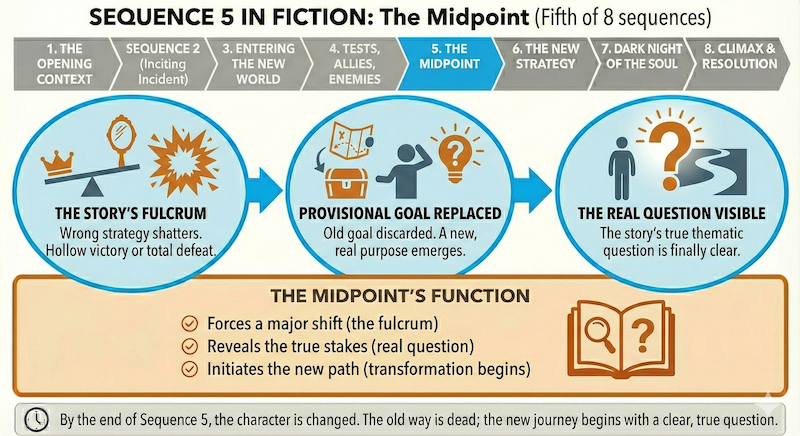
Dramatic Purpose of Sequence 5
The midpoint is the story’s second most important structural event — second only to the climax, and by some arguments equal to it. Its position at the exact center of the narrative is not coincidental: the midpoint is the story’s fulcrum, the moment at which the first half of the story’s weight tips into the second half. Everything before it has been building toward this event; everything after it flows from it. A weak midpoint produces a story that feels unbalanced — all setup and no turn, or all consequence and no cause.
The midpoint’s defining dramatic function is the shattering of the wrong strategy. Not the gradual erosion of it — that has been happening since section 3c — but the sudden, definitive revelation that it has failed. The protagonist has been operating under a set of assumptions about what their situation requires, what they are capable of, and what success looks like. The midpoint proves those assumptions wrong. Not partially wrong, not directionally wrong — fundamentally, structurally, irreversibly wrong.
This shattering takes one of two classical forms: the false victory or the false defeat. In the false victory pattern, the protagonist appears to achieve their provisional goal — and the achievement reveals itself to be hollow, poisoned, or the very thing that destroys what they most needed to protect. In the false defeat pattern, the protagonist suffers a catastrophic setback that appears to end their chances — but the setback strips away the wrong strategy and exposes what the story has actually been about all along. In both forms, the surface outcome is inverted by the revelation that accompanies it.
Sequence 5 occupies roughly pages 55—70 of a feature screenplay — the story’s exact center. In the Rossio framework and the Disney sequence book, it is often the sequence that receives the most development attention, because it is the hinge on which the entire second half turns. If the midpoint is not earned — if the revelation is not the logical culmination of everything Sequences 3 and 4 have built — the second half of the story will feel arbitrary, and the protagonist’s transformation will feel unearned.
| THE MIDPOINT’S DUAL NATURE |
|---|
Every midpoint event has two simultaneous meanings. The surface meaning is what happens in the plot: a victory achieved, a defeat suffered, a discovery made. The deep meaning is what this event reveals about the protagonist’s actual situation — the truth about who they are, what the story has actually been about, and what they will need to become to have any chance of resolution. The surface meaning is visible to the protagonist. The deep meaning is what they are about to be forced to see. The power of the midpoint comes from the gap between these two levels, and from the moment — in 5b — when that gap is suddenly closed. |
What Must Be True at the End of Sequence 5
| Was NOT true at the start of Sequence 5 | IS true at the end of Sequence 5 |
|---|---|
The wrong strategy was visibly failing but still operational |
The wrong strategy has been definitively shattered — it cannot be continued without active self-destruction |
The protagonist’s fundamental misunderstanding of their situation was intact |
The protagonist has been forced to see the truth of their situation — the illusion that sustained the wrong strategy has been destroyed |
The stakes were personal but not yet existential |
The stakes have become existential — the protagonist now understands that what they stand to lose is not just their goal but their identity, their most valued relationship, or their life |
The antagonistic force was a serious threat |
The antagonistic force has demonstrated it can win — the protagonist’s defeat is now a credible outcome that the audience genuinely fears |
The protagonist was pursuing a provisional goal |
The provisional goal has been replaced — or radically reframed — by the story’s true dramatic question, which the midpoint has finally made visible |
A sixth condition governs the emotional state of the protagonist as Sequence 5 closes: they are at their most exposed, their most uncertain, and their most ready — structurally if not psychologically — for the transformation the story requires. They do not yet know this. The dark night of the soul lies ahead. But the midpoint has done its essential work: the protagonist is no longer the person who crossed the Act One threshold. The wrong strategy is gone. Only the story’s real question remains.
Section 5a — The False Peak
Section 5a constructs the conditions for the midpoint revelation by bringing the wrong strategy to its highest point of apparent success — or its most credible position before catastrophic failure. This is the false peak: the moment at which the protagonist, and possibly the audience, believes that the provisional goal is within reach, that the wrong strategy has been working after all, and that the story might be moving toward resolution.
The false peak is an act of narrative misdirection with a specific moral function: it allows the story to show the protagonist exactly what they would get if the wrong strategy succeeded. In the false victory pattern, the protagonist achieves the provisional goal — and the achievement is shown to be insufficient, hollow, or destructive of the very thing it was meant to secure. In the false defeat pattern, the protagonist is brought to the edge of apparent success before being toppled — and the toppling reveals that success on those terms was never what the story needed.
The craft challenge of 5a is sustaining genuine dramatic uncertainty. The audience must not be certain whether they are watching a false peak or a genuine one. If the false peak is obviously false — if the story telegraphs that the apparent success is about to be reversed — it loses its capacity to generate the midpoint’s shock. The false peak must feel real enough that some part of the audience genuinely wonders: could this be the resolution?
| THE TWO MIDPOINT PATTERNS |
|---|
FALSE VICTORY PATTERN: The protagonist achieves their provisional goal — and the achievement destroys something more important than what it gained. Examples: the hero wins the battle but loses the relationship that made the battle worth fighting; the protagonist gets the recognition they sought and discovers it requires them to become someone they despise; the plan succeeds and the success exposes the protagonist to a danger greater than the one they were solving. |
FALSE DEFEAT PATTERN: The protagonist suffers a catastrophic reversal that appears to end their chances — but the reversal strips away the wrong strategy and forces the protagonist to confront the story’s real question. Examples: the protagonist is publicly exposed, loses their position, or is betrayed by someone they trusted — and in the aftermath of the collapse, they discover what the story has actually been about all along. |
Required Dramatic Ingredients in Section 5a
1. The Apparent Triumph or Impending Collapse
The false peak manifests as either the apparent achievement of the provisional goal or the final credible position of the wrong strategy before it fails catastrophically. In either case, the sequence is organized around maximum apparent stakes: this is the moment the protagonist has been working toward since Sequence 3, and the story has earned the audience’s investment in its outcome.
The apparent triumph or impending collapse must feel narratively conclusive in one direction: either the protagonist seems to have won, or they seem about to win before the rug is pulled. Ambiguity at the false peak weakens the midpoint’s impact. The reversal only lands with full force if the audience was genuinely invested in the surface outcome.
2. The Hidden Cost Made Visible
As the protagonist approaches the false peak, the accumulated cost of the wrong strategy becomes suddenly, inescapably visible — not as an abstraction but as a specific, concrete consequence that is now embedded in the apparent triumph. The victory contains the defeat; the success has produced the very thing it was meant to prevent. This is the story’s central irony crystallized: the wrong strategy has led somewhere the protagonist never intended to go.
The hidden cost made visible is usually a relationship consequence: someone the protagonist cared about has been damaged, a trust has been broken, a person has been used rather than valued. The protagonist can see this, in 5a, without yet being able to reckon with it — the false peak’s momentum is still carrying them forward. But the cost has been planted, visibly, so that the revelation of 5b has the specific evidence it needs to be devastating.
3. The Dramatic Irony at Maximum
In 5a, the gap between what the protagonist believes about their situation and what the audience understands about it is at its widest. The protagonist is confident, committed, and operating with the certainty that their strategy has been essentially correct. The audience can see — because of everything Sequences 3 and 4 have built — that this certainty is the last expression of the wrong strategy’s hold on the protagonist before it breaks.
This maximum dramatic irony creates a specific kind of tension that is distinct from suspense: not 'will they survive?' but 'when will they see?' The audience is waiting for the protagonist’s understanding to catch up with what the audience already knows. The tension is internal, psychological, almost unbearable — because the protagonist is about to experience something painful that the audience has been watching approach for thirty pages.
4. The Final Commitment to the Wrong Strategy
In 5a, the protagonist makes one final, fully committed move on behalf of the wrong strategy — an action that expresses everything they have been building toward and that simultaneously makes the midpoint revelation’s consequences irreversible. This final commitment is the point of no return for the wrong strategy itself: after this, it cannot be uncommitted to. The protagonist has gone too far in the wrong direction to simply back up and try something else.
The final commitment is often the protagonist’s most competent, most confident action in the entire story — a moment of genuine mastery of the wrong strategy’s approach. The skill is real. The direction is wrong. The combination is precisely what makes the midpoint so painful.
5. The Structural Foreshadow of the Revelation
Embedded within 5a is a specific image, line of dialogue, or small event that foreshadows the revelation that is about to arrive — visible to the attentive audience, invisible to the protagonist. This structural foreshadow gives the midpoint revelation its quality of inevitability: on second viewing, the audience will see that the revelation was already present in 5a, waiting to be understood.
The structural foreshadow of 5a is the most precise piece of dramatic writing in Sequence 5: it must be legible enough to create the inevitability effect on re-watch, and invisible enough not to defuse the first-viewing impact of the revelation. Writers who struggle with the midpoint often struggle specifically with this element — the balance between visible and hidden is technically difficult to achieve.
How to Render These Ingredients as Scenes
Scene Type 1: The Approach to Peak Scene
The protagonist moves into position for the false peak’s climactic moment — executing the final stages of the wrong strategy with focus and competence. This scene should feel kinetically alive: the protagonist is in motion, making things happen, exercising the capabilities they have developed across Act Two’s first half. The audience’s engagement with the sequence’s outcome should be at its highest.
The craft challenge: simultaneously show the protagonist at their most capable (which creates investment in the surface outcome) and embed the first visible sign of the hidden cost (which creates the dramatic irony that will pay off in 5b). These two registers must coexist in the same scene without canceling each other.
Scene Type 2: The False Peak Scene
The apparent triumph is achieved or the wrong strategy reaches its final, committed position. This is one of the story’s most carefully crafted scenes: it must deliver the emotional satisfaction of apparent success (or the dramatic weight of apparent imminent success) while containing the precise elements that will make the revelation of 5b inevitable.
The false peak scene often has a slightly off quality — something in the triumph that feels wrong, slightly too easy, slightly too convenient, or slightly hollow. The audience may or may not consciously register this quality; what they register is a subliminal unease beneath the surface satisfaction. That unease is the story’s preparation for what is coming.
Scene Type 3: The Harbinger Scene
A brief scene — sometimes a single beat — in which something arrives or is revealed that is clearly significant but whose significance the protagonist cannot yet process. A messenger with news they defer reading. A character who appears and says something that does not compute in the moment. An image that lands with unusual weight without explanation. This is the structural foreshadow made flesh: the revelation is in this room, but it has not been opened yet.
| 5a SEQUENCE DIAGNOSTIC |
|---|
Ask these questions of any section 5a draft: |
Is the false peak genuinely uncertain — could the audience believe this is the real resolution? |
Is the hidden cost of the wrong strategy visibly embedded in the apparent triumph? |
Is the dramatic irony at maximum — the widest gap between what the protagonist believes and what the audience understands? |
Has the protagonist made a final, irrevocable commitment to the wrong strategy? |
Is the structural foreshadow present — the revelation waiting to be opened? |
Section 5b — The Revelation
Section 5b delivers the midpoint revelation — the event, discovery, or confrontation that shatters the wrong strategy and forces the protagonist to see their situation clearly, often for the first time. This is the story’s most structurally dense scene or scene cluster: it must accomplish the destruction of the wrong strategy, the revelation of the story’s true stakes, the exposure of the protagonist’s fundamental misunderstanding, and the redefinition of what the second half of the story will be about — all in the space of a single dramatic event or its immediate aftermath.
The revelation is not always a single piece of information. It is more accurately described as a perceptual shift: the protagonist’s understanding of their situation reorganizes around a new truth, and the reorganization makes everything they have been doing look different. The wrong strategy was not just tactically insufficient — it was built on a fundamental misreading of what the situation required. The revelation makes this misreading visible, specific, and undeniable.
The sequence’s emotional texture is one of controlled devastation. The protagonist is not simply sad or surprised; they are structurally displaced — the ground on which they have been standing has been removed, and they must now find a different kind of ground. This displacement is the midpoint’s gift to the story: it makes transformation not just possible but necessary. The protagonist cannot continue as they were. The revelation has made that impossible.
| THE REVELATION’S STRUCTURAL REQUIREMENT |
|---|
The midpoint revelation must be the logical culmination of everything Sequences 3 and 4 have built. It cannot arrive from outside the story’s established logic — it must be something that was always present in the situation, something that the wrong strategy was specifically designed to avoid seeing. The revelation does not introduce new information to the story’s world; it reframes existing information in a way that makes the wrong strategy’s blindness suddenly, painfully obvious. If the revelation feels like a plot twist — something that arrives from outside — it has not been properly prepared. |
Required Dramatic Ingredients in Section 5b
1. The Shattering Event
The revelation arrives through a specific, concrete event — not a gradual realization but a sudden impact. The shattering event is the narrative equivalent of a bone breaking: before it, the structure was intact; after it, everything is different. The event can be a discovery, a confrontation, a betrayal, a loss, or an achievement whose consequences are immediately catastrophic. What matters is that it is specific, concrete, and irreversible.
The shattering event must be directly connected to the wrong strategy: it must be something that the wrong strategy made possible, or made inevitable, or was specifically blind to. The protagonist must be able to see — even if they cannot yet fully acknowledge — the connection between how they have been operating and what has just happened. The revelation is not bad luck; it is the wrong strategy’s bill coming due.
| SHATTERING EVENT: MICRO-PATTERNS |
|---|
The Betrayal Revealed: A false ally’s true allegiance is exposed, and the protagonist understands that the relationships they have been depending on were not what they appeared. The wrong strategy made this betrayal possible by valuing utility over authenticity. |
The Consequence Arrived: The accumulated cost of the wrong strategy reaches a tipping point and produces a specific, catastrophic consequence — the thing the strategy was extracting as payment finally destroys what the protagonist most needed to protect. |
The Truth Exposed: A fundamental misunderstanding about the protagonist’s situation — the false belief that the wrong strategy was built on — is revealed. The protagonist now knows something they cannot unknow. |
The Victory Reversed: The apparent triumph of 5a is immediately revealed to be a defeat — what was achieved has destroyed something more important, or has placed the protagonist in a worse position than failure would have. |
The Loss That Cannot Be Undone: Something the protagonist valued — a relationship, an identity, a possibility — is suddenly and permanently gone. The loss is directly traceable to the wrong strategy’s logic. |
The Mirror Moment: The protagonist sees themselves clearly — through a confrontation, a witness, or a reflection — and the image they see is not the person they believed themselves to be. |
2. The New Truth
The shattering event delivers a new truth — a piece of understanding that reorganizes the protagonist’s entire perception of their situation. This new truth is almost always a character truth rather than a plot truth: not just 'I was wrong about the facts' but 'I was wrong about who I am, what I have been doing, and what the story has actually been about.' The new truth is the story’s central theme, compressed into a moment of personal recognition.
The new truth must be painful in direct proportion to how deeply the protagonist has been invested in the wrong strategy. A protagonist who has sacrificed little for the wrong strategy will experience a mild corrective; a protagonist who has sacrificed everything — relationships, integrity, identity — will experience the new truth as a form of annihilation. The story’s emotional range in the second half depends entirely on how much the wrong strategy cost in the first half.
3. The Redefined Stakes
The midpoint revelation replaces the provisional goal with the story’s real stakes. What the protagonist has been pursuing — recognition, safety, power, reunion, justice — is revealed to be either the wrong goal entirely or the right goal pursued in a way that has made achievement impossible. The real stakes are what the story has actually been about: the transformation the protagonist must undergo, the relationship they must save or lose, the truth they must face or deny.
The redefined stakes are typically more personal, more fundamental, and more costly than the provisional goal. The provisional goal was achievable with moderate growth; the real stakes require genuine transformation. This escalation of personal cost is what makes the second half of the story more dramatically demanding than the first — not more plot, but more truth.
4. The Protagonist’s Response to the Revelation
How the protagonist responds to the midpoint revelation is one of the story’s most important character moments. The range of possible responses — denial, collapse, rage, grief, desperate action, frozen paralysis — each tells us something different about who they are and what their transformation will require. The response must be psychologically specific: not a generic 'devastated' reaction but the specific form of devastation that this particular person, with their particular wound and wrong strategy, would experience.
The response in 5b is typically not the protagonist’s final response to the revelation — that is the work of the dark night of the soul in Sequence 7. What 5b delivers is the first response: the immediate, unprocessed, raw reaction before the protagonist has had time to make meaning of what has happened. This first response is often the most honest thing the protagonist does in the entire story.
5. The Destroyed Alliance
The midpoint revelation typically destroys or severely damages at least one of the protagonist’s key alliances — the relational consequence of the shattering event. This destroyed alliance is the human cost of the midpoint: it makes the revelation personal beyond the protagonist’s internal experience by extending its consequences into the relationships that matter most. The protagonist now faces the second half of the story not just with a different understanding but with a diminished support system.
The destroyed alliance is often the false ally of section 4b, finally unmasked. But it can also be a genuine ally, damaged not by betrayal but by the consequences of the wrong strategy — someone who has been hurt by how the protagonist has been operating and can no longer sustain the relationship. Either way, the alliance loss gives the protagonist something specific to mourn as they enter the dark corridor of Act Two’s second half.
How to Render These Ingredients as Scenes
Scene Type 1: The Impact Scene
The shattering event arrives. This scene must be executed with maximum clarity: the audience must understand exactly what has happened and why it is devastating. The craft temptation is to make this scene dramatic in the conventional sense — loud, kinetic, emotionally overcharged. But the most effective midpoint revelations are often quiet: a discovery made alone, a conversation that reframes everything, a moment of sudden understanding in a still place.
The impact scene’s emotional tone is not sadness or anger but something more fundamental: the specific feeling of a world reorganizing around a new fact. It is the feeling of the ground shifting. The audience should feel it as viscerally as the protagonist does.
Scene Type 2: The Full Reckoning Scene
The protagonist sits with the revelation — processing, responding, beginning to absorb what it means. This scene is often the most emotionally raw scene in the story: the protagonist without defenses, without strategy, without the wrong approach to organize their behavior. They are simply in the reality of what has just happened.
The full reckoning scene should be given its full time. Writers who rush past it — who move quickly from the shattering event to the protagonist’s response to the next plot development — deny the audience the emotional experience that makes the second half meaningful. The reckoning is the midpoint’s emotional payload: it must be allowed to land.
Scene Type 3: The Alliance Fracture Scene
The relational consequence of the revelation plays out: a key alliance breaks, strains to its limit, or is revealed as something other than what the protagonist believed. This scene connects the midpoint’s internal revelation to its external consequences, establishing that the protagonist’s situation has changed not just internally but socially — they are now more alone, more exposed, more dependent on whatever they are about to discover in themselves.
Scene Type 4: The First Gesture Toward the New Direction
The sequence ends with the protagonist making a single, tentative gesture in a new direction — not yet the transformation the story requires, but the first movement away from the wrong strategy. This gesture is often small, almost imperceptible: a decision not to do what they would previously have done, a question asked that they would previously have avoided, a choice made from a different place than the wrong strategy’s logic. It is the seed of Act Two’s second half.
| 5b SEQUENCE DIAGNOSTIC |
|---|
Ask these questions of any section 5b draft: |
Does the shattering event connect directly to the wrong strategy — is the connection visible? |
Is the new truth a character truth, not just a plot correction? |
Have the stakes been redefined — does the protagonist now understand what the story is actually about? |
Is the protagonist’s first response psychologically specific to this particular person? |
Has at least one key alliance been destroyed or severely damaged? |
Is there a first gesture toward a new direction — however small — that seeds Act Two’s second half? |
Section 5c — The New Commitment
Section 5c closes the midpoint movement by establishing the protagonist’s new orientation — the direction they will pursue in Act Two’s second half in response to the revelation. This new direction is not yet the full transformation the story requires: that happens across Sequences 6, 7, and 8. But it is the protagonist’s first conscious acknowledgment that the wrong strategy is dead and that something else must take its place.
The new commitment is not optimistic in the way the wrong strategy’s provisional goal was optimistic. The protagonist is not excited about what lies ahead — they have just been through the midpoint’s destruction and are operating from a position of loss rather than confidence. What they commit to in 5c is not a better strategy (they don’t yet have one) but a different orientation: a willingness to see what they have been refusing to see, to face what they have been avoiding, to pursue the story’s real question rather than the wrong strategy’s provisional answer.
In structural terms, 5c is the Act Two midpoint’s equivalent of the Act One threshold crossing: it is the protagonist committing to the second half of the story in full knowledge of what it will cost. The Act One threshold was crossed under illusion — the protagonist did not fully understand what they were agreeing to. The midpoint commitment is made with open eyes. The protagonist knows the price now. They commit anyway. This is the story’s first genuine act of courage.
| THE COURAGE OF THE NEW COMMITMENT |
|---|
The new commitment that closes section 5c is structurally distinct from every previous commitment the protagonist has made. Every prior commitment was made in service of the wrong strategy — in pursuit of the provisional goal, in defense of the false equilibrium, in avoidance of the wound. The new commitment is made in direct confrontation with all of those things. It is the protagonist choosing, for the first time, to move toward rather than away from the thing the story requires. This is not heroism in the conventional sense. It is simply the willingness to continue after the illusion has been destroyed. |
Required Dramatic Ingredients in Section 5c
1. The Rejection of the Easy Exit
Before committing to the new direction, the protagonist must be presented with and explicitly or implicitly reject the easy exit — the option of not continuing. The easy exit is the path of least resistance: returning to what remains of the ordinary world, accepting defeat, withdrawing from the story’s central conflict. The new commitment is only meaningful if the alternative — not committing — was genuinely available.
The rejection of the easy exit is often rendered as a moment of stillness: the protagonist sitting with the possibility of withdrawal before choosing engagement. It does not require a long scene. What it requires is the sense that the protagonist has considered the alternative and chosen against it — not because they are obligated to, but because of who they are becoming.
2. The Redefined Goal
The provisional goal of the wrong strategy is replaced by a redefined goal — something that reflects the new truth delivered by the midpoint revelation. The redefined goal is typically more personal, more vulnerable, and more directly related to the protagonist’s wound and unconscious need than the provisional goal was. It is the goal that the story has actually been about all along, now finally made explicit.
The redefined goal does not need to be fully articulated by the protagonist — in many stories, the protagonist cannot yet name what they are really pursuing. What must be present is a shift in orientation: the protagonist is now moving toward something different from what they were pursuing in the first half of Act Two. The audience must be able to feel the difference even if the protagonist cannot yet describe it.
3. The New Resource or Alliance
With the old alliances damaged or destroyed by the midpoint revelation, the protagonist must identify or deepen a resource — a relationship, a capability, a piece of knowledge — that will sustain the second half of their journey. This new resource is often something that was present but undervalued throughout Act Two’s first half: the ally who represented the right path in section 4b, a capability the protagonist developed but did not fully claim, a truth they glimpsed but deflected.
The new resource is the story’s way of saying that the protagonist is not starting over from nothing. They have been changed by everything that has happened. That change is itself a resource — a form of knowledge, resilience, or connection that was not available to the Act One protagonist. The new commitment is made from this changed position, not from the original one.
4. The Raised Stakes Made Personal
The redefined stakes of the revelation are made concrete and personal in 5c: the protagonist understands, specifically and viscerally, what they stand to lose if they do not engage fully with the story’s real question. This is not abstract — it is a specific person, a specific relationship, a specific version of themselves that is now at risk. The personal stakes are the emotional engine of Act Two’s second half.
The raised stakes made personal is often the sequence’s most emotionally resonant moment: the protagonist alone with the full weight of what is at risk, making the choice to continue in full knowledge of the cost. It is the story’s most honest emotional beat — neither triumphant nor despairing, but clear-eyed and committed.
5. The New Direction’s First Step
Section 5c — and the midpoint movement as a whole — ends with the protagonist taking a concrete first step in the new direction. This step is not a dramatic declaration; it is a specific action that signals the end of the wrong strategy’s hold and the beginning of whatever comes next. It may be going to a person they have been avoiding. It may be admitting something they have been denying. It may be making a choice they have been refusing to make.
The first step’s quality is quiet purpose: the protagonist moving with intention toward a goal they now understand, rather than with urgency toward a goal they have been misreading. The pace has changed. The story has changed. The protagonist, at last, is beginning to change with it.
How to Render These Ingredients as Scenes
Scene Type 1: The Withdrawal Temptation Scene
The protagonist encounters the possibility of the easy exit — a concrete opportunity to step back from the story’s central conflict and return to whatever remains of safety. This scene must make the easy exit genuinely tempting: a real offer, a real possibility, something that a reasonable person in the protagonist’s position would seriously consider. The protagonist’s rejection of it must be a choice, not an inevitability.
The withdrawal temptation scene is often very quiet — a private moment of reckoning rather than a dramatic confrontation. Its power comes from the specificity of what is being rejected: we must feel what the protagonist is giving up by choosing to continue. The cost of engagement must be real and acknowledged.
Scene Type 2: The Redefined Goal Scene
The protagonist articulates — to themselves, to a remaining ally, or through action — what they are now actually pursuing. This articulation need not be explicit; a gesture, a decision, or a concrete action can communicate the redefined goal as effectively as dialogue. What matters is that the audience understands: the protagonist is now pursuing something different, something more true, something that reflects the new understanding the midpoint delivered.
The redefined goal scene often has the quality of relief alongside its grief: the protagonist is no longer performing the wrong strategy, no longer managing the cost, no longer pretending. They are simply pursuing what actually matters. This clarity, arriving in the aftermath of devastation, is one of the story’s most emotionally complex tones to achieve.
Scene Type 3: The New Alliance Scene
The protagonist connects — or reconnects — with the ally or resource that will sustain the second half of the journey. This connection is made from a different place than the alliances of Act Two’s first half: it is made with honesty rather than strategy, with need rather than utility, with vulnerability rather than competence. The new alliance is built on what the protagonist actually is rather than on what they have been performing.
The new alliance scene is often the most emotionally warm scene since the midpoint’s destruction — a moment of genuine human connection after the isolation of the revelation. Its warmth is not false comfort but earned: something has been lost, and something new — smaller, realer, more necessary — is being found.
Scene Type 4: The First Step Scene
The protagonist takes the concrete first step in the new direction that closes section 5c and launches Act Two’s second half. This step is the sequence’s final image: the protagonist in motion, committed, moving toward the story’s real question with whatever they have left. The scene should carry the emotional weight of everything the sequence has produced — the loss, the clarity, the new commitment — in a single, definitive action.
In the Disney sequence book structure, this scene is often the most carefully storyboarded moment in the midpoint sequence, because it is the visual hinge of the entire film: the image of the protagonist at the end of their old strategy and the beginning of their new one, carrying both in the same frame.
| 5c SEQUENCE DIAGNOSTIC |
|---|
Ask these questions of any section 5c draft: |
Has the easy exit been presented and rejected — is the new commitment a genuine choice? |
Has the provisional goal been replaced by a redefined goal that reflects the midpoint’s new truth? |
Is there a new resource or alliance that will sustain the second half — found or deepened after the midpoint’s destruction? |
Are the redefined stakes specific and personal — a concrete understanding of what will be lost if the protagonist does not engage fully? |
Does the sequence end with a concrete first step — the protagonist in motion toward the story’s real question? |
Common Failures in Seq. 5
The Unearned Revelation (Section 5b Failure)
The most common midpoint failure: a revelation that arrives without adequate preparation in Sequences 3 and 4. The revelation introduces information or events that the story’s first half did not establish, producing a plot twist rather than a structural revelation. The test: the midpoint revelation must be comprehensible as the logical culmination of what has come before, not as the arrival of new plot from outside the story’s established logic. If the audience’s response is surprise at new information rather than recognition of a truth that was always present, the midpoint has been constructed rather than earned.
The Survivable False Peak (Section 5a Failure)
A false peak whose apparent triumph or impending collapse does not feel genuinely consequential — where the audience never really believes the surface outcome matters. The false peak must cost something real for the revelation’s destruction of it to land. If the apparent triumph was never very triumphant, or the impending collapse was never very serious, the midpoint revelation cannot produce the structural displacement it needs to.
The Revelation Without Redefined Stakes (Section 5b Failure)
A midpoint revelation that corrects a tactical misunderstanding without redefining the story’s fundamental stakes. The protagonist learns that their approach was wrong but not why it was wrong at the deepest level — the wrong strategy is corrected but the wound it was built on remains invisible. The result is a second half that feels like a revised version of the first half rather than a genuinely new movement of the story.
The Heroic New Commitment (Section 5c Failure)
A new commitment that is made with enthusiasm, confidence, or triumphant energy — as if the protagonist has been refreshed by the midpoint rather than devastated by it. The new commitment that closes Sequence 5 must be made from a position of real loss: the protagonist is choosing to continue despite having paid a genuine price. A commitment made from strength is not yet earned. The protagonist who emerges from the midpoint stronger and more confident has not truly experienced the midpoint.
The Midpoint That Doesn’t Change the Story’s Direction
A midpoint that produces emotional impact without redirecting the story’s trajectory. The protagonist is shaken, saddened, or challenged — but when Sequence 6 begins, they are essentially pursuing the same goal by the same methods as before. The midpoint is the story’s structural pivot: it must change the direction of what follows. A story with a midpoint that does not change direction is a story with a dramatic speed bump rather than a genuine second-act break.
The Missing False Peak (Section 5a Failure)
A midpoint sequence that moves directly from the escalating pressure of Sequence 4 to the revelation of 5b, without the false peak’s construction of apparent success. Without the false peak, the revelation arrives in a vacuum of dramatic tension: there is nothing for it to shatter. The revelation needs the false peak’s structure of apparent success precisely because the shattering of that structure is what gives the revelation its force. A revelation that lands on an already-failing protagonist is not a midpoint; it is a continuation of the downward trajectory that began in section 3c.
Cross-Media Examples
Film — Toy Story (Pixar, 1995)
- Section 5a
-
Woody and Buzz’s capture by Sid constitutes the false defeat pattern’s false peak — both toys are in maximum danger, all escape routes apparently closed. Woody’s apparent plan to escape (using Buzz’s rocket) fails, and with it the last vestiges of Woody’s wrong strategy: he can no longer maintain the fiction that his jealousy of Buzz has been justified, or that his manipulation has served any purpose other than getting them both killed.
- Section 5b
-
The revelation is Woody confronting the truth of his own behavior — not a plot revelation but a character one. The new truth: Buzz’s arrival was never a threat to be managed; it was a mirror Woody refused to look into. The shattering event is Buzz’s broken arm and the toy graveyard’s mirror — Woody seeing, perhaps for the first time, what he has actually been doing. The destroyed alliance: the other toys' trust, seemingly irreparably broken.
- Section 5c
-
The new commitment is Woody’s decision to save Buzz — not as strategy, not as self-interest, but as genuine care for someone he has wronged. The redefined goal: not to reclaim Andy’s favor but to be the toy — the friend — that Buzz deserves. The first step: working with the mutant toys to repair Buzz rather than trying to escape alone.
Film — Arrival (Villeneuve, 2016)
- Section 5a
-
Louise Banks' communication progress with the heptapods constitutes the false peak — she is closer than anyone to genuine understanding, and the military apparatus is increasingly ready to weaponize that understanding regardless of whether it is correct. The hidden cost: her growing personal investment in the heptapods' message, which is being systematically separated from her professional mission.
- Section 5b
-
The revelation is double-layered — the visions Louise has been dismissing as memory are revealed to be foresight. The new truth reorganizes the entire story’s logic: she has already experienced the future she is moving toward, including its losses. The midpoint revelation is not a plot twist; it is a perceptual reorganization that makes everything the story has shown mean something different.
- Section 5c
-
The new commitment is Louise’s choice to pursue the heptapods' message despite — or because of — what she now knows she will lose. The redefined goal shifts from translation to acceptance: she is not trying to understand the heptapods' language but to inhabit it. The first step is engaging with the circular time structure rather than resisting it.
Novel — Crime and Punishment (Dostoevsky, 1866)
- Section 5a
-
Raskolnikov’s false peak is the apparent success of the murder itself — the extraordinary man theory tested and apparently validated. The hidden cost is immediately present: the psychological disintegration that begins the moment the act is committed, the evidence that the theory was wrong from its first application.
- Section 5b
-
The revelation accumulates rather than arriving in a single event — Raskolnikov’s increasing inability to maintain the psychological position his wrong strategy required. The new truth: he is not extraordinary, not above ordinary moral law, not the Napoleonic figure of his theory. The destroyed alliance is with his own self-image, which the murder has permanently compromised.
- Section 5c
-
The new commitment is Raskolnikov’s first turn toward Sonya — not yet confession, not yet transformation, but the first movement toward the person who will witness and sustain his eventual reckoning. The redefined goal: not escape from punishment but from the prison of the wrong theory’s logic.
TV — The Bear (Season 1, Episode 7 — 'Review')
- Section 5a
-
The pre-service rush at The Beef constitutes the false peak — Carmy has been pushing the wrong strategy (military kitchen discipline imposed on a traumatized family business) to its limit, and the sequence shows the maximum achievable result of that approach: a kitchen that is technically superior to what it was but psychologically on the verge of collapse.
- Section 5b
-
The revelation is the letter from Mikey — the shattering event that reorganizes Carmy’s understanding of why he came back and what the restaurant has actually been about. The new truth: the wrong strategy (imposed excellence) has been preventing exactly the connection — with the kitchen, with Mikey’s memory, with his own grief — that returning to The Beef was always about. The destroyed alliance: the rupture with Richie, who has been absorbing the wrong strategy’s human cost.
- Section 5c
-
The new commitment is Carmy’s decision to stop performing competence and begin acknowledging what he doesn’t know — specifically, what the kitchen needs from him rather than what his version of excellence requires of it. The first step: a single, genuine conversation with Sydney rather than another performance of authority.