Arc Interaction and Ensemble Structure
A single protagonist arc makes an argument. Multiple arcs in relationship make a richer argument — or a more complex question. The way arcs relate to each other, amplify or complicate each other, and distribute thematic weight is one of the least-discussed structural considerations in fiction, which is why complex narratives so often fail in one of two opposite directions: either a single arc monopolizes attention while everything else drifts, or multiple arcs create a dispersed narrative that feels like several adjacent stories sharing a setting.
Getting arc interaction right requires understanding not just how individual arcs work, but how they function as a system.
Two Structural Models
Every multi-arc narrative operates on one of two models, or a hybrid of both.
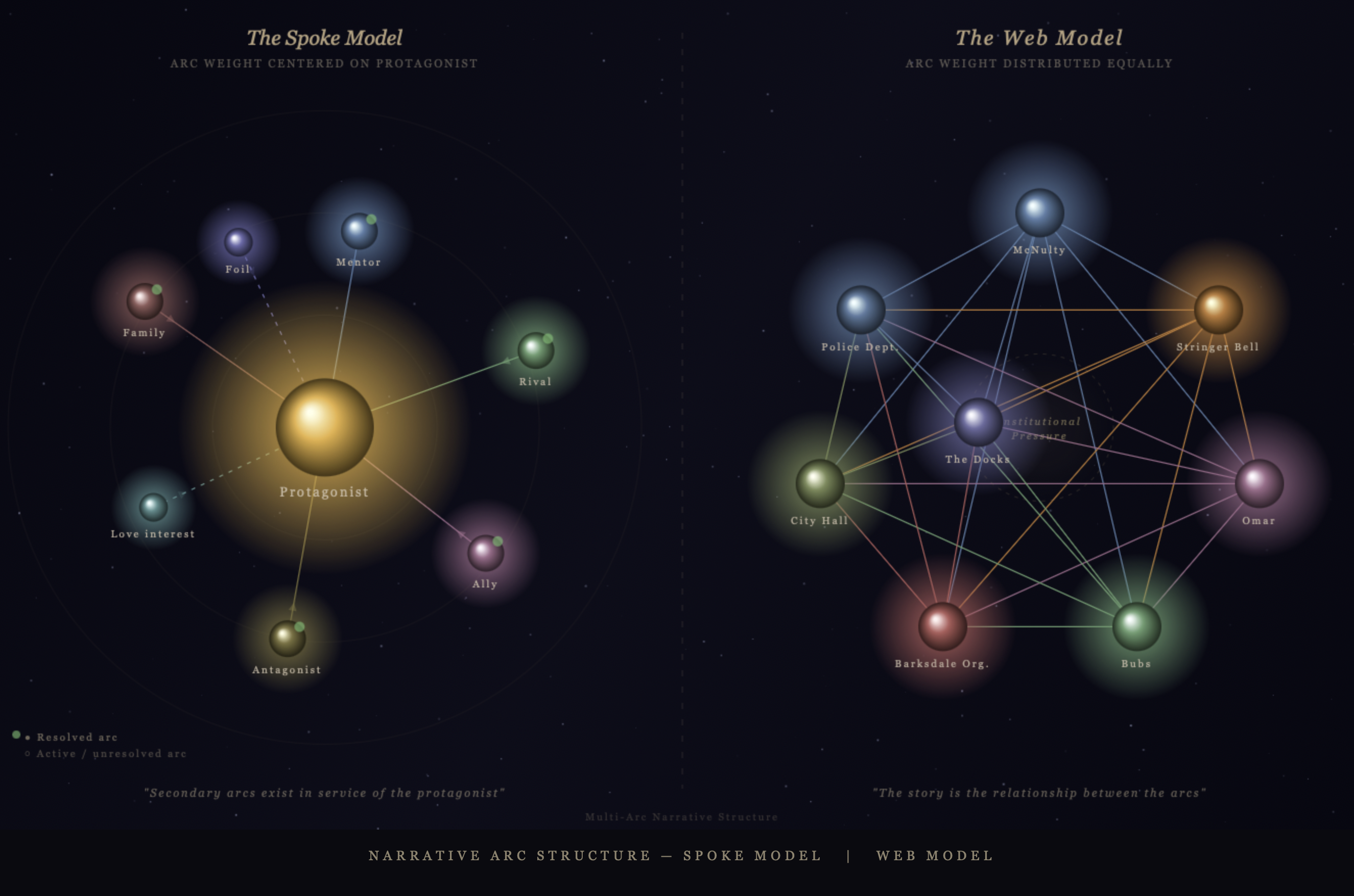
The spoke model organizes arcs around a protagonist at the center. Supporting character arcs are satellites — they orbit the protagonist’s central journey, illuminating it from different angles, but they aren’t equal in structural weight. Most narrative fiction uses this model. The protagonist’s arc is the primary argument; secondary arcs exist in service of it, thematically adjacent, providing contrast or amplification. The audience understands that the protagonist’s transformation is the story’s central concern; everything else is commentary.
In the spoke model, supporting arcs typically complete before the protagonist’s does. They’re resolved, or foreclosed, or paused — and then the protagonist’s arc arrives at its climax with the secondary arcs' outcomes as context. The contrast between a secondary arc’s conclusion and the protagonist’s still-unresolved state sharpens the protagonist’s final choice.
The web model distributes arc weight across multiple characters without a single center. The story is the intersection of multiple arcs, each of which is genuinely primary within its own strand. The argument emerges from the pattern of how the arcs relate — which positions the different characters hold, what different responses to the same central pressure look like when all enacted simultaneously, and what the comparative outcomes reveal. No individual arc contains the story; the story is the relationship between them.
The Wire is the canonical contemporary example. McNulty, Stringer Bell, Omar, Bubs, the Barksdale organization, the police department, the docks, City Hall — each strand contains characters with genuine arcs, and none is subordinate to the others. The show’s argument about institutions and the people they shape cannot be made through a single protagonist. It requires multiple simultaneous arcs so that the pattern — the same institutional logic producing the same consequences for people in fundamentally different positions — can be visible as a pattern rather than a personal story.
The web model requires proportional structural investment. You cannot use it with five equally weighted protagonist-scale arcs and maintain narrative coherence unless you have the page count, the pacing control, and the thematic focus to sustain it. Most novelists who attempt the web model underestimate how much structural work each arc requires to feel complete.
How Arcs Amplify Each Other
When two arcs move in parallel — toward the same transformation, through different circumstances — they produce amplification. The Truth the protagonist is discovering becomes visible from multiple angles; the reader’s understanding of it deepens with each confirmation.
But amplification isn’t just repetition. The most powerful form operates when two characters approach the same truth through fundamentally different starting positions, so the convergence at the middle is itself the argument.
In Good Will Hunting, Will’s arc (opening himself to connection after a childhood of abuse) and Sean’s arc (returning to life after the death of his wife) move toward the same destination from opposite wounds. Will is locked out by fear of vulnerability; Sean has withdrawn from it by grief. Two different forms of the same failure to inhabit one’s life. Their therapeutic relationship is the mechanism through which both arcs advance simultaneously — Will’s progress is Sean’s, and Sean’s is Will’s. Each arc makes the other more true.
This is what separates thematic amplification from structural redundancy: the parallel arcs must be arriving at the same truth from different directions, not simply duplicating each other’s journey.
How Arcs Argue Against Each Other
The most structurally sophisticated use of multiple arcs is the counter-arc — a supporting character whose arc arrives at a different position than the protagonist’s, by design.
The counter-arc isn’t a failure. It’s the story’s internal self-examination. If the protagonist’s arc argues that vulnerability is worth the cost, the counter-arc might follow a character who chose safety and shows what that choice yields. Both outcomes are honest. The story isn’t arguing one position by ignoring the other. It’s showing that the choice was real, that the alternative was possible, that the protagonist’s path was not the only path.
Charlotte Lucas in Pride and Prejudice takes a different path than Elizabeth. She is not wrong, exactly — she has made a rational calculation about her options and accepted its costs. The novel respects her. It shows her established in her home, managing her life, not miserable but not what Elizabeth would have chosen. The counter-arc makes Elizabeth’s choice meaningful: there was another way. Elizabeth chose differently.
When a protagonist’s arc is the only arc in a narrative, their transformation can feel like the story demanding it — like the narrative logic, rather than genuine choice. The counter-arc is what makes the protagonist’s choice feel chosen. It demonstrates that the alternative existed, was coherent, and led somewhere.
Thematic Distribution and the Premise
Multiple arcs let a story distribute its thematic premise across more than one proof. The premise is argued once through the protagonist; secondary arcs re-prove it under different conditions, or test it against different objections, or show what a related misbelief (rather than the protagonist’s exact Lie) produces.
The more different the secondary characters' situations are from the protagonist’s, the more universally the thematic premise applies. If the premise is "control as a defense mechanism leads to isolation," and the protagonist demonstrates it in a romantic context, a secondary character demonstrating it in a professional context, and another in a parental context, the reader’s experience shifts from "this is true for this person" to "this is true." The premise becomes general without being abstractly stated; it has been proved in multiple specific cases.
There is a failure mode here: distributing the premise too broadly across too many arcs produces a story that feels like a thesis paper with multiple case studies rather than a narrative. The distribution must serve the story’s emotional argument, not substitute for it. Each arc must be human first — a specific person in a specific situation — and thematically resonant second.
Structural Timing Across Arcs
In multi-arc narratives, the timing of arc beats requires explicit attention. Different arcs moving at different speeds produce useful complexity; arcs that repeatedly hit the same beat simultaneously lose the counterpoint that makes multiple arcs worth following.
Several patterns appear in well-constructed multi-arc narratives:
Staggered midpoints. When multiple characters have genuine arcs, their midpoint revelations — the shattering of the wrong strategy — rarely land in the same scene. They’re staggered: one character hits their midpoint while another is still in Act 2a, deepening commitment to their wrong strategy. The reader holds both positions simultaneously — one character seeing through their Lie while another doubles down on theirs — which creates thematic irony and structural rhythm. It also prevents the narrative from requiring all its attention in the same place at the same time.
Dark nights that illuminate each other. Secondary character dark nights often arrive earlier than the protagonist’s — their collapse provides context, or contrast, or foreshadowing for the protagonist’s impending reckoning. A supporting character’s failure to face their wound can be the warning the protagonist ignores. A supporting character’s successful reckoning can be what makes the protagonist’s possible — providing a model, or creating the conditions in which the protagonist can finally see.
Resolutions that complicate, not only confirm. The most interesting multi-arc structures don’t have all arcs resolving to the same outcome. When secondary arcs resolve differently than the protagonist’s — when the counter-arc’s different choice leads somewhere honestly different, not to ruin but to a life with its own coherence — the protagonist’s resolution carries moral weight. They chose. What they chose against was possible. The multiple resolution is the argument’s proof that the choice was real.
Managing Attention
The practical challenge of multiple arcs is attention: the reader can only follow what the narrative makes followable. Arcs that receive insufficient narrative real estate don’t register as arcs; they register as character texture or subplot.
The minimum structural requirement for an arc is three visible movement moments: an establishing scene that plants the arc’s beginning position (the Lie visible in action), a midpoint-adjacent disruption (the Lie being tested), and a resolution (the Lie either confronted or cemented). Everything else is expansion. An arc that gets only one of these three reads as a character moment, not a structural arc.
The sparing test: can you remove this character’s arc from the narrative without the story’s thematic argument losing something irreplaceable? If yes, the arc is ornamental. If no — if removing the arc removes an angle of vision the story needs to make its case — the arc belongs. The test works for both directions: adding arcs that don’t pass it clutters the narrative; cutting arcs that do pass it impoverishes it.
Ensemble Structures by Genre
Arc interaction patterns differ by genre because reader expectations about whose transformation is central differ.
Romance with dual protagonists typically operates on a spoke model with two poles rather than one center — both protagonists arc toward the same relational truth, but from opposite misbeliefs. The arc interaction is the courtship: each protagonist’s Lie creates the obstacle to the other’s arc. When Darcy’s pride prevents him from seeing Elizabeth clearly, it forces Elizabeth to test her own prejudice; when Elizabeth’s prejudice is challenged, it creates the conditions in which Darcy can revise his pride. The arcs produce each other. This mutual generation is the structural signature of the well-constructed romance.
Ensemble thriller often uses partial arcs — characters who begin arc trajectories that the plot forecloses before completion, characters who arrive at new positions through plot pressure rather than psychological growth, and one or two characters who carry genuine arcs amid the external action. The partial arc is a legitimate tool here: a character who begins to transform and is killed, or who faces their Lie and cannot act on the Truth in time, carries the emotional weight of a full arc without requiring its structural machinery.
Epic fantasy with multiple protagonists most often uses a modified web model — several genuine protagonists, each with a complete arc, arguing the same thematic territory from different positions. Frodo’s arc, Sam’s arc, Aragorn’s arc in The Lord of the Rings each address the same central question (what does it cost to carry the weight of the world, and is it worth it?) from different angles of vision. The arcs cohere because they share a thematic address even as they differ in form. The failure mode is arcs that address entirely different questions — producing not a web but several separate stories.
Literary fiction most commonly uses the web model or a deep spoke model with thick secondary arcs. The genre’s structural permission for ambiguity in resolution allows multiple arcs to end in different states — some transformed, some not, some in transit — which is often more honest about how transformation works in actual human lives than the genre convention of complete arcs resolving cleanly. The Wire’s refusal to complete most of its characters' arcs fully — most people don’t change, or change incompletely, or change in ways that don’t save them — is itself the argument.